Digital adherence technologies did not reduce poor outcomes for adults with drug-sensitive tuberculosis
Digital adherence technology interventions to reduce poor end-of-treatment outcomes and recurrence among adults with drug-sensitive tuberculosis in Ethiopia: a three-arm, pragmatic, cluster-randomised, controlled trial
Pragmatic cluster-randomised controlled trialNo clear difference
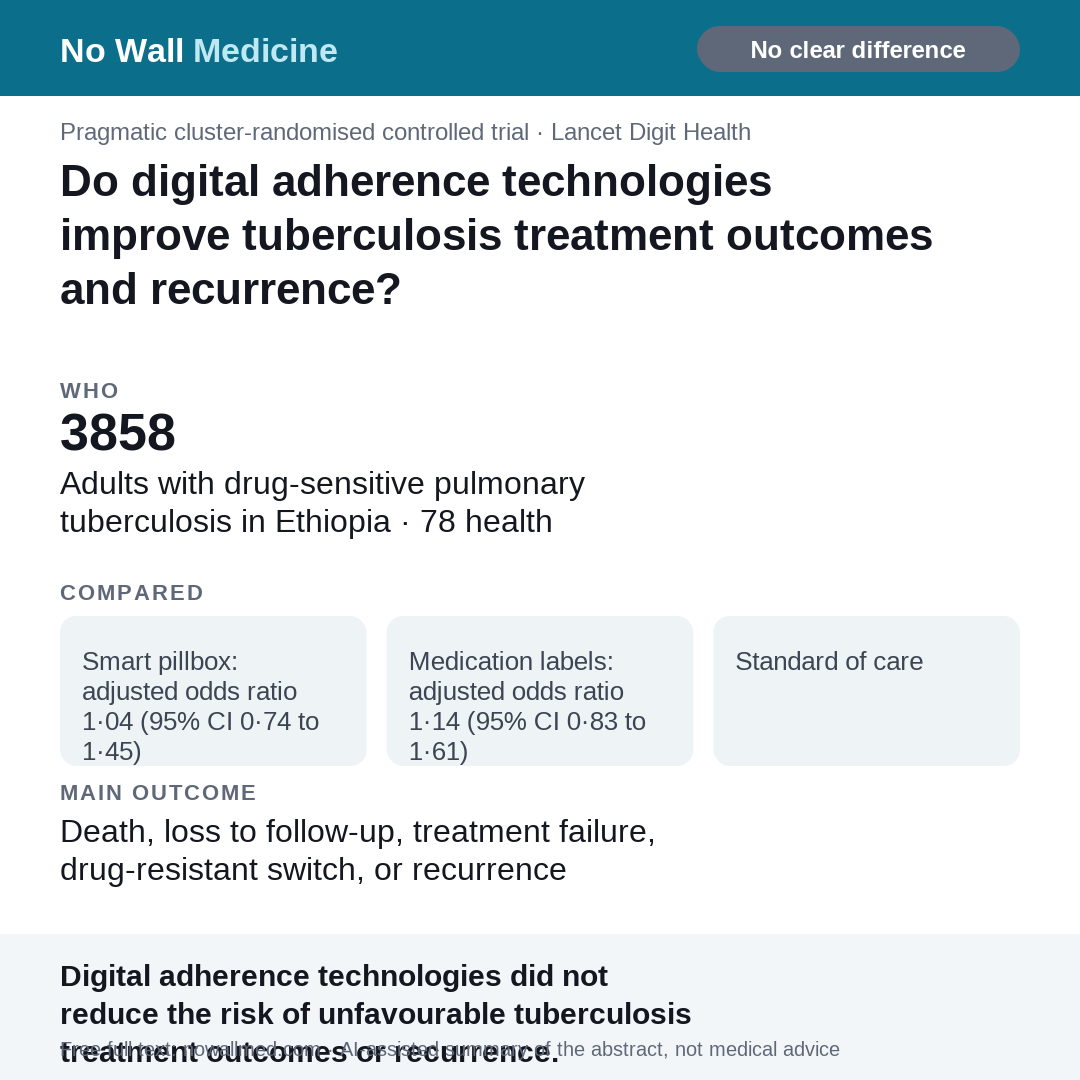
Do digital adherence technologies improve tuberculosis treatment outcomes and recurrence?
Who
3858
Adults with drug-sensitive pulmonary tuberculosis in Ethiopia · 78 health facilities in Ethiopia
Compared
Smart pillbox: adjusted odds ratio 1·04 (95% CI 0·74 to 1·45)
Medication labels: adjusted odds ratio 1·14 (95% CI 0·83 to 1·61)
Standard of care
Main outcome
Death, loss to follow-up, treatment failure, drug-resistant switch, or recurrence
Result: adjusted odds ratio 1·04 (95% CI 0·74 to 1·45)
Bottom line: Digital adherence technologies did not reduce the risk of unfavourable tuberculosis treatment outcomes or recurrence.
Funded by: Unitaid
Lancet Digit Health · 2025-09-30Download image
Clinical question: Do digital adherence technologies improve tuberculosis treatment outcomes and recurrence?
Why it matters: The effect of digital adherence technologies, such as smart pillboxes or medication labels, on long-term tuberculosis treatment outcomes and recurrence remains unclear.
Key points
- Researchers conducted a trial in Ethiopia involving 3858 adults with drug-sensitive pulmonary tuberculosis assigned to a smart pillbox, medication labels, or standard care.
- Neither the smart pillbox group nor the medication labels group showed a reduction in the primary composite outcome of death, loss to follow-up, treatment failure, drug-resistant treatment switch, or recurrence.
- The interventions also showed no evidence of effect on poor end-of-treatment outcomes or loss to follow-up, though the medication labels showed weak evidence of reduced loss to follow-up.
Headline and key points written with AI from the paper’s abstract, with every number checked against it. Read the paper before relying on them.
Topics
Cite this article
Tadesse AW, Sahile M, Foster N, McQuaid CF, Weldemichael GT, Abdurhman T. Digital adherence technology interventions to reduce poor end-of-treatment outcomes and recurrence among adults with drug-sensitive tuberculosis in Ethiopia: a three-arm, pragmatic, cluster-randomised, controlled trial. Lancet Digit Health. 2025. doi:10.1016/j.landig.2025.100895
Spotted a mistake? Suggest a correction