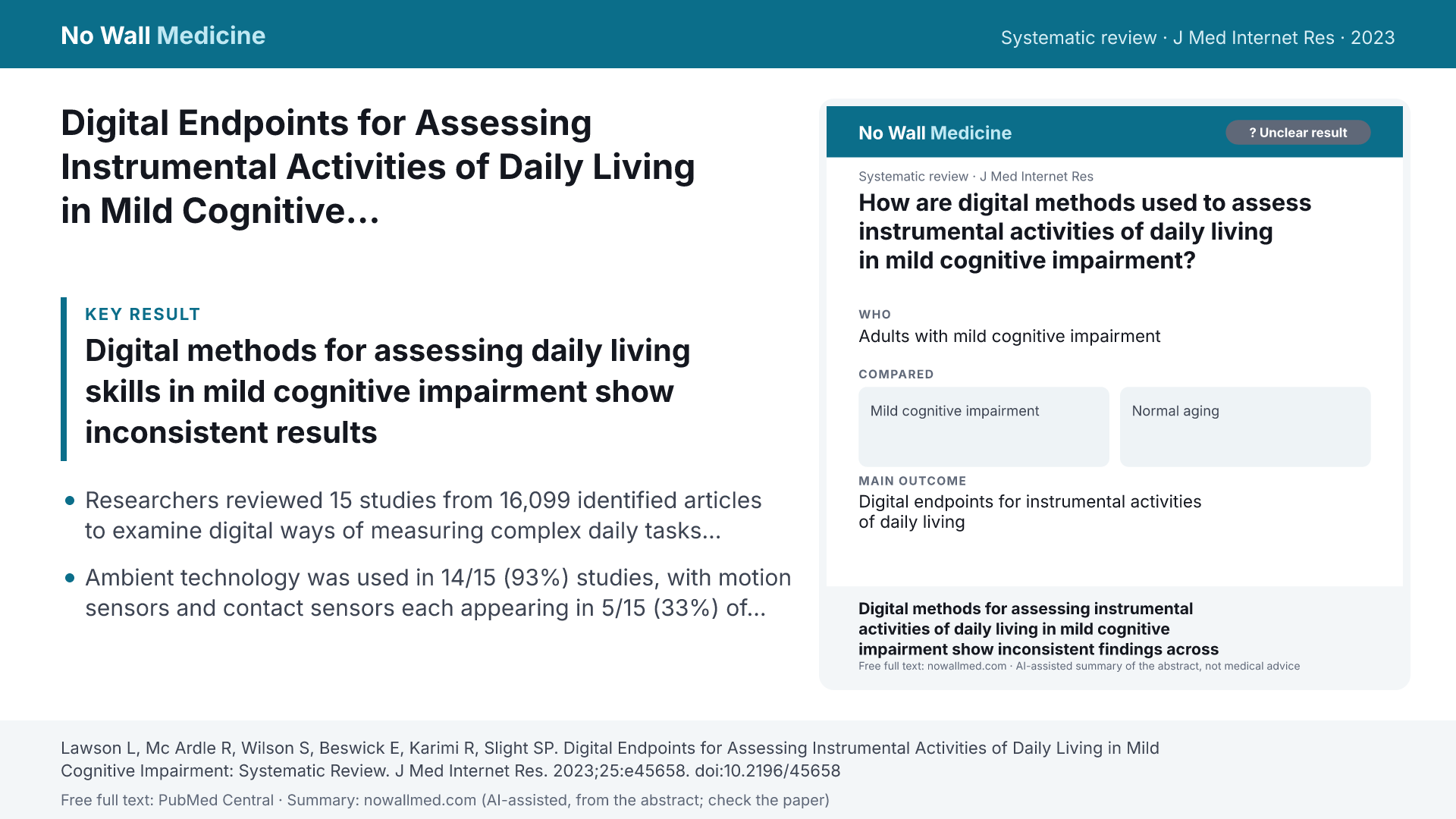
Digital Endpoints for Assessing Instrumental Activities of Daily Living in Mild Cognitive Impairment: Systematic Review
Key result: Digital methods for assessing daily living skills in mild cognitive impairment show inconsistent results
Key points
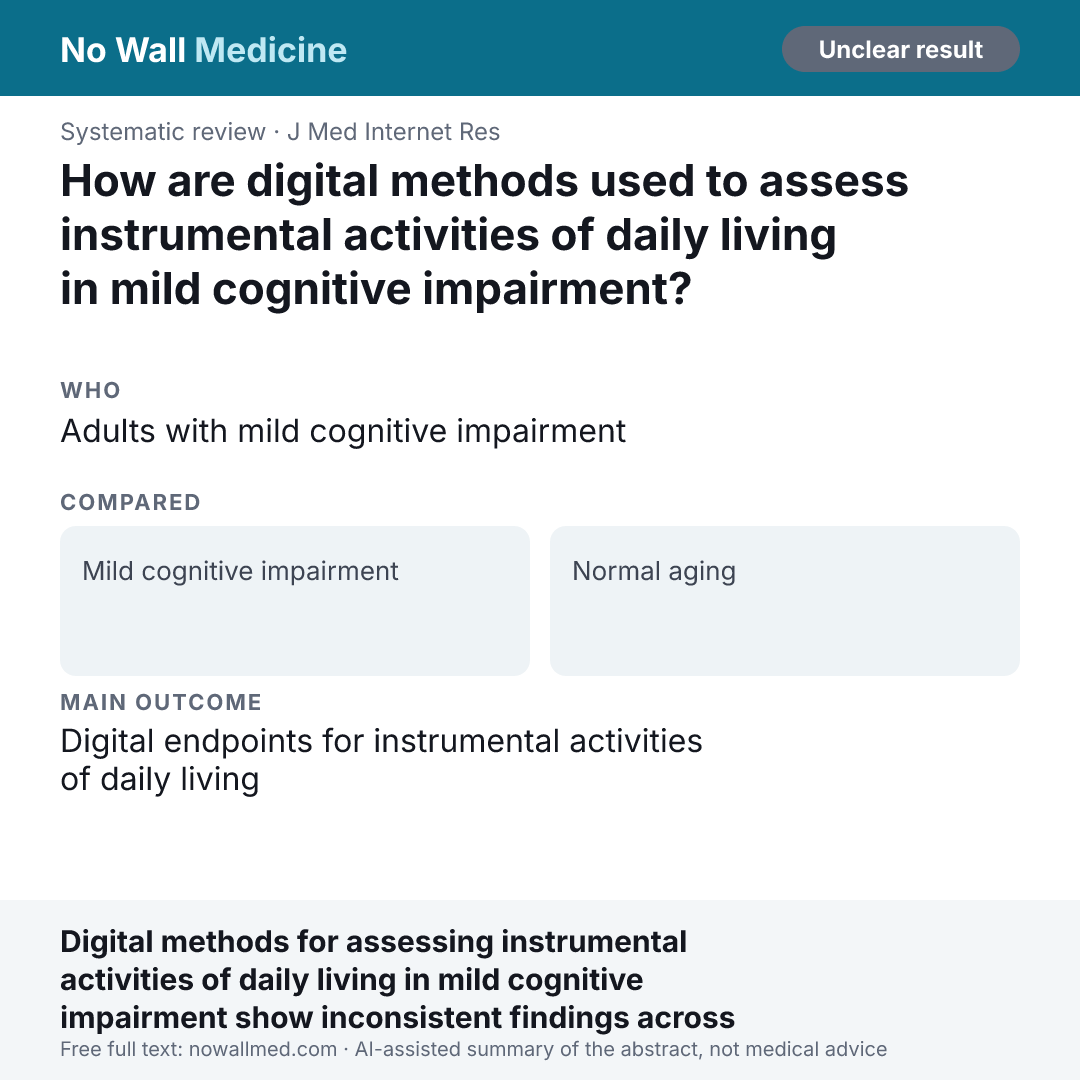
- Researchers reviewed 15 studies from 16,099 identified articles to examine digital ways of measuring complex daily tasks in adults with mild cognitive impairment.
- Ambient technology was used in 14/15 (93%) studies, with motion sensors and contact sensors each appearing in 5/15 (33%) of the research.
- Findings regarding differences in digital endpoints between mild cognitive impairment and normal aging were inconsistent, and there was limited data on changes over time.
Limitation the authors note: The review found inconsistent findings regarding differences in digital endpoints across the cognitive spectrum and limited longitudinal assessment of how they changed over time.
Discussion prompts
- Would these patients look like yours? Who was left out?
- Is the main outcome one that matters to patients?
- Is the difference large enough to change what you do?
Cite: Lawson L, Mc Ardle R, Wilson S, Beswick E, Karimi R, Slight SP. Digital Endpoints for Assessing Instrumental Activities of Daily Living in Mild Cognitive Impairment: Systematic Review. J Med Internet Res. 2023;25:e45658. doi:10.2196/45658
Free full text: PubMed Central · Summary and visual abstract: nowallmed.com/a/digital-endpoints-for-assessing-instrumental-activities-of-daily-o2a47p/ (AI-assisted from the abstract; check the paper before relying on it).