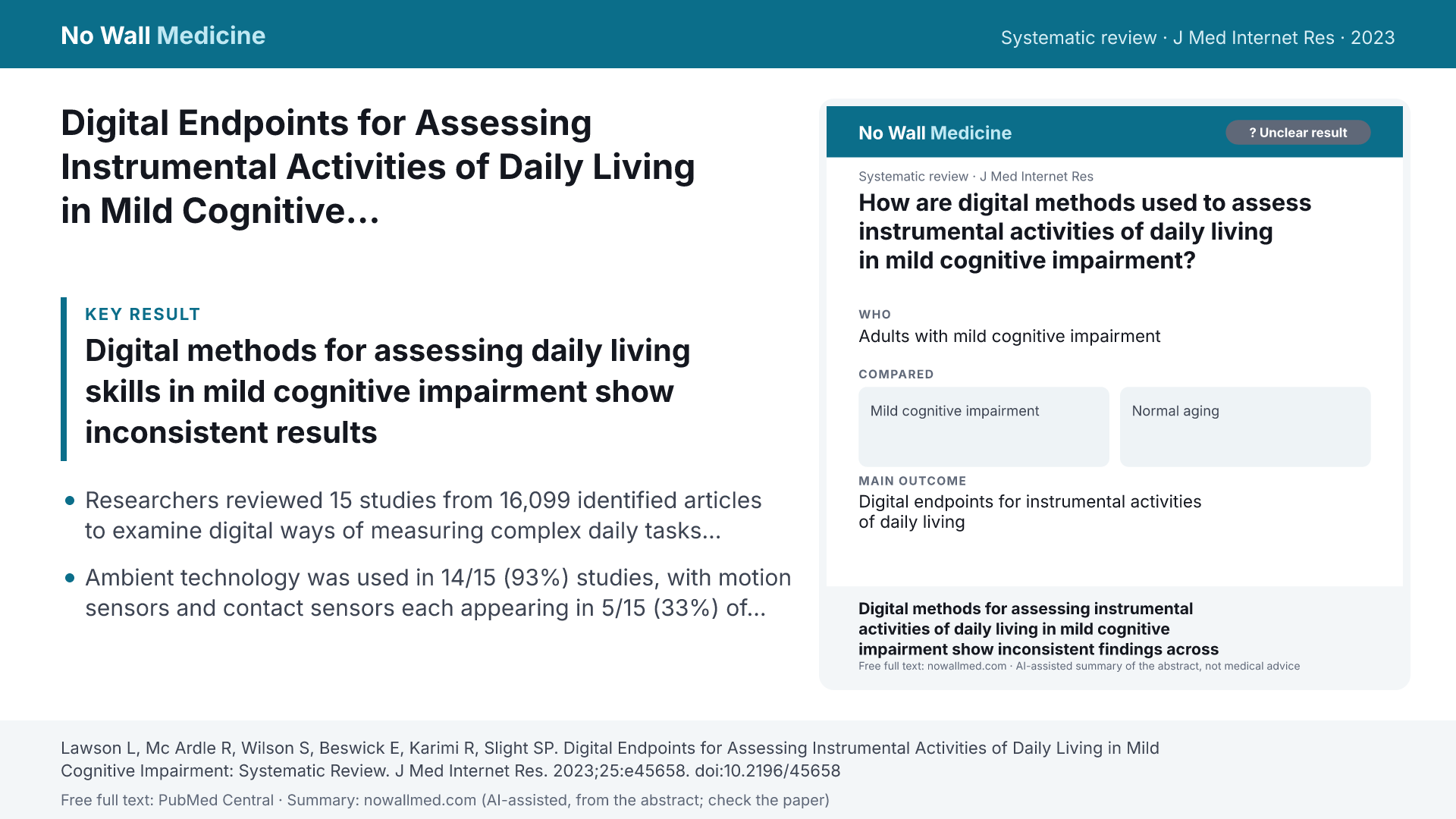
Digital methods for assessing daily living skills in mild cognitive impairment show inconsistent results
Digital Endpoints for Assessing Instrumental Activities of Daily Living in Mild Cognitive Impairment: Systematic Review
Systematic reviewUnclear result
How are digital methods used to assess instrumental activities of daily living in mild cognitive impairment?
Who
Adults with mild cognitive impairment
Compared
Mild cognitive impairment
Normal aging
Main outcome
Digital endpoints for instrumental activities of daily living
Bottom line: Digital methods for assessing instrumental activities of daily living in mild cognitive impairment show inconsistent findings across the cognitive spectrum.
Limitation: Inconsistent findings regarding differences in digital endpoints and limited longitudinal assessment of changes over time.
J Med Internet Res · 2023-07-25Download image
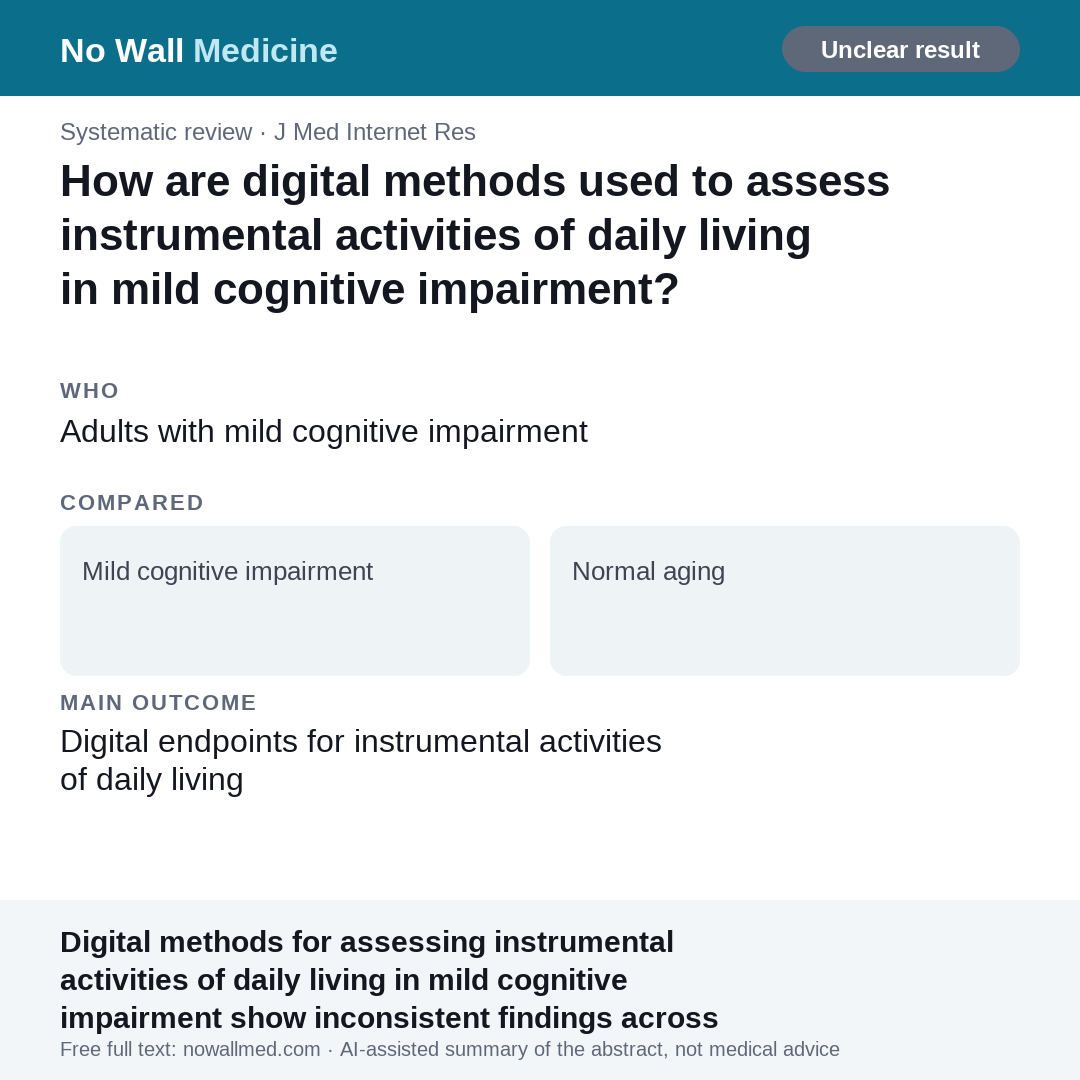
Clinical question: How are digital methods used to assess instrumental activities of daily living in mild cognitive impairment?
Why it matters: It is unclear how digital health technology can objectively assess complex daily activities and whether these digital measures differ between normal aging and mild cognitive impairment.
Key points
- Researchers reviewed 15 studies from 16,099 identified articles to examine digital ways of measuring complex daily tasks in adults with mild cognitive impairment.
- Ambient technology was used in 14/15 (93%) studies, with motion sensors and contact sensors each appearing in 5/15 (33%) of the research.
- Findings regarding differences in digital endpoints between mild cognitive impairment and normal aging were inconsistent, and there was limited data on changes over time.
Limitation the authors note: The review found inconsistent findings regarding differences in digital endpoints across the cognitive spectrum and limited longitudinal assessment of how they changed over time.
Headline and key points written with AI from the paper’s abstract, with every number checked against it. Read the paper before relying on them.
Was this summary helpful?
Subject terms
Cite this article
Lawson L, Mc Ardle R, Wilson S, Beswick E, Karimi R, Slight SP. Digital Endpoints for Assessing Instrumental Activities of Daily Living in Mild Cognitive Impairment: Systematic Review. J Med Internet Res. 2023. doi:10.2196/45658
Spotted a mistake? Suggest a correction