Digital Interventions Targeting Parents to Improve Early Childhood Movement, Nutrition, and Sleep Behaviors: Systematic Review
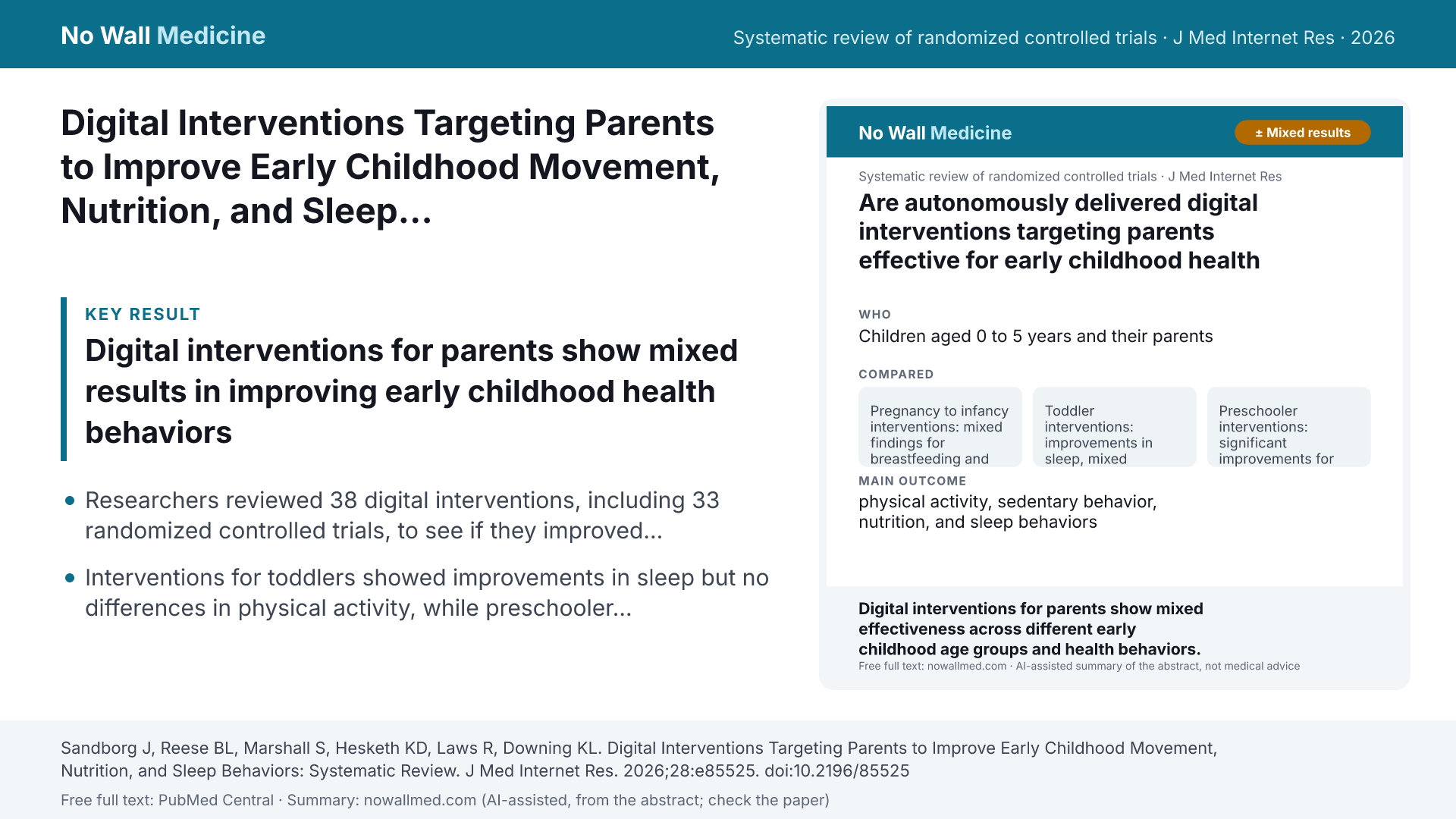
Key result: Digital interventions for parents show mixed results in improving early childhood health behaviors
Key points
- Researchers reviewed 38 digital interventions, including 33 randomized controlled trials, to see if they improved movement, nutrition, or sleep in children aged 0 to 5 years.
- Interventions for toddlers showed improvements in sleep but no differences in physical activity, while preschooler studies showed improvements in diet but no differences in sleep or sedentary behavior.
- Studies targeting pregnancy to infancy reported mixed findings regarding breastfeeding and feeding practices.
Why it matters: Most research on digital health promotion has focused on childhood more broadly, leaving limited evidence for the specific early childhood period of 0 to 5 years.
Limitation the authors note: The authors state that interpretation was limited by heterogeneous designs, inconsistent outcome measures, and mixed risk-of-bias ratings across studies.
Discussion prompts
- Would these patients look like yours? Who was left out?
- Is the main outcome one that matters to patients?
- Is the difference large enough to change what you do?
Cite: Sandborg J, Reese BL, Marshall S, Hesketh KD, Laws R, Downing KL. Digital Interventions Targeting Parents to Improve Early Childhood Movement, Nutrition, and Sleep Behaviors: Systematic Review. J Med Internet Res. 2026;28:e85525. doi:10.2196/85525
Free full text: PubMed Central · Summary and visual abstract: nowallmed.com/a/digital-interventions-targeting-parents-to-improve-early-childhood-eszg8g/ (AI-assisted from the abstract; check the paper before relying on it).