Digital interventions for parents show mixed results in improving early childhood health behaviors
Digital Interventions Targeting Parents to Improve Early Childhood Movement, Nutrition, and Sleep Behaviors: Systematic Review
Systematic review of randomized controlled trialsMixed results
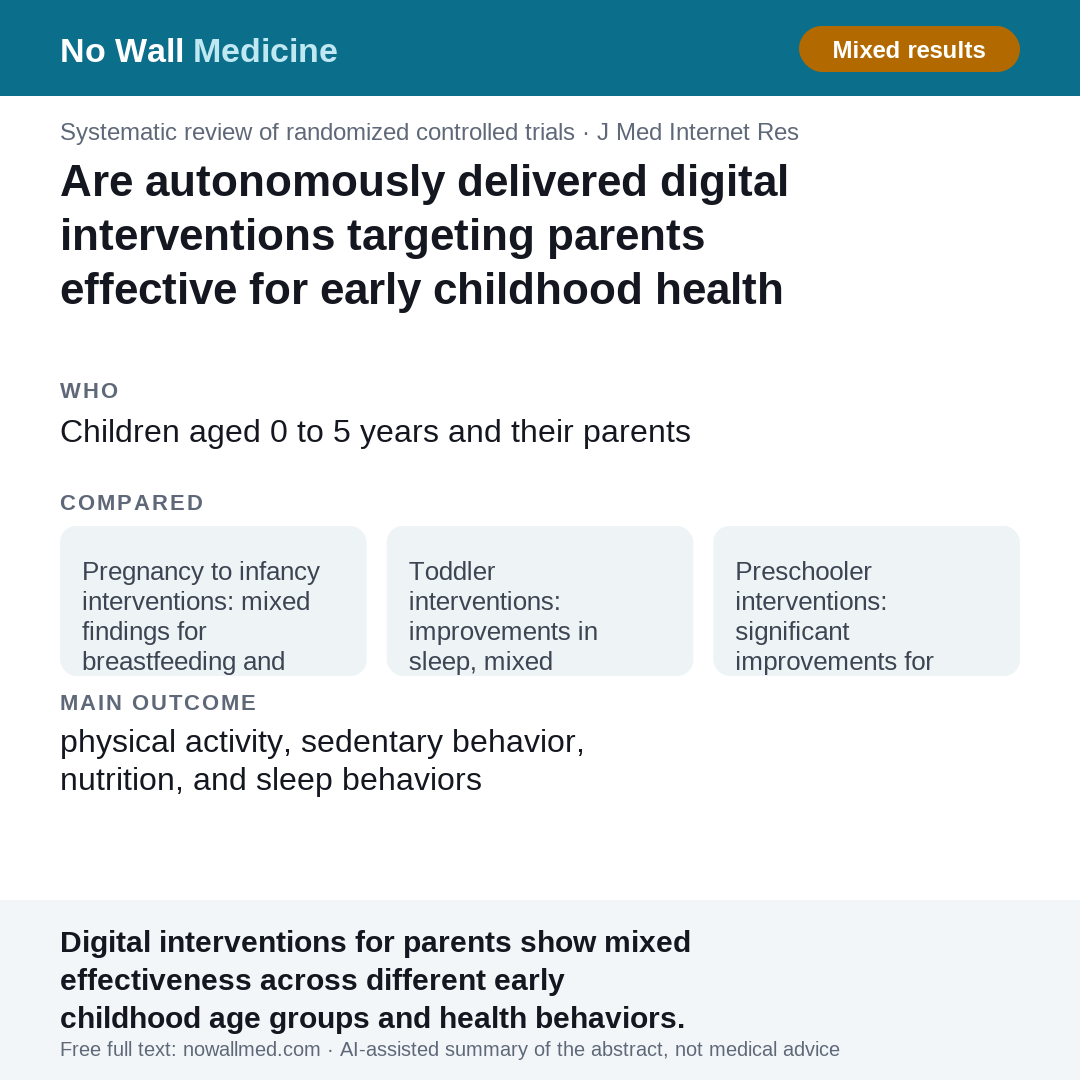
Are autonomously delivered digital interventions targeting parents effective for early childhood health behaviors?
Who
Children aged 0 to 5 years and their parents
Compared
Pregnancy to infancy interventions: mixed findings for breastfeeding and feeding practices
Toddler interventions: improvements in sleep, mixed findings for diet and screen time
Preschooler interventions: significant improvements for feeding practices and diet
Main outcome
physical activity, sedentary behavior, nutrition, and sleep behaviors
Bottom line: Digital interventions for parents show mixed effectiveness across different early childhood age groups and health behaviors.
Limitation: Heterogeneous designs, inconsistent outcome measures, and mixed risk-of-bias ratings across studies.
J Med Internet Res · 2026-06-26Download image
Clinical question: Are autonomously delivered digital interventions targeting parents effective for early childhood health behaviors?
Why it matters: Most research on digital health promotion has focused on childhood more broadly, leaving limited evidence for the specific early childhood period of 0 to 5 years.
Key points
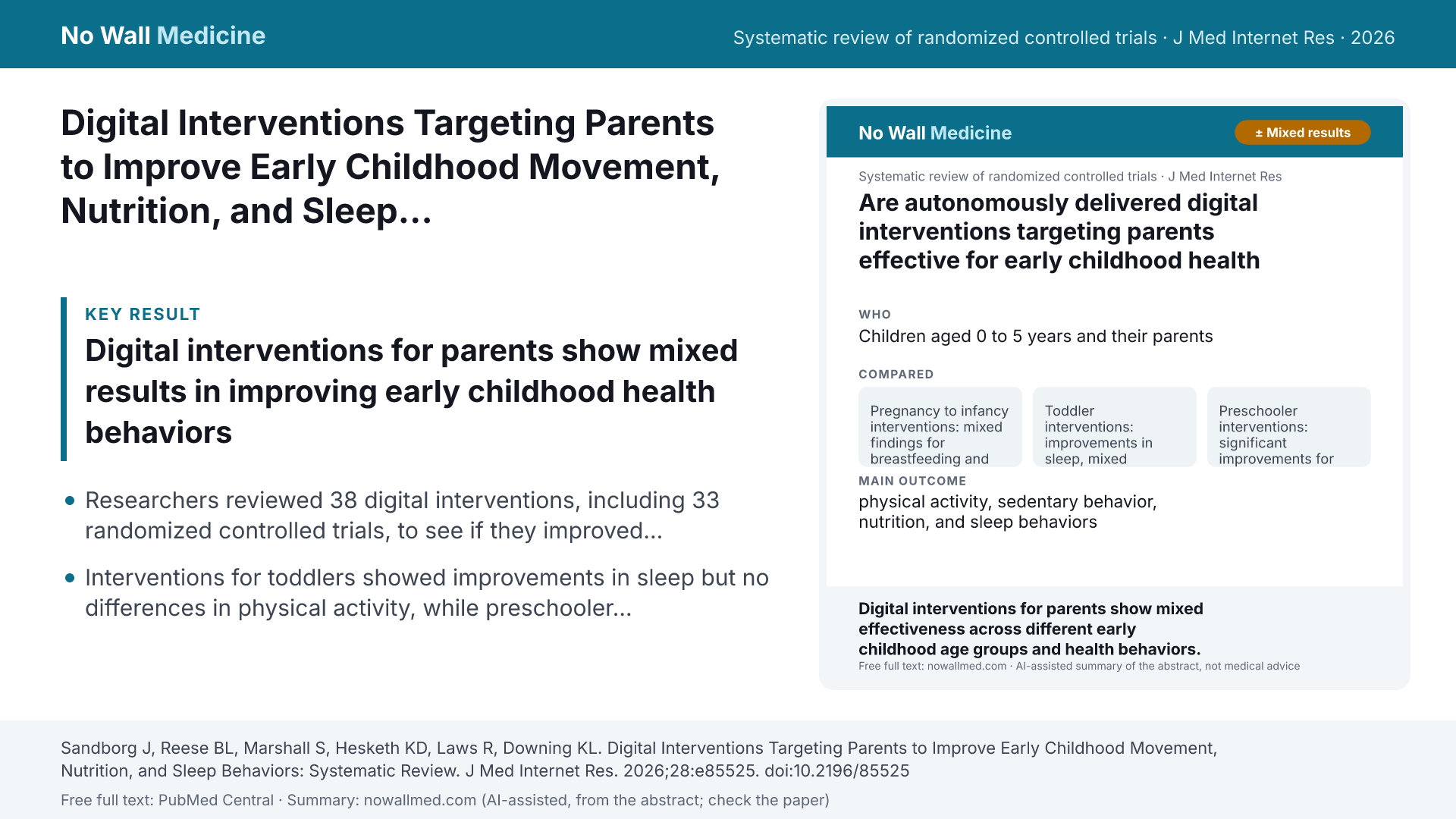
- Researchers reviewed 38 digital interventions, including 33 randomized controlled trials, to see if they improved movement, nutrition, or sleep in children aged 0 to 5 years.
- Interventions for toddlers showed improvements in sleep but no differences in physical activity, while preschooler studies showed improvements in diet but no differences in sleep or sedentary behavior.
- Studies targeting pregnancy to infancy reported mixed findings regarding breastfeeding and feeding practices.
Limitation the authors note: The authors state that interpretation was limited by heterogeneous designs, inconsistent outcome measures, and mixed risk-of-bias ratings across studies.
Headline and key points written with AI from the paper’s abstract, with every number checked against it. Read the paper before relying on them.
Was this summary helpful?
Subject terms
Cite this article
Sandborg J, Reese BL, Marshall S, Hesketh KD, Laws R, Downing KL. Digital Interventions Targeting Parents to Improve Early Childhood Movement, Nutrition, and Sleep Behaviors: Systematic Review. J Med Internet Res. 2026. doi:10.2196/85525
Spotted a mistake? Suggest a correction