Digital mental health interventions show efficacy for social anxiety in children and young adults
Digital Mental Health Interventions for the Prevention and Treatment of Social Anxiety Disorder in Children, Adolescents, and Young Adults: Systematic Review and Meta-Analysis of Randomized Controlled Trials
Systematic review and meta-analysis of randomized controlled trialsBenefit found
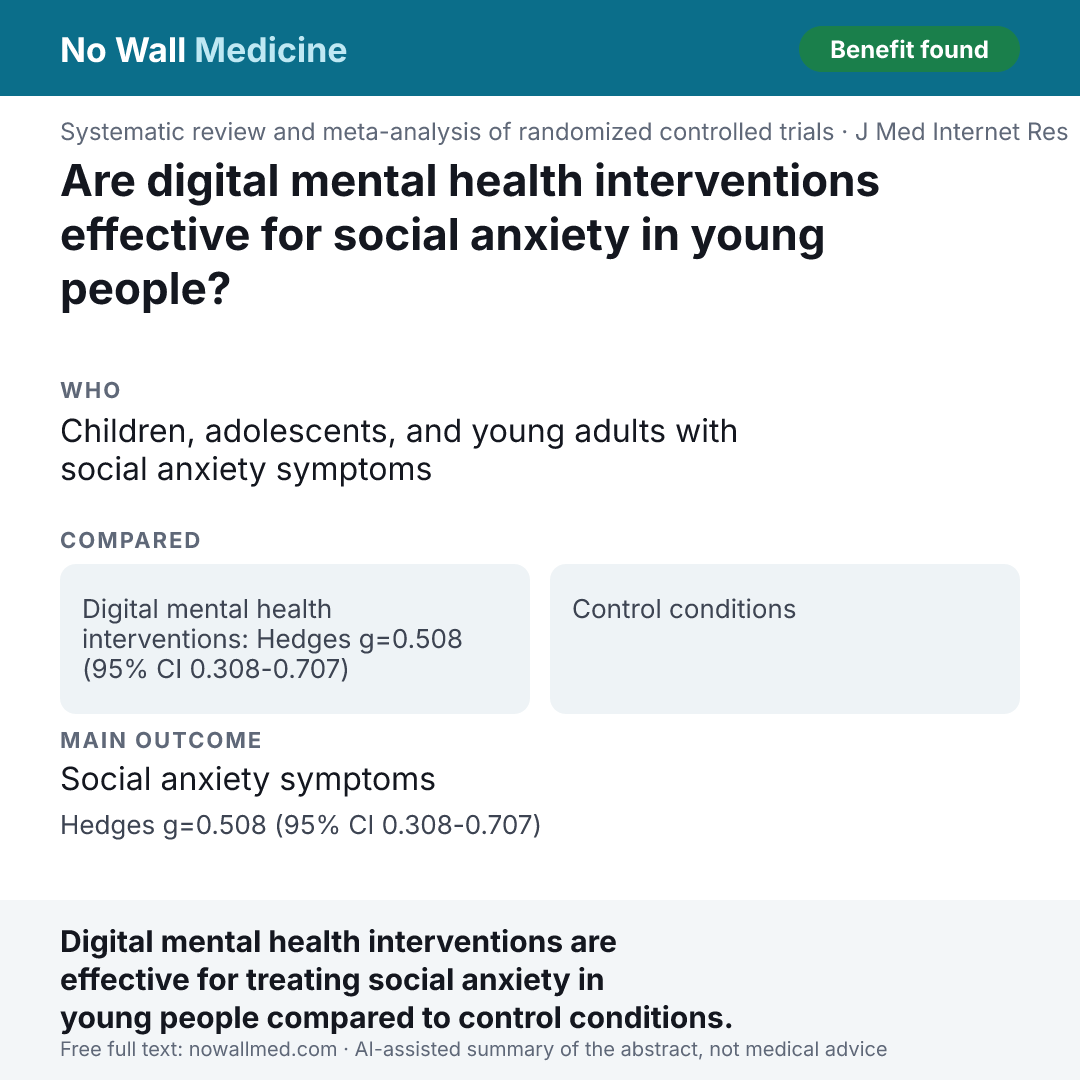
Are digital mental health interventions effective for social anxiety in young people?
Who
Children, adolescents, and young adults with social anxiety symptoms
Compared
Digital mental health interventions: Hedges g=0.508 (95% CI 0.308-0.707)
Control conditions
Main outcome
Social anxiety symptoms
Result: Hedges g=0.508 (95% CI 0.308-0.707)
Bottom line: Digital mental health interventions are effective for treating social anxiety in young people compared to control conditions.
Limitation: Most studies showed some concerns or high risk of bias and reporting of adherence varied substantially.
J Med Internet Res · 2025-06-12 · Save PNG
Clinical question: Are digital mental health interventions effective for social anxiety in young people?
Key points
- Researchers analyzed 21 randomized controlled trials involving children, adolescents, and young adults with a mean age under 25 years.
- Digital mental health interventions showed a significant effect compared to all control conditions with a Hedges g of 0.508.
- The largest effects were seen in interventions with social anxiety disorder-specific components (Hedges g=0.878) and those including human guidance (Hedges g=0.825).
Limitation the authors note: The authors noted that 73% of the 22 studies included showed some concerns regarding risk of bias and reporting of adherence varied substantially.
Headline and key points written with AI from the paper’s abstract, with every number checked against it. Read the paper before relying on them.
Was this summary helpful?
Subject terms
Headline, design, result, key points, caveat and citation as plain text.
Cite this article
Walder N, Frey A, Berger T, Schmidt SJ. Digital Mental Health Interventions for the Prevention and Treatment of Social Anxiety Disorder in Children, Adolescents, and Young Adults: Systematic Review and Meta-Analysis of Randomized Controlled Trials. J Med Internet Res. 2025;27:e67067. doi:10.2196/67067
Spotted a mistake? Suggest a correction