Digital therapeutic AspyreRx showed efficacy in lowering hemoglobin A1C at 90 days
Digital Therapeutic Based Randomized Investigation to Improve Glycemic Control in Patients With Type 2 Diabetes and Residual Hyperglycemia on Stable Medical Therapy: Rationale, Design, and Baseline Characteristics of the BRIGHT Trial
Randomized, controlled, multicenter, pragmatic, pivotal trialBenefit found
Does AspyreRx improve glycemic control and cardiometabolic measures in type 2 diabetes?
Who
Patients with type 2 diabetes and residual hyperglycemia on stable medical therapy · Virtual, decentralized model with a diverse site mix
Compared
AspyreRx digital therapeutic
Control application added to usual care
Main outcome
Glycemic control and cardiometabolic measures
Bottom line: AspyreRx demonstrated efficacy for lowering hemoglobin A1C at 90 days in patients with type 2 diabetes.
Limitation: Long-term effects and effectiveness in a broader, more diverse real-world environment require further understanding.
J Am Heart Assoc · 2025-07-17Download image
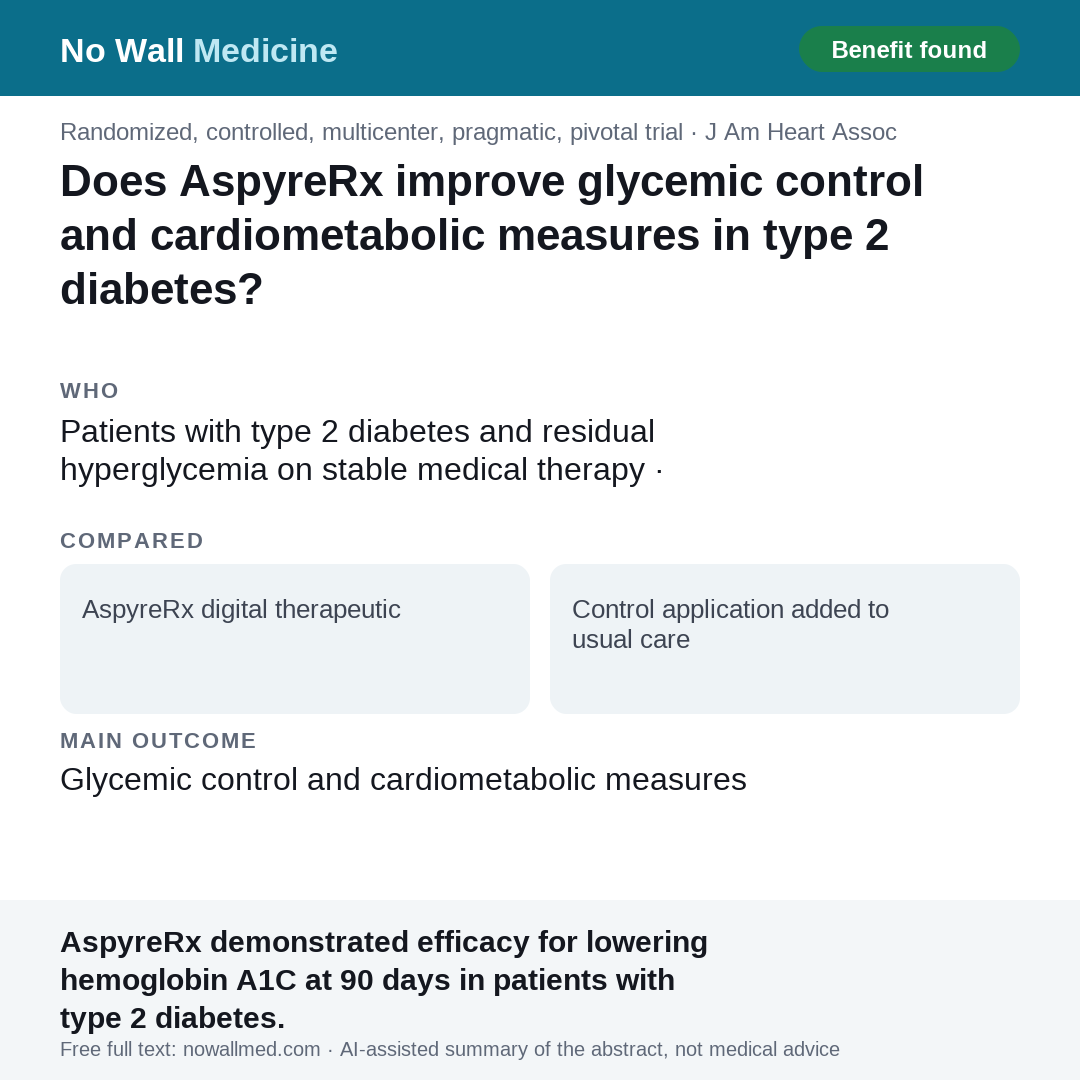
Clinical question: Does AspyreRx improve glycemic control and cardiometabolic measures in type 2 diabetes?
Why it matters: Patients with type 2 diabetes may have residual high blood sugar despite stable medical therapy or may be unable to tolerate new medications.
Key points
- The BRIGHT trial is a randomized, controlled, multicenter, pragmatic trial evaluating AspyreRx, a digital cognitive behavioral therapy, against a control application added to usual care.
- The study demonstrated that AspyreRx was effective for lowering hemoglobin A1C, which is a measure of average blood sugar, at 90 days.
Limitation the authors note: The authors note that opportunities remain to better understand long-term effects and effectiveness and safety in a broader and more diverse real-world environment.
Headline and key points written with AI from the paper’s abstract, with every number checked against it. Read the paper before relying on them.
Topics
Cite this article
Canonico ME, Hsia J, Masoudi FA, Bosworth HB, Greene S, Batch BC. Digital Therapeutic Based Randomized Investigation to Improve Glycemic Control in Patients With Type 2 Diabetes and Residual Hyperglycemia on Stable Medical Therapy: Rationale, Design, and Baseline Characteristics of the BRIGHT Trial. J Am Heart Assoc. 2025. doi:10.1161/JAHA.124.038737
Spotted a mistake? Suggest a correction
Top studies every Monday
The week’s key trials and guidelines in your specialties, plus any topics you follow. By email, free.
Get the weekly digest