Digoxin reduced the risk of death or worsening heart failure in rheumatic heart disease patients
Digoxin in Patients With Symptomatic Rheumatic Heart Disease: A Randomized Clinical Trial
Multicenter, randomized, placebo-controlled trialBenefit found
Does digoxin improve death or new-onset or worsening heart failure in symptomatic rheumatic heart disease?
Who
1759
Patients with symptomatic rheumatic heart disease, heart failure, or atrial fibrillation · 12 tertiary care hospitals in India
Compared
31.4%Digoxin
35.5%Placebo
Main outcome
Composite of all-cause death or new-onset or worsening heart failure
Result: hazard ratio 0.82 (95% CI 0.70-0.97)
Bottom line: In patients with symptomatic rheumatic heart disease, digoxin reduced the risk of death or worsening heart failure.
JAMA · 2026-05-10Download image
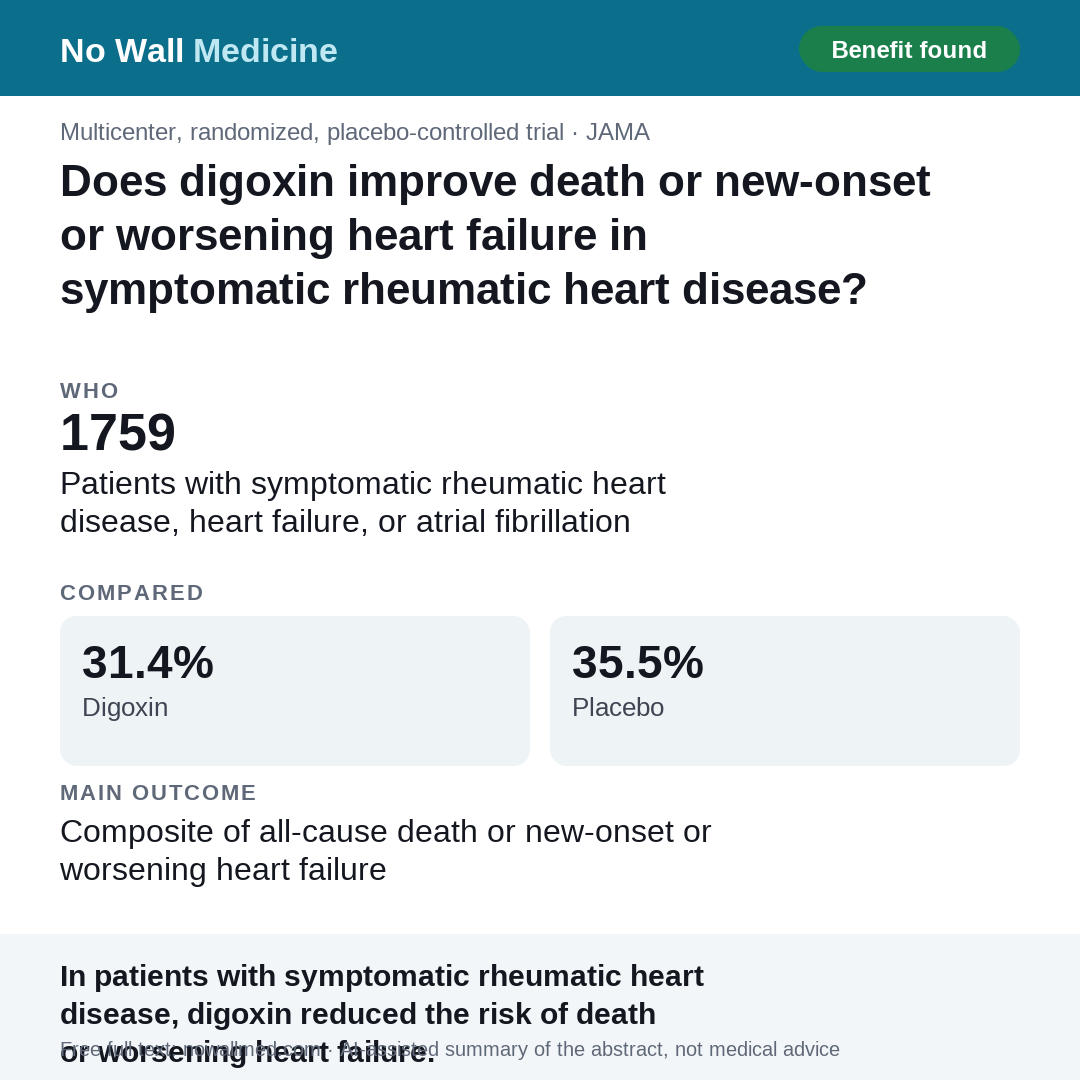
Clinical question: Does digoxin improve death or new-onset or worsening heart failure in symptomatic rheumatic heart disease?
Why it matters: The efficacy and safety of digoxin in patients with rheumatic heart disease are not known.
In absolute numbers
Digoxin: 31.4% · Placebo: 35.5% → a difference of 4.1 percentage points, so about 25 people would need the treatment for 1 more to benefit (number needed to treat) over the trial’s follow-up.
Worked out by us from the two group results above, not reported by the authors. Check the paper for the exact outcome and timing.
Key points
- Researchers studied 1759 patients with symptomatic rheumatic heart disease in India, comparing daily digoxin to a placebo over a median follow-up of 2.1 years.
- The primary composite outcome of death or new or worsening heart failure occurred in 31.4% of the digoxin group compared to 35.5% in the placebo group.
- New-onset or worsening heart failure occurred in 25.8% of those taking digoxin and 29.2% of those taking the placebo.
Headline and key points written with AI from the paper’s abstract, with every number checked against it. Read the paper before relying on them.
Topics
Cite this article
Karthikeyan G, Devasenapathy N, Ghosh A, Kini PR, Varyani R, Satheesh S. Digoxin in Patients With Symptomatic Rheumatic Heart Disease: A Randomized Clinical Trial. JAMA. 2026. doi:10.1001/jama.2026.7335
Spotted a mistake? Suggest a correction