Disease risk but not remission status determines transplant outcomes in AML: long-term outcomes of the ASAP trial
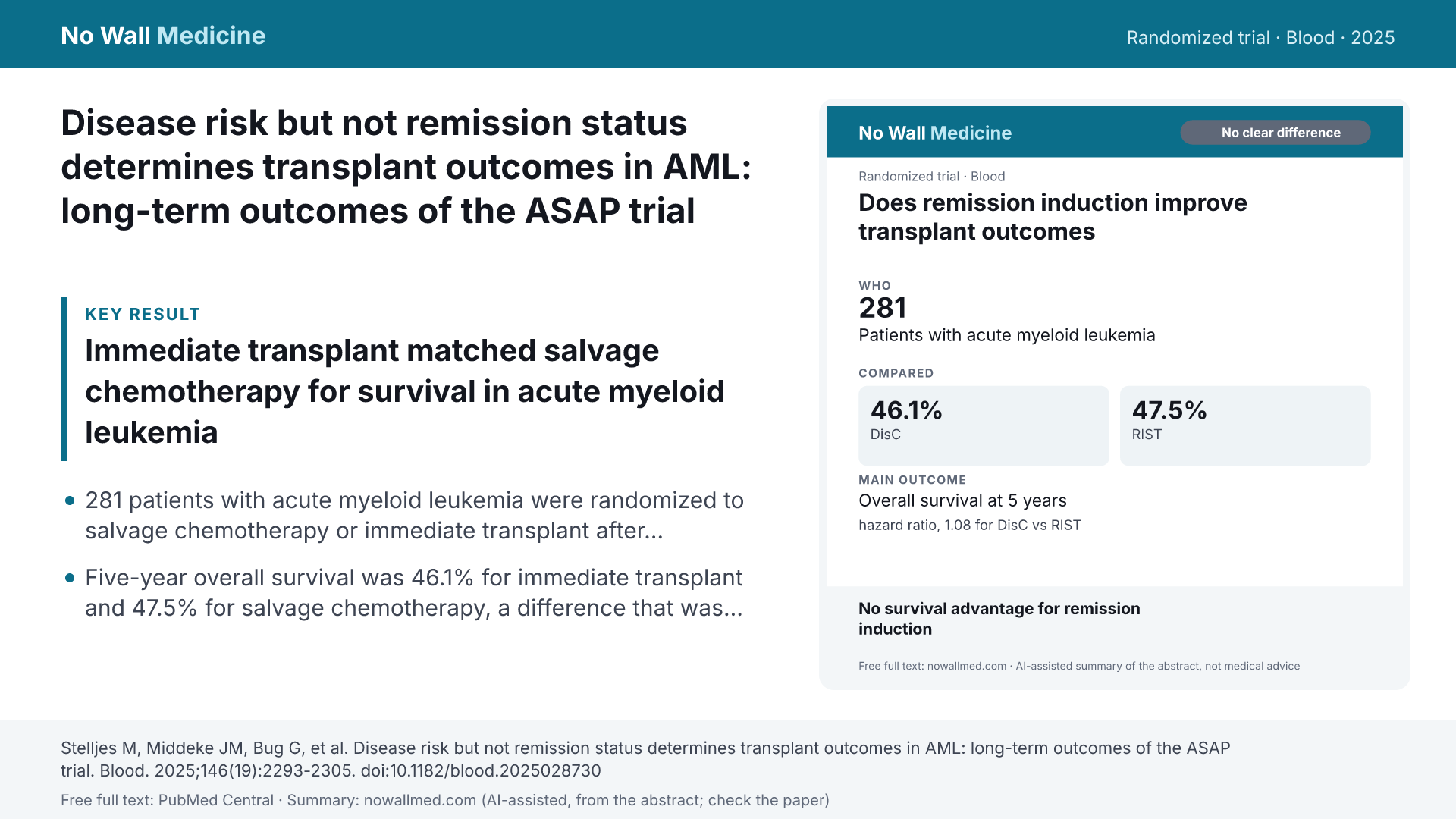
Key result: Immediate transplant matched salvage chemotherapy for survival in acute myeloid leukemia
Randomized trialNo clear difference
Does remission induction improve transplant outcomes
Who
281
Patients with acute myeloid leukemia
Compared
46.1%DisC
47.5%RIST
Main outcome
Overall survival at 5 years
Result: hazard ratio, 1.08 for DisC vs RIST
Bottom line: No survival advantage for remission induction
Blood · 2025-07-30
Key points
- 281 patients with acute myeloid leukemia were randomized to salvage chemotherapy or immediate transplant after nonintensive disease control.
- Five-year overall survival was 46.1% for immediate transplant and 47.5% for salvage chemotherapy, a difference that was not statistically significant.
- Genetic risk, age, and comorbidities predicted survival, but the treatment arm did not significantly affect outcomes in multivariable analysis.
Discussion prompts
- Would these patients look like yours? Who was left out?
- Is the main outcome one that matters to patients?
- Is the difference large enough to change what you do?
Cite: Stelljes M, Middeke JM, Bug G, et al. Disease risk but not remission status determines transplant outcomes in AML: long-term outcomes of the ASAP trial. Blood. 2025;146(19):2293-2305. doi:10.1182/blood.2025028730
Free full text: PubMed Central · Summary and visual abstract: nowallmed.com/a/disease-risk-but-not-remission-status-determines-transplant-outcomes-bpv48u/ (AI-assisted from the abstract; check the paper before relying on it).