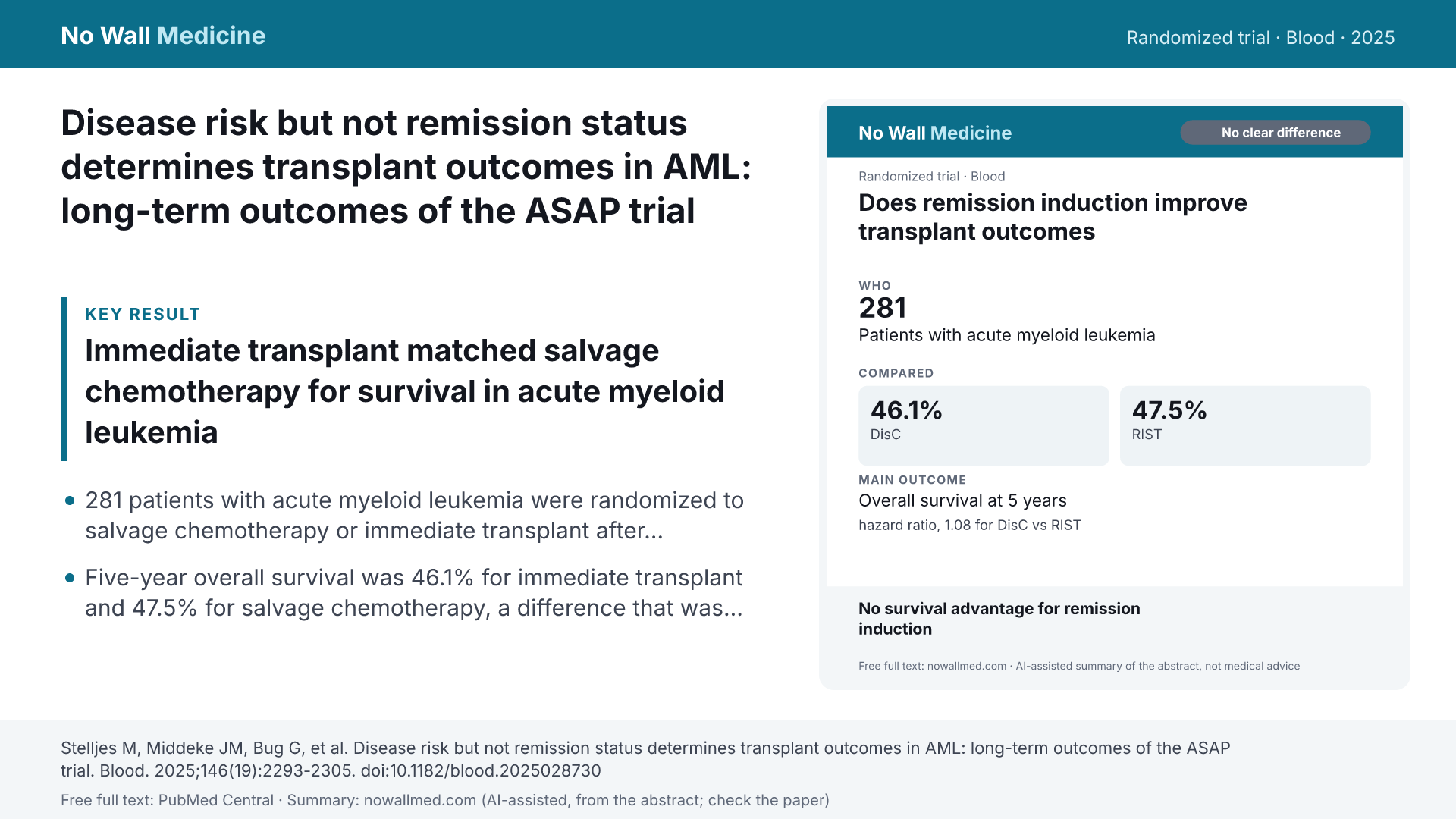
Immediate transplant matched salvage chemotherapy for survival in acute myeloid leukemia
Disease risk but not remission status determines transplant outcomes in AML: long-term outcomes of the ASAP trial
Randomized trialNo clear difference
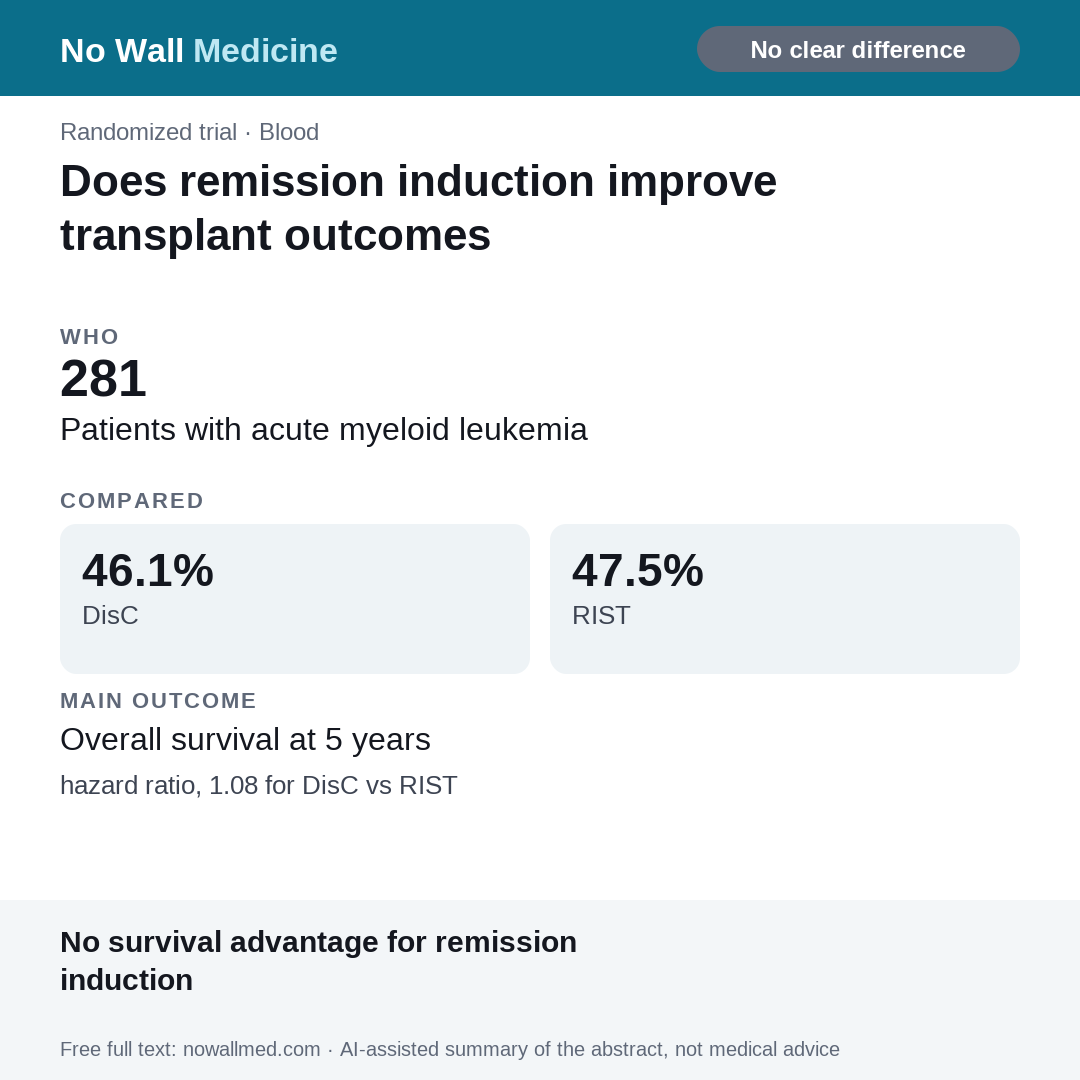
Does remission induction improve transplant outcomes
Who
281
Patients with acute myeloid leukemia
Compared
46.1%DisC
47.5%RIST
Main outcome
Overall survival at 5 years
Result: hazard ratio, 1.08 for DisC vs RIST
Bottom line: No survival advantage for remission induction
Blood · 2025-07-30Download image
Why it matters: It was unknown whether inducing remission with salvage chemotherapy before transplant improved survival compared to immediate transplant in patients with poor response or relapse.
Key points
- 281 patients with acute myeloid leukemia were randomized to salvage chemotherapy or immediate transplant after nonintensive disease control.
- Five-year overall survival was 46.1% for immediate transplant and 47.5% for salvage chemotherapy, a difference that was not statistically significant.
- Genetic risk, age, and comorbidities predicted survival, but the treatment arm did not significantly affect outcomes in multivariable analysis.
Headline and key points written with AI from the paper’s abstract, with every number checked against it. Read the paper before relying on them.
Was this summary helpful?
Abstract
Attempting to induce a complete remission before allogeneic hematopoietic cell transplant (alloHCT) is current practice in patients with acute myeloid leukemia (AML). However, benefit of remission induction strategy (RIST) before alloHCT has never been proven in a prospective trial. Potent conditioning regimens exist that allow for successful alloHCT in patients with active AML. Therefore, the ASAP trial was conducted to test RIST by salvage chemotherapy before alloHCT against immediate transplant after intensified conditioning. In total, 281 patients with AML with poor response after first induction or untreated first relapse were randomized 1:1 to RIST with high-dose cytarabine plus mitoxantrone vs immediate alloHCT with sequential conditioning after nonintensive disease control (DisC) measures, preferentially watchful waiting only. Overall survival at 5 years from randomization analyzed according to intention-to-treat was 46.1% for DisC vs 47.5% for RIST (P = .82). In multivariable Cox regression analysis, genetic AML risk according to European LeukemiaNet criteria (P < .0001), age (P = .001), and comorbidities (P = .046) predicted survival, but not treatment arm (hazard ratio, 1.08 for DisC vs RIST; P = .67). In conclusion, long-term follow-up of the ASAP trial showed no survival advantage for standard salvage chemotherapy before alloHCT as opposed to immediate alloHCT. The trial results question the general concept of RIST with intensive standard salvage therapy before alloHCT for all patients, because immediate alloHCT may reduce time in hospital and health care expenses. Novel bridging therapies that are well tolerated, and posttransplant maintenance with targeted drugs are urgently warranted, especially for adverse-risk AML, to improve outcomes after alloHCT. This trial was registered at www.ClinicalTrials.gov as #NCT02461537.
Abstract reproduced under the article’s CC BY NC ND licence.
Subject terms
Cite this article
Stelljes M, Middeke JM, Bug G, et al. Disease risk but not remission status determines transplant outcomes in AML: long-term outcomes of the ASAP trial. Blood. 2025. doi:10.1182/blood.2025028730
Spotted a mistake? Suggest a correction