Remission induction chemotherapy was not found to be non-inferior to immediate stem cell transplantation
Remission induction versus immediate allogeneic haematopoietic stem cell transplantation for patients with relapsed or poor responsive acute myeloid leukaemia (ASAP): a randomised, open-label, phase 3, non-inferiority trial
Randomised, open-label, phase 3, non-inferiority trialNo clear difference
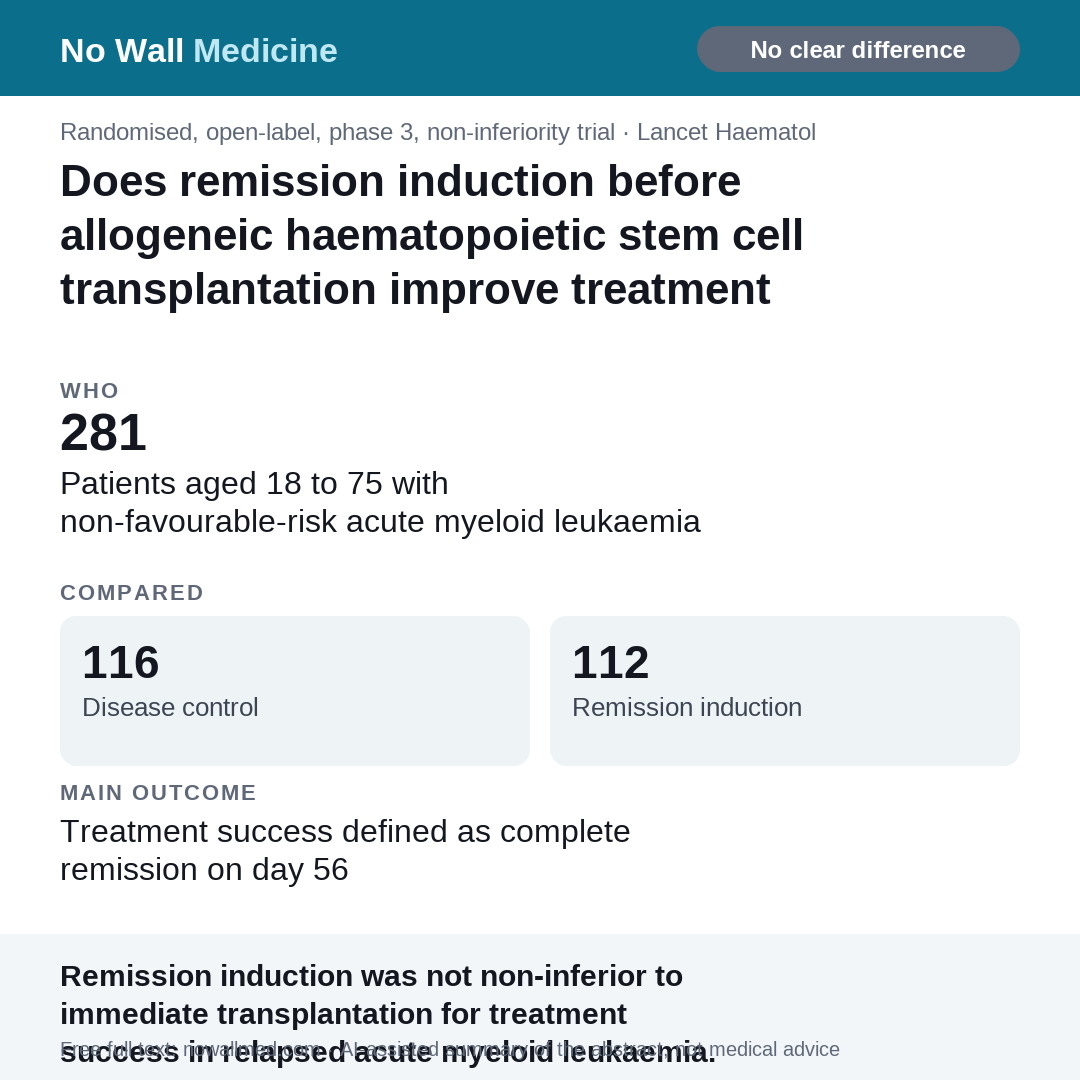
Does remission induction before allogeneic haematopoietic stem cell transplantation improve treatment success?
Who
281
Patients aged 18 to 75 with non-favourable-risk acute myeloid leukaemia
Compared
116Disease control (83%)
112Remission induction (79%)
Main outcome
Treatment success defined as complete remission on day 56
Result: difference 3·4% (95% CI -5·8 to 12·6)
Bottom line: Remission induction was not non-inferior to immediate transplantation for treatment success in relapsed acute myeloid leukaemia.
Funded by: DKMS and the Gert and Susanna Mayer Stiftung Foundation
Lancet Haematol · 2024-04-04Download image
Clinical question: Does remission induction before allogeneic haematopoietic stem cell transplantation improve treatment success?
Why it matters: It is unclear if high-dose cytarabine-based salvage chemotherapy before allogeneic haematopoietic stem cell transplantation provides a survival advantage for patients with relapsed or poor responsive acute myeloid leukaemia.
Key points
- The trial studied 281 patients with relapsed or poor responsive acute myeloid leukaemia, comparing remission induction chemotherapy to immediate allogeneic haematopoietic stem cell transplantation.
- In the intention-to-treat population, treatment success was 83% for the immediate transplantation group versus 79% for the remission induction group.
- Patients receiving immediate transplantation spent a median of 15 days in the hospital compared to a median of 42 days for those receiving remission induction.
Headline and key points written with AI from the paper’s abstract, with every number checked against it. Read the paper before relying on them.
Was this summary helpful?
Abstract
Background
Whether high-dose cytarabine-based salvage chemotherapy, administered to induce complete remission in patients with poor responsive or relapsed acute myeloid leukaemia scheduled for allogeneic haematopoietic stem-cell transplantation (HSCT) after intensive conditioning confers a survival advantage, is unclear. Methods
To test salvage chemotherapy before allogeneic HSCT, patients aged between 18 and 75 years with non-favourable-risk acute myeloid leukaemia not in complete remission after first induction or untreated first relapse were randomly assigned 1:1 to remission induction with high-dose cytarabine (3 g/m2 intravenously, 1 g/m2 intravenously for patients >60 years or with a substantial comorbidity) twice daily on days 1-3 plus mitoxantrone (10 mg/m2 intravenously) on days 3-5 or immediate allogeneic HSCT for the disease control group. Block randomisation with variable block lengths was used and patients were stratified by age, acute myeloid leukaemia risk, and disease status. The study was open label. The primary endpoint was treatment success, defined as complete remission on day 56 after allogeneic HSCT, with the aim to show non-inferiority for disease control compared with remission induction with a non-inferiority-margin of 5% and one-sided type 1 error of 2·5%. The primary endpoint was analysed in both the intention-to-treat (ITT) population and in the per-protocol population. The trial is completed and was registered at ClinicalTrials.gov, NCT02461537. Findings
281 patients were enrolled between Sept 17, 2015, and Jan 12, 2022. Of 140 patients randomly assigned to disease control, 135 (96%) proceeded to allogeneic HSCT, 97 (69%) after watchful waiting only. Of 141 patients randomly assigned to remission induction, 134 (95%) received salvage chemotherapy and 128 (91%) patients subsequently proceeded to allogeneic HSCT. In the ITT population, treatment success was observed in 116 (83%) of 140 patients in the disease control group versus 112 (79%) of 141 patients with remission induction (test for non-inferiority, p=0·036). Among per-protocol treated patients, treatment success was observed in 116 (84%) of 138 patients with disease control versus 109 (81%) of 134 patients in the remission induction group (test for non-inferiority, p=0·047). The difference in treatment success between disease control and remission induction was estimated as 3·4% (95% CI -5·8 to 12·6) for the ITT population and 2·7% (-6·3 to 11·8) for the per-protocol population. Fewer patients with disease control compared with remission induction had non-haematological adverse events grade 3 or worse (30 [21%] of 140 patients vs 86 [61%] of 141 patients, χ2 test p<0·0001). Between randomisation and the start of conditioning, with disease control two patients died from progressive acute myeloid leukaemia and zero from treatment-related complications, and with remission induction two patients died from progressive acute myeloid leukaemia and two from treatment-related complications. Between randomisation and allogeneic HSCT, patients with disease control spent a median of 27 days less in hospital than those with remission induction, ie, the median time in hospital was 15 days (range 7-64) versus 42 days (27-121, U test p<0·0001), respectively. Interpretation
Non-inferiority of disease control could not be shown at the 2·5% significance level. The rate of treatment success was also not statistically better for patients with remission induction. Watchful waiting and immediate transplantation could be an alternative for fit patients with poor response or relapsed acute myeloid leukaemia who have a stem cell donor available. More randomised controlled intention-to-transplant trials are needed to define the optimal treatment before transplantation for patients with active acute myeloid leukaemia. Funding
DKMS and the Gert and Susanna Mayer Stiftung Foundation.
Abstract reproduced under the article’s CC BY licence.
Subject terms
Cite this article
Stelljes M, Middeke JM, Bug G, Wagner-Drouet EM, Müller LP, Schmid C. Remission induction versus immediate allogeneic haematopoietic stem cell transplantation for patients with relapsed or poor responsive acute myeloid leukaemia (ASAP): a randomised, open-label, phase 3, non-inferiority trial. Lancet Haematol. 2024. doi:10.1016/S2352-3026(24)00065-6
Spotted a mistake? Suggest a correction
Top studies every Monday
The week’s key trials and guidelines in your specialties, plus any topics you follow. By email, free.
Get the weekly digest