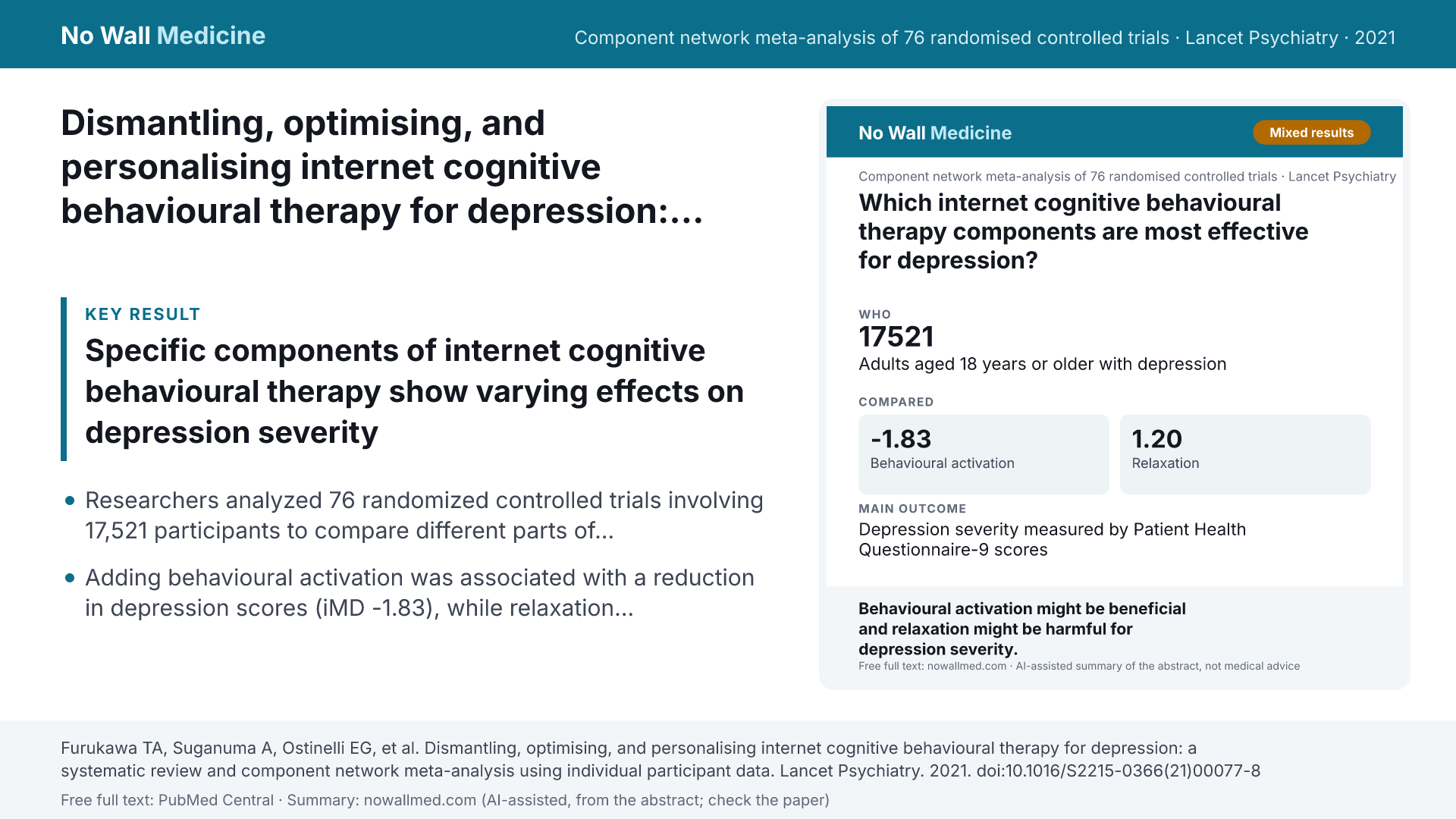
Specific components of internet cognitive behavioural therapy show varying effects on depression severity
Dismantling, optimising, and personalising internet cognitive behavioural therapy for depression: a systematic review and component network meta-analysis using individual participant data
Component network meta-analysis of 76 randomised controlled trialsMixed results
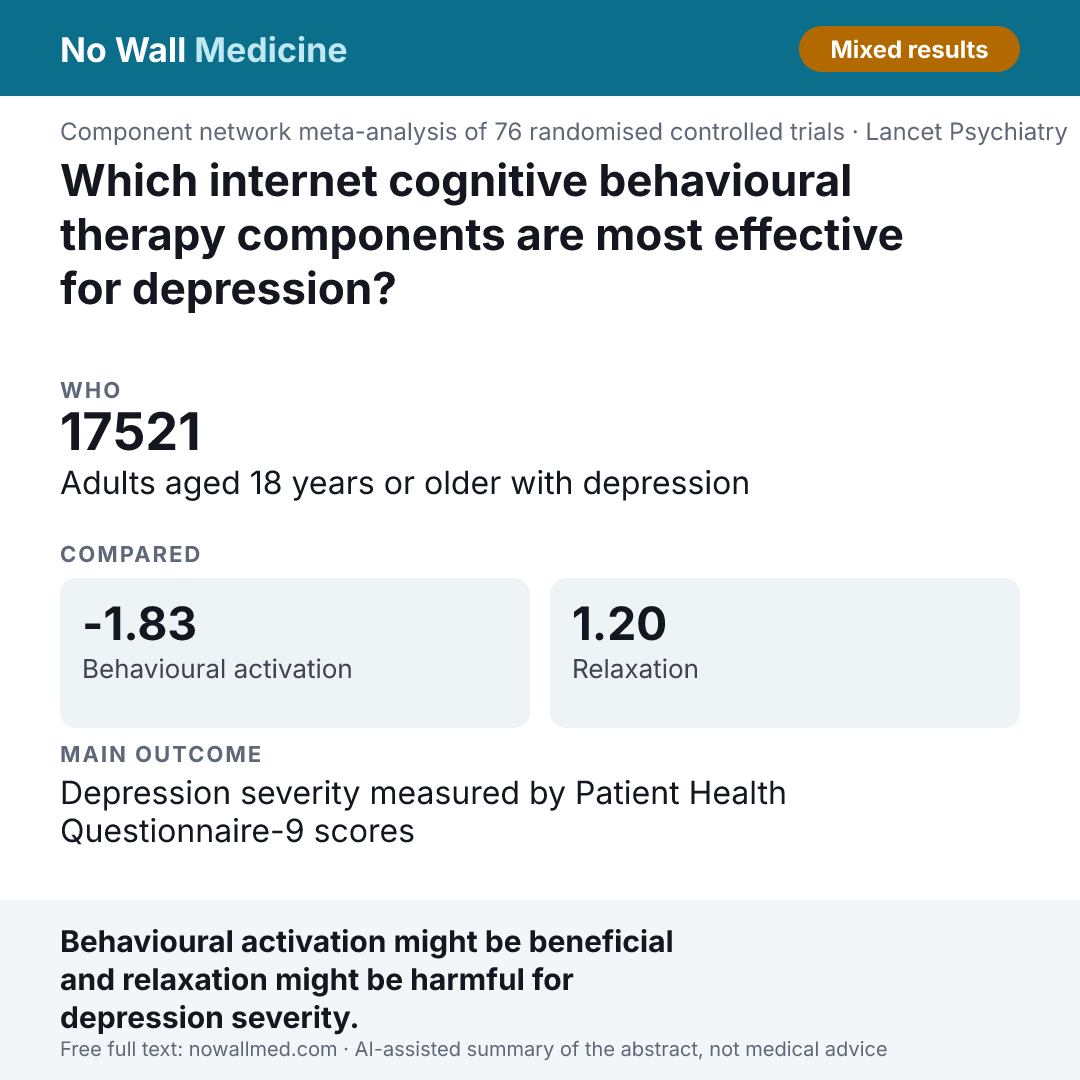
Which internet cognitive behavioural therapy components are most effective for depression?
Who
17521
Adults aged 18 years or older with depression
Compared
-1.83Behavioural activation (95% CrI -2.90 to -0.80)
1.20Relaxation (95% CrI 0.17 to 2.27)
Main outcome
Depression severity measured by Patient Health Questionnaire-9 scores
Result: Behavioural activation iMD -1.83 (95% CrI -2.90 to -0.80); Relaxation iMD 1.20 (95% CrI 0.17 to 2.27)
Bottom line: Behavioural activation might be beneficial and relaxation might be harmful for depression severity.
Limitation: High risk of bias for outcome measurement and moderate to high heterogeneity
Funded by: Japan Society for the Promotion of Science
Lancet Psychiatry · 2021-05-03 · Save PNG
Clinical question: Which internet cognitive behavioural therapy components are most effective for depression?
Key points
- Researchers analyzed 76 randomized controlled trials involving 17,521 participants to compare different parts of internet cognitive behavioural therapy for depression.
- Adding behavioural activation was associated with a reduction in depression scores (iMD -1.83), while relaxation was associated with higher scores (1.20).
- Combining human and automated encouragement was associated with a reduction in treatment dropouts (incremental odds ratio 0.32).
Limitation the authors note: The researchers noted moderate to high heterogeneity among the studies and their components, and a high risk of bias for the measurement of outcomes.
Headline and key points written with AI from the paper’s abstract, with every number checked against it. Read the paper before relying on them.
Was this summary helpful?
Subject terms
Headline, design, result, key points, caveat and citation as plain text.
Cite this article
Furukawa TA, Suganuma A, Ostinelli EG, et al. Dismantling, optimising, and personalising internet cognitive behavioural therapy for depression: a systematic review and component network meta-analysis using individual participant data. Lancet Psychiatry. 2021. doi:10.1016/S2215-0366(21)00077-8
Spotted a mistake? Suggest a correction