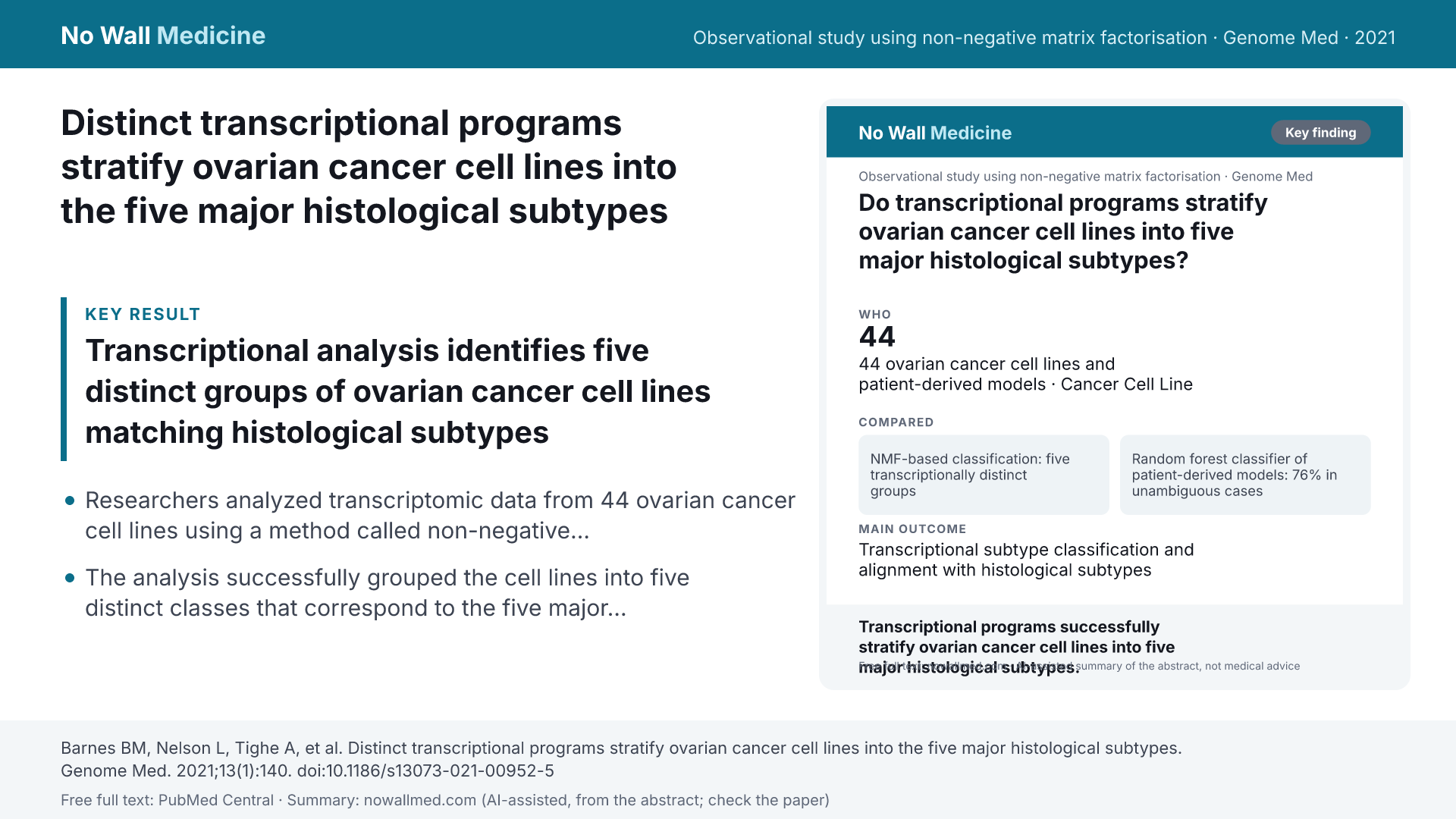
Transcriptional analysis identifies five distinct groups of ovarian cancer cell lines matching histological subtypes
Distinct transcriptional programs stratify ovarian cancer cell lines into the five major histological subtypes
Observational study using non-negative matrix factorisationBenefit found
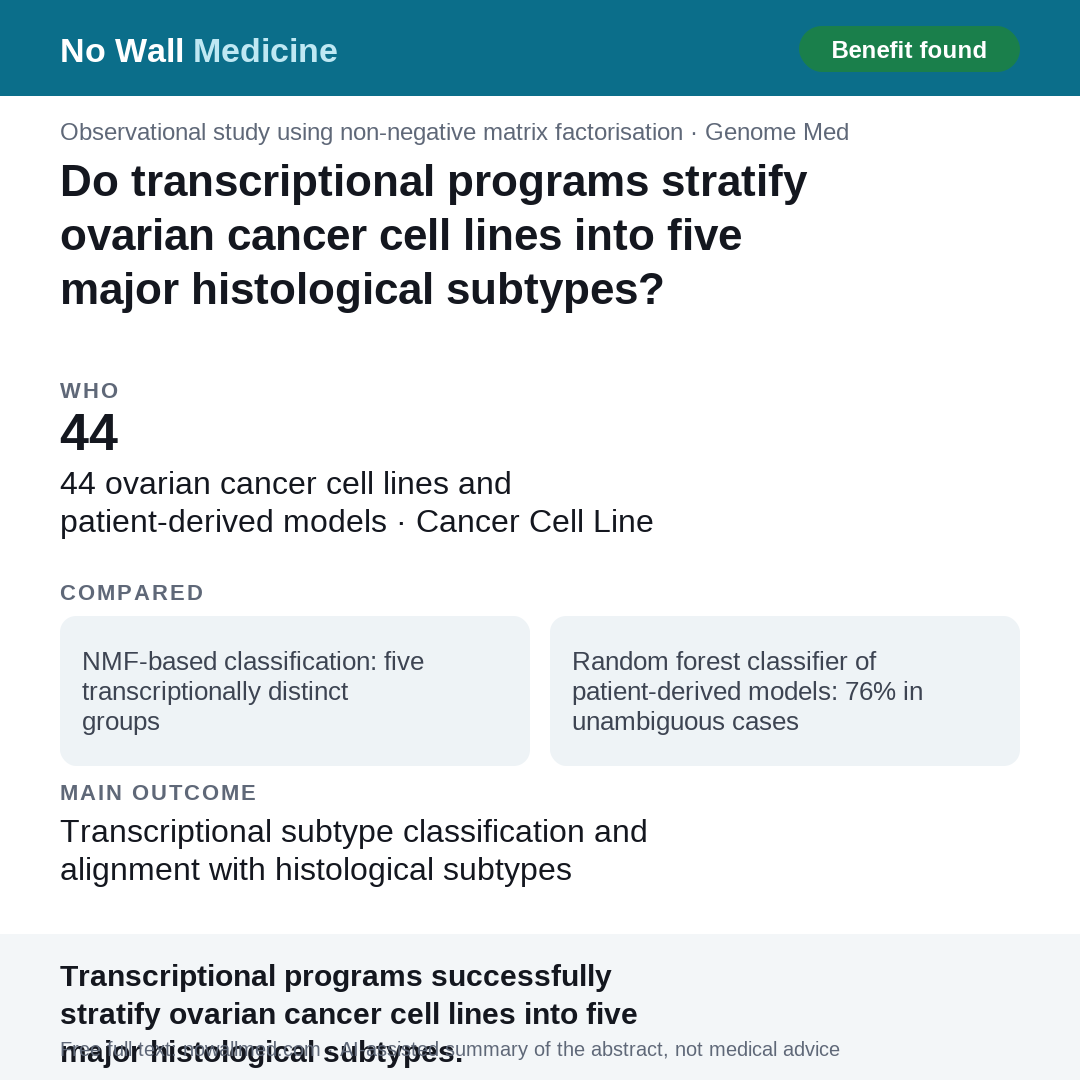
Do transcriptional programs stratify ovarian cancer cell lines into five major histological subtypes?
Who
44
44 ovarian cancer cell lines and patient-derived models · Cancer Cell Line Encyclopedia
Compared
NMF-based classification: five transcriptionally distinct groups
Random forest classifier of patient-derived models: 76% in unambiguous cases
Main outcome
Transcriptional subtype classification and alignment with histological subtypes
Bottom line: Transcriptional programs successfully stratify ovarian cancer cell lines into five major histological subtypes.
Limitation: Requires further refinement on larger training cohorts.
Genome Med · 2021-09-01Download image
Clinical question: Do transcriptional programs stratify ovarian cancer cell lines into five major histological subtypes?
Why it matters: Existing ovarian cancer cell lines may not be molecularly representative of high-grade serous ovarian cancer, which is the most common subtype.
Key points
- Researchers analyzed transcriptomic data from 44 ovarian cancer cell lines using a method called non-negative matrix factorization to group them by gene expression.
- The analysis successfully grouped the cell lines into five distinct classes that correspond to the five major histological subtypes of epithelial ovarian cancer.
- A machine learning classifier predicted the subtype of patient-derived models with 76% accuracy in unambiguous cases.
Headline and key points written with AI from the paper’s abstract, with every number checked against it. Read the paper before relying on them.
Was this summary helpful?
Subject terms
Cite this article
Barnes BM, Nelson L, Tighe A, et al. Distinct transcriptional programs stratify ovarian cancer cell lines into the five major histological subtypes. Genome Med. 2021. doi:10.1186/s13073-021-00952-5
Spotted a mistake? Suggest a correction