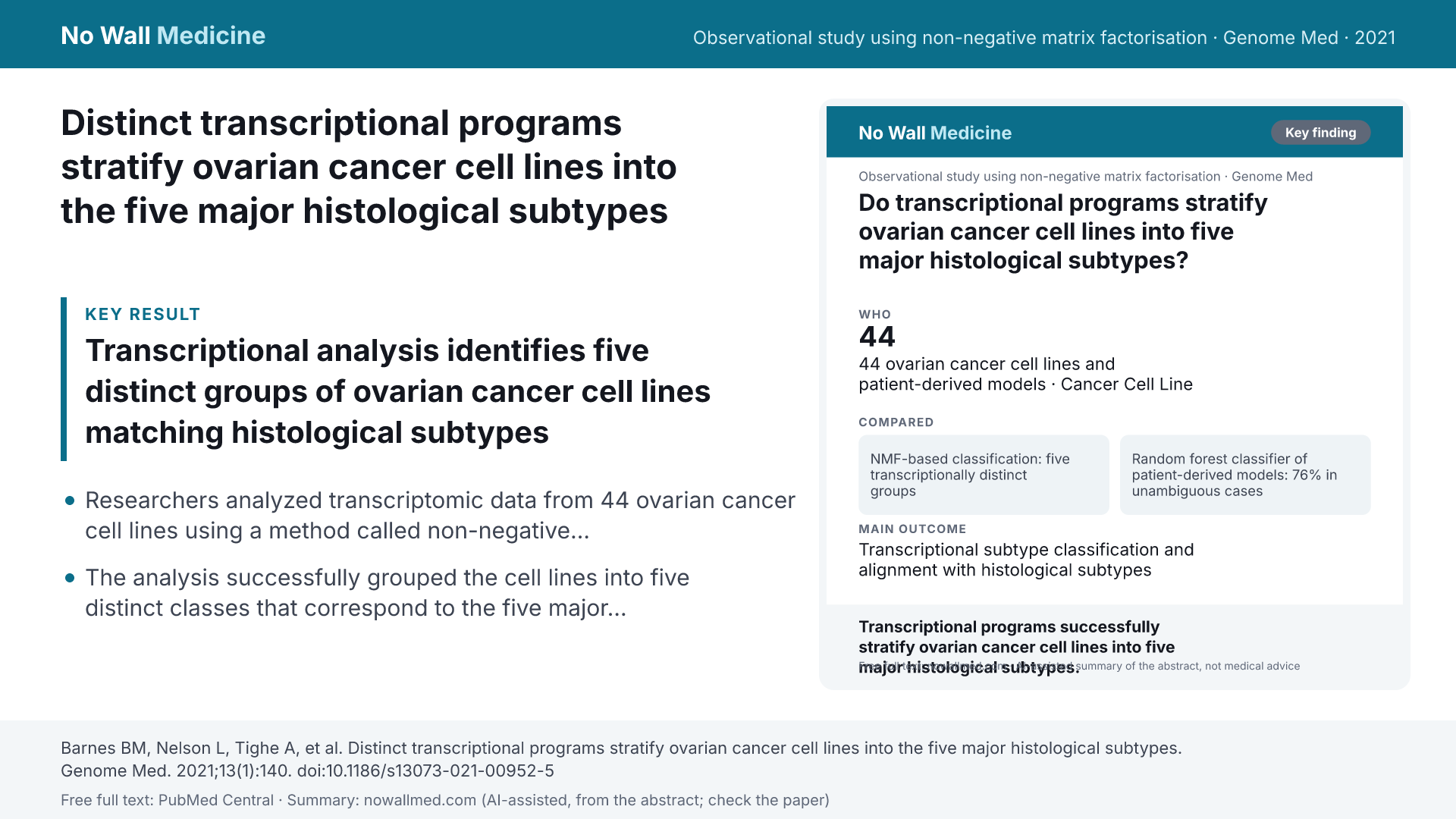
Distinct transcriptional programs stratify ovarian cancer cell lines into the five major histological subtypes
Key result: Transcriptional analysis identifies five distinct groups of ovarian cancer cell lines matching histological subtypes
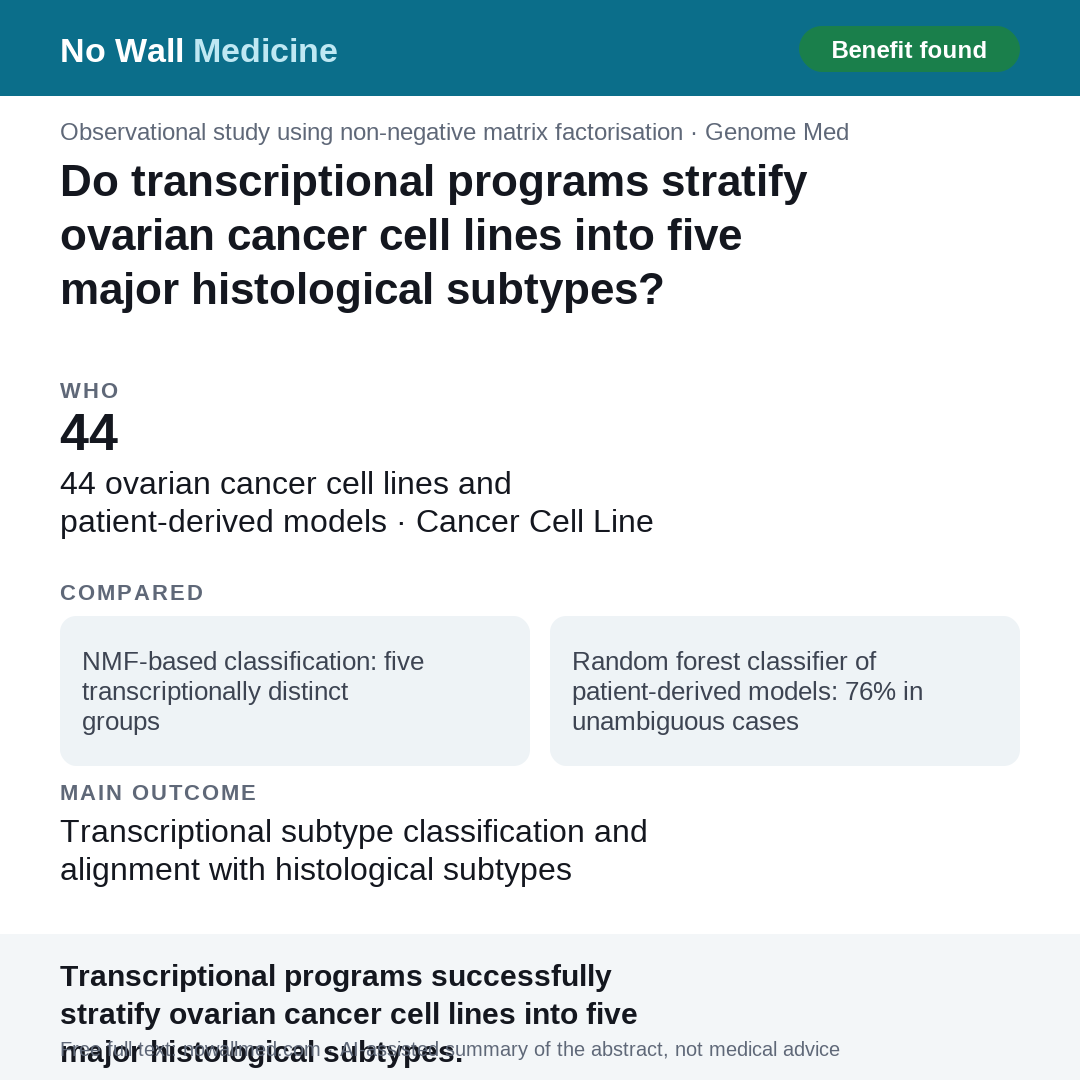
Observational study using non-negative matrix factorisationBenefit found
Do transcriptional programs stratify ovarian cancer cell lines into five major histological subtypes?
Who
44
44 ovarian cancer cell lines and patient-derived models · Cancer Cell Line Encyclopedia
Compared
NMF-based classification: five transcriptionally distinct groups
Random forest classifier of patient-derived models: 76% in unambiguous cases
Main outcome
Transcriptional subtype classification and alignment with histological subtypes
Bottom line: Transcriptional programs successfully stratify ovarian cancer cell lines into five major histological subtypes.
Limitation: Requires further refinement on larger training cohorts.
Genome Med · 2021-09-01Download image
Key points
- Researchers analyzed transcriptomic data from 44 ovarian cancer cell lines using a method called non-negative matrix factorization to group them by gene expression.
- The analysis successfully grouped the cell lines into five distinct classes that correspond to the five major histological subtypes of epithelial ovarian cancer.
- A machine learning classifier predicted the subtype of patient-derived models with 76% accuracy in unambiguous cases.
Why it matters: Existing ovarian cancer cell lines may not be molecularly representative of high-grade serous ovarian cancer, which is the most common subtype.
Discussion prompts
- Would these patients look like yours? Who was left out?
- Is the main outcome one that matters to patients?
- Is the difference large enough to change what you do?
Cite: Barnes BM, Nelson L, Tighe A, et al. Distinct transcriptional programs stratify ovarian cancer cell lines into the five major histological subtypes. Genome Med. 2021. doi:10.1186/s13073-021-00952-5
Free full text: PubMed Central · Summary and visual abstract: nowallmed.com/a/distinct-transcriptional-programs-stratify-ovarian-cancer-cell-lines-1lielr1/ (AI-assisted from the abstract; check the paper before relying on it).