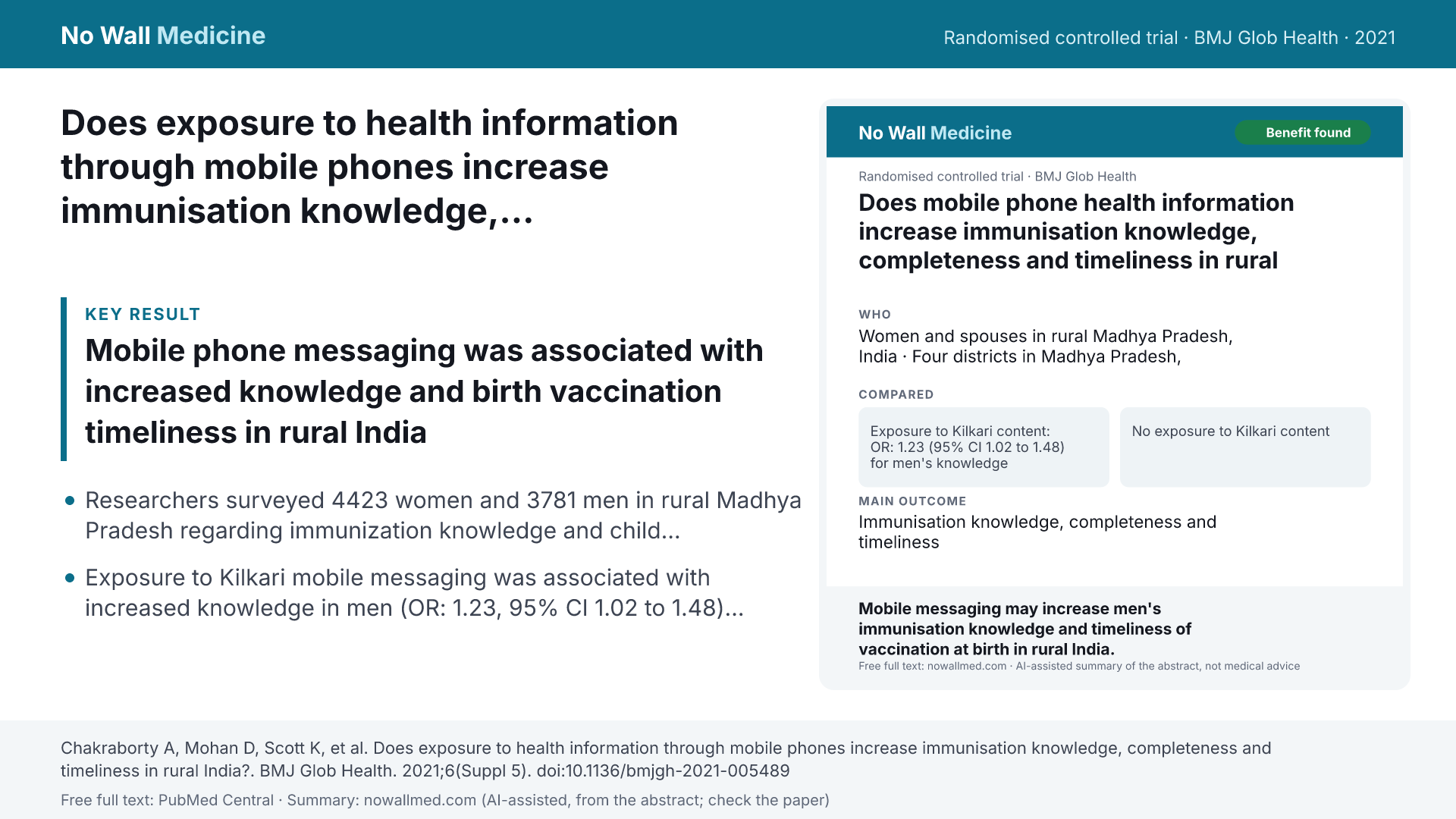
Mobile phone messaging was associated with increased knowledge and birth vaccination timeliness in rural India
Does exposure to health information through mobile phones increase immunisation knowledge, completeness and timeliness in rural India?
Randomised controlled trialBenefit found
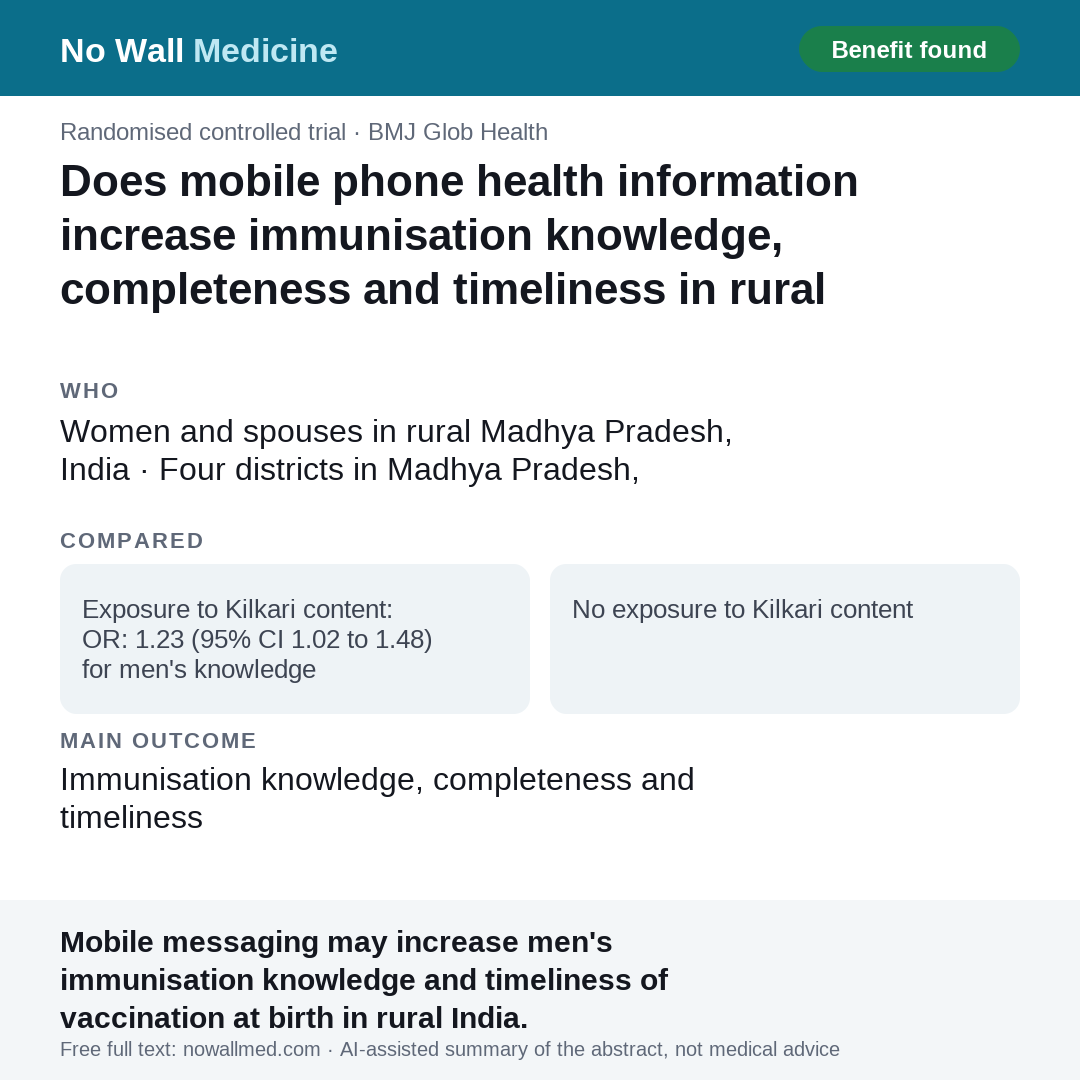
Does mobile phone health information increase immunisation knowledge, completeness and timeliness in rural India?
Who
Women and spouses in rural Madhya Pradesh, India · Four districts in Madhya Pradesh, India
Compared
Exposure to Kilkari content: OR: 1.23 (95% CI 1.02 to 1.48) for men's knowledge
No exposure to Kilkari content
Main outcome
Immunisation knowledge, completeness and timeliness
Result: OR: 1.23 (95% CI 1.02 to 1.48)
Bottom line: Mobile messaging may increase men's immunisation knowledge and timeliness of vaccination at birth in rural India.
BMJ Glob Health · 2021-07-27Download image
Clinical question: Does mobile phone health information increase immunisation knowledge, completeness and timeliness in rural India?
Why it matters: It was unknown if mobile phone messaging programs could address gaps in immunization knowledge, completeness, and timeliness in rural India.
Key points
- Researchers surveyed 4423 women and 3781 men in rural Madhya Pradesh regarding immunization knowledge and child vaccination status.
- Exposure to Kilkari mobile messaging was associated with increased knowledge in men (OR: 1.23, 95% CI 1.02 to 1.48) and increased timeliness of birth vaccinations.
- Only 33% of parents knew vaccination timing and benefits, while 47% of children received the basic 8-vaccine package and 44% received the 19-vaccine package.
Headline and key points written with AI from the paper’s abstract, with every number checked against it. Read the paper before relying on them.
Was this summary helpful?
Abstract
Introduction
Immunisation plays a vital role in reducing child mortality and morbidity against preventable diseases. As part of a randomised controlled trial in rural Madhya Pradesh, India to assess the impact of Kilkari, a maternal messaging programme, we explored determinants of parental immunisation knowledge and immunisation practice (completeness and timeliness) for children 0-12 months of age from four districts in Madhya Pradesh. Methods
Data were drawn from a cross-sectional survey of women (n=4423) with access to a mobile phone and their spouses (n=3781). Parental knowledge about immunisation and their child's receipt of vaccines, including timeliness and completeness, was assessed using self-reports and vaccination cards. Ordered logistic regressions were used to analyse the factors associated with parental immunisation knowledge. A Heckman two-stage probit model was used to analyse completeness and timeliness of immunisation after correcting for selection bias from being able to produce the immunisation card. Results
One-third (33%) of women and men knew the timing for the start of vaccinations, diseases linked to immunisations and the benefits of Vitamin-A. Less than half of children had received the basic package of 8 vaccines (47%) and the comprehensive package of 19 vaccines (44%). Wealth was the most significant determinant of men's knowledge and of the child receiving complete and timely immunisation for both basic and comprehensive packages. Exposure to Kilkari content on immunisation was significantly associated with an increase in men's knowledge (but not women's) about child immunisation (OR: 1.23, 95% CI 1.02 to1.48) and an increase in the timeliness of the child receiving vaccination at birth (Probit coefficient: 0.08, 95% CI 0.08 to 0.24). Conclusion
Gaps in complete and timely immunisation for infants persist in rural India. Mobile messaging programmes, supported by mass media messages, may provide one important source for bolstering awareness, uptake and timeliness of immunisation services. Trial registration number
NCT03576157.
Abstract reproduced under the article’s CC BY NC licence.
Subject terms
Cite this article
Chakraborty A, Mohan D, Scott K, et al. Does exposure to health information through mobile phones increase immunisation knowledge, completeness and timeliness in rural India?. BMJ Glob Health. 2021. doi:10.1136/bmjgh-2021-005489
Spotted a mistake? Suggest a correction