Does frailty status predict outcome in major trauma in older people? A systematic review and meta-analysis
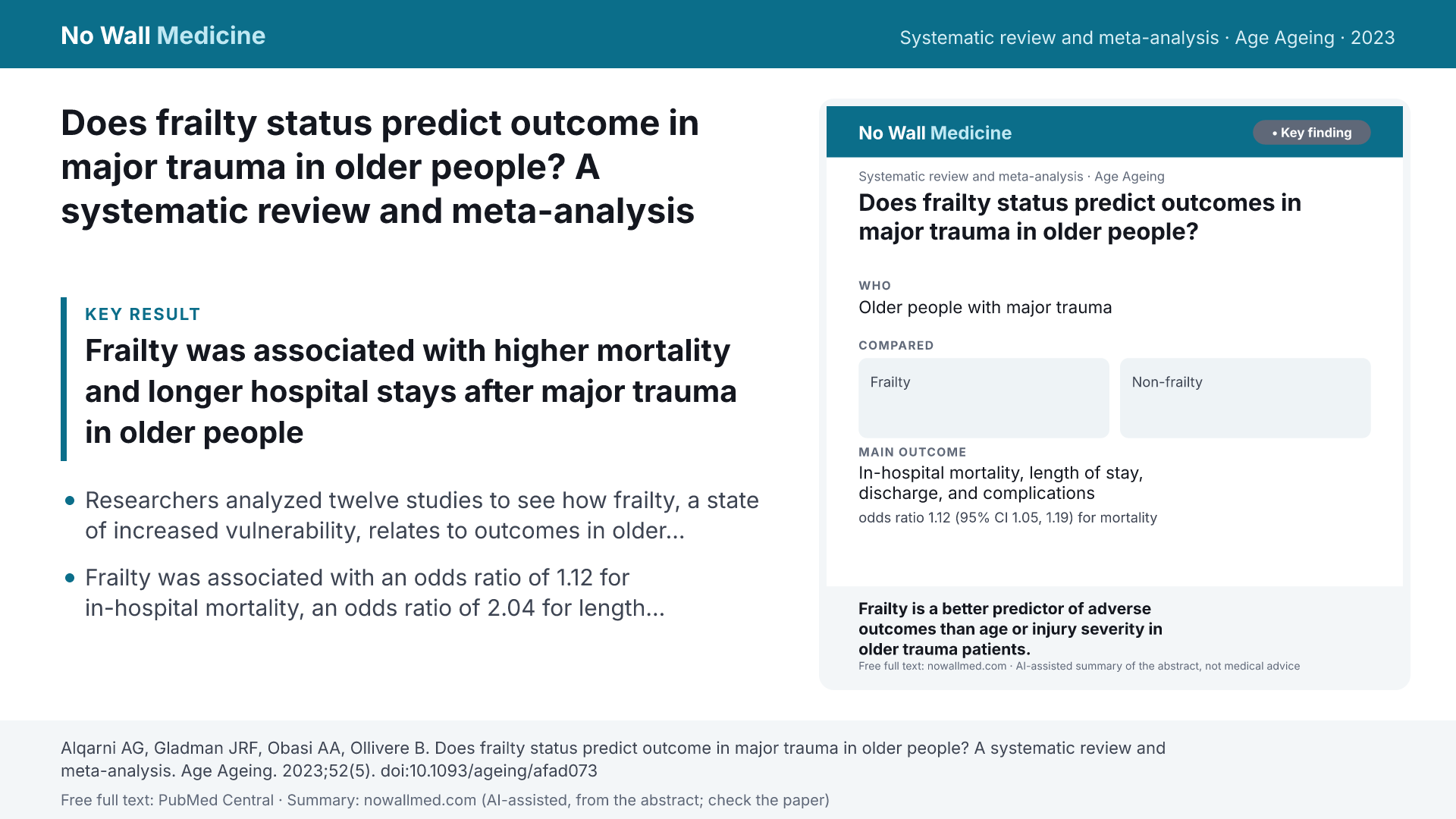
Key result: Frailty was associated with higher mortality and longer hospital stays after major trauma in older people
Systematic review and meta-analysisKey finding
Does frailty status predict outcomes in major trauma in older people?
Who
Older people with major trauma
Compared
Frailty
Non-frailty
Main outcome
In-hospital mortality, length of stay, discharge, and complications
Result: odds ratio 1.12 (95% CI 1.05, 1.19) for mortality
Bottom line: Frailty is a better predictor of adverse outcomes than age or injury severity in older trauma patients.
Age Ageing · 2023-05-29
Key points
- Researchers analyzed twelve studies to see how frailty, a state of increased vulnerability, relates to outcomes in older people after major trauma.
- Frailty was associated with an odds ratio of 1.12 for in-hospital mortality, an odds ratio of 2.04 for length of stay, and an odds ratio of 1.17 for complications.
- In six studies using multivariate regression analysis, frailty was a more consistent predictor of mortality and adverse outcomes than age or injury severity.
Discussion prompts
- Would these patients look like yours? Who was left out?
- Is the main outcome one that matters to patients?
- Is the difference large enough to change what you do?
Cite: Alqarni AG, Gladman JRF, Obasi AA, Ollivere B. Does frailty status predict outcome in major trauma in older people? A systematic review and meta-analysis. Age Ageing. 2023;52(5). doi:10.1093/ageing/afad073
Free full text: PubMed Central · Summary and visual abstract: nowallmed.com/a/does-frailty-status-predict-outcome-in-major-trauma-in-older-people-a-ef5pmq/ (AI-assisted from the abstract; check the paper before relying on it).