Routine spirometry use was associated with more clinical decision changes in children with respiratory issues
Does routine spirometry impact on clinical decisions and patient-related outcome measures of children seen in respiratory clinics: an open-label randomised controlled trial
Parallel open-label randomised controlled trialBenefit found
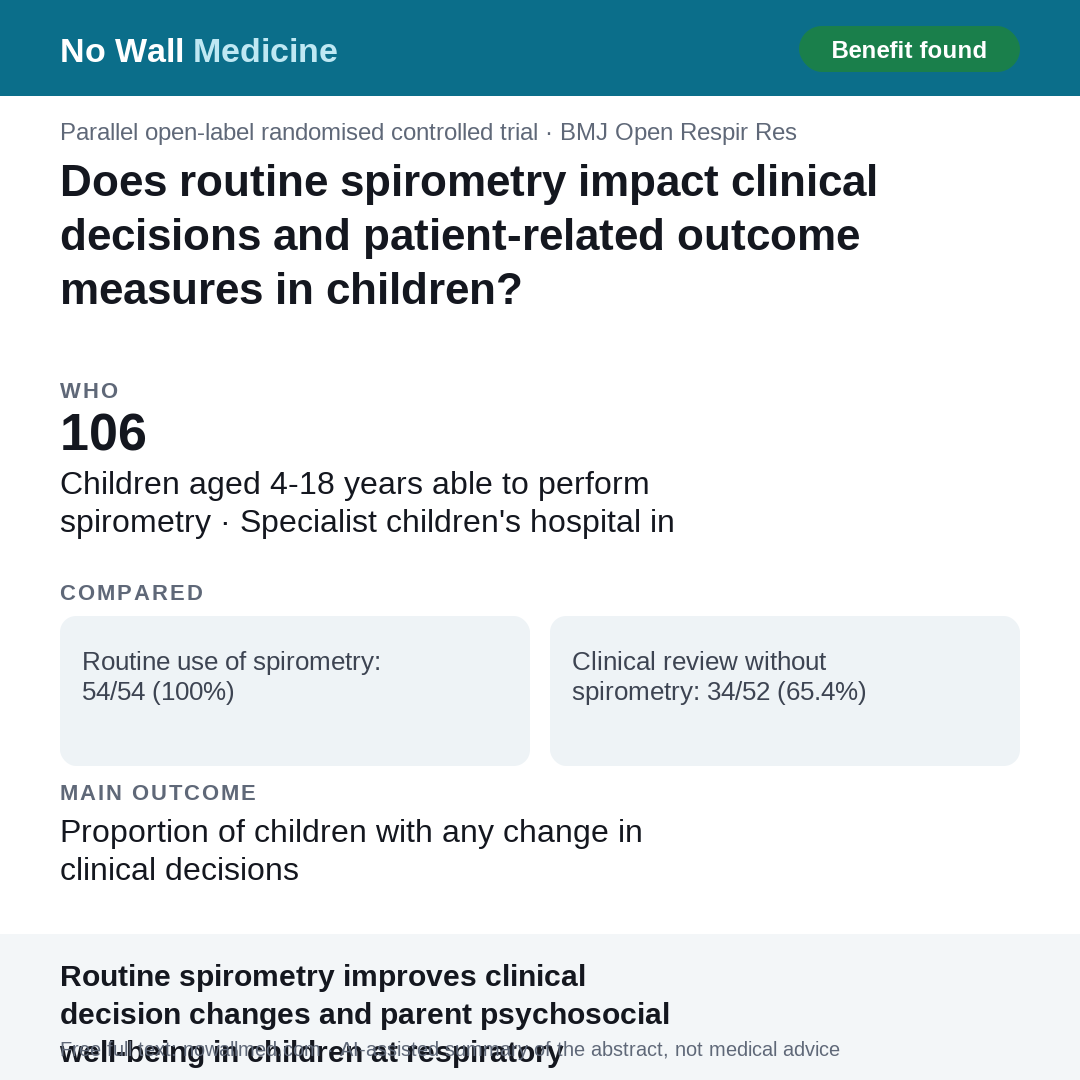
Does routine spirometry impact clinical decisions and patient-related outcome measures in children?
Who
106
Children aged 4-18 years able to perform spirometry · Specialist children's hospital in Australia
Compared
Routine use of spirometry: 54/54 (100%)
Clinical review without spirometry: 34/52 (65.4%)
Main outcome
Proportion of children with any change in clinical decisions
Bottom line: Routine spirometry improves clinical decision changes and parent psychosocial well-being in children at respiratory clinics.
BMJ Open Respir Res · 2023-05-12Download image
Clinical question: Does routine spirometry impact clinical decisions and patient-related outcome measures in children?
Why it matters: It is unknown if using spirometry, a test that measures how much air a person can inhale and exhale, routinely improves clinical decisions and patient outcomes in pediatric respiratory care.
Key points
- Researchers conducted a randomized controlled trial with 106 children aged 4-18 years to compare routine spirometry use against clinical review without spirometry.
- The group receiving routine spirometry had a higher proportion of clinical decision changes at 100% compared to 65.4% in the control group.
- Routine spirometry was associated with greater improvements in anxiety scores and social domain quality of life scores for parents.
Headline and key points written with AI from the paper’s abstract, with every number checked against it. Read the paper before relying on them.
Abstract
Introduction
There is limited evidence on the efficacy of using spirometry routinely in paediatric practice for improving outcomes. Objective
To determine whether the routine use of spirometry alters clinical decisions and patient-related outcome measures for children managed by respiratory paediatricians. Methods
We undertook a parallel open-label randomised controlled trial involving children (aged 4-18 years) able to perform spirometry in a specialist children's hospital in Australia. Children were randomised to either routine use of spirometry (intervention) or clinical review without use of spirometry (control) for one clinic visit. The primary outcomes were the (a) proportion of children with 'any change in clinical decisions' and (b) 'change score' in clinical decisions. Secondary outcomes were change in patient-related outcome measures assessed by State-Trait Anxiety Inventory (STAI) and Parent-Proxy QoL questionnaire for paediatric chronic cough (PC-QoL). Results
Of 136 eligible children, 106 were randomised. Compared with controls, the intervention group had significantly higher proportion of children with 'any change in clinical decisions' (n=54/54 (100%) vs n=34/52 (65.4%), p<0.001) and higher clinical decision 'change score' (median=2 (IQR 1-4) vs 1 (0-2), p<0.001). Also, improvement was significantly greater in the intervention group for overall STAI score (median=-5 (IQR -10 to -2) vs -2.5 (-8.5, 0), p=0.021) and PC-QoL social domain (median=3 (IQR 0 to 5) vs 0 (-1, 1), p=0.017). Conclusion
The routine use of spirometry in children evaluated for respiratory issues at clinical outpatient review is beneficial for optimising clinical management and improving parent psychosocial well-being. Registration
Australia and New Zealand Clinical Trials Registry ACTRN12619001686190.
Abstract reproduced under the article’s CC BY NC licence.
Topics
Cite this article
Boonjindasup W, Marchant JM, McElrea MS, Yerkovich ST, Masters IB, Chang AB. Does routine spirometry impact on clinical decisions and patient-related outcome measures of children seen in respiratory clinics: an open-label randomised controlled trial. BMJ Open Respir Res. 2023. doi:10.1136/bmjresp-2022-001402
Spotted a mistake? Suggest a correction
Top studies every Monday
The week’s key trials and guidelines in your specialties, plus any topics you follow. By email, free.
Get the weekly digest