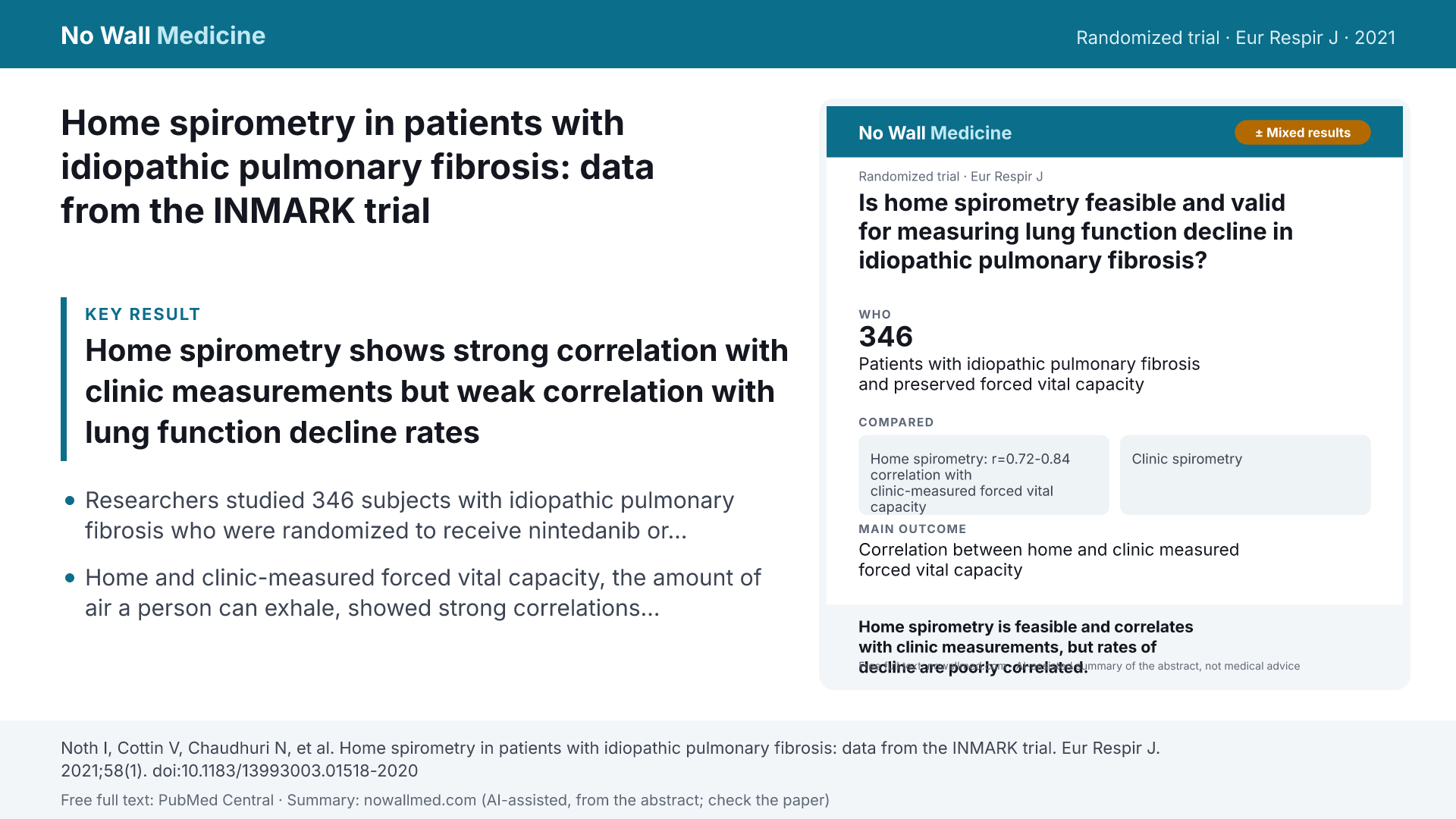
Home spirometry shows strong correlation with clinic measurements but weak correlation with lung function decline rates
Home spirometry in patients with idiopathic pulmonary fibrosis: data from the INMARK trial
Randomized trialMixed results
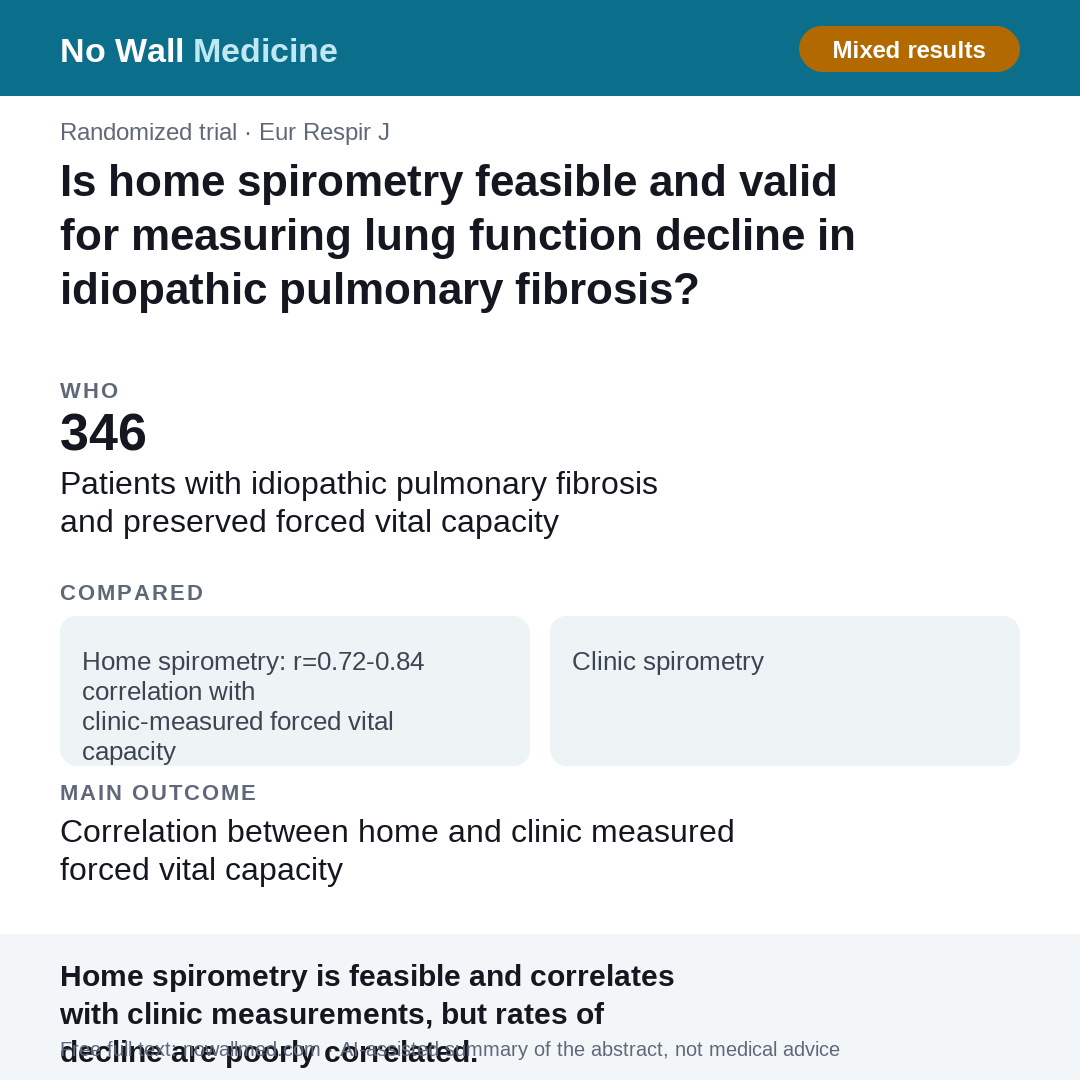
Is home spirometry feasible and valid for measuring lung function decline in idiopathic pulmonary fibrosis?
Who
346
Patients with idiopathic pulmonary fibrosis and preserved forced vital capacity
Compared
Home spirometry: r=0.72-0.84 correlation with clinic-measured forced vital capacity
Clinic spirometry
Main outcome
Correlation between home and clinic measured forced vital capacity
Result: r=0.26 for rate of decline in forced vital capacity over 52 weeks
Bottom line: Home spirometry is feasible and correlates with clinic measurements, but rates of decline are poorly correlated.
Eur Respir J · 2021-07-08Download image
Clinical question: Is home spirometry feasible and valid for measuring lung function decline in idiopathic pulmonary fibrosis?
Why it matters: It was unknown if home spirometry, a way to measure lung function at home, is a valid way to track how lung function declines in patients with idiopathic pulmonary fibrosis.
Key points
- Researchers studied 346 subjects with idiopathic pulmonary fibrosis who were randomized to receive nintedanib or a placebo.
- Home and clinic-measured forced vital capacity, the amount of air a person can exhale, showed strong correlations of r=0.72-0.84 at all time-points.
- The correlation between home and clinic measurements for the rate of decline in forced vital capacity over 52 weeks was weak at r=0.26.
Headline and key points written with AI from the paper’s abstract, with every number checked against it. Read the paper before relying on them.
Was this summary helpful?
Subject terms
Cite this article
Noth I, Cottin V, Chaudhuri N, Corte TJ, Johannson KA, Wijsenbeek M. Home spirometry in patients with idiopathic pulmonary fibrosis: data from the INMARK trial. Eur Respir J. 2021. doi:10.1183/13993003.01518-2020
Spotted a mistake? Suggest a correction
Top studies every Monday
The week’s key trials and guidelines in your specialties, plus any topics you follow. By email, free.
Get the weekly digest