Home spirometry in patients with idiopathic pulmonary fibrosis: data from the INMARK trial
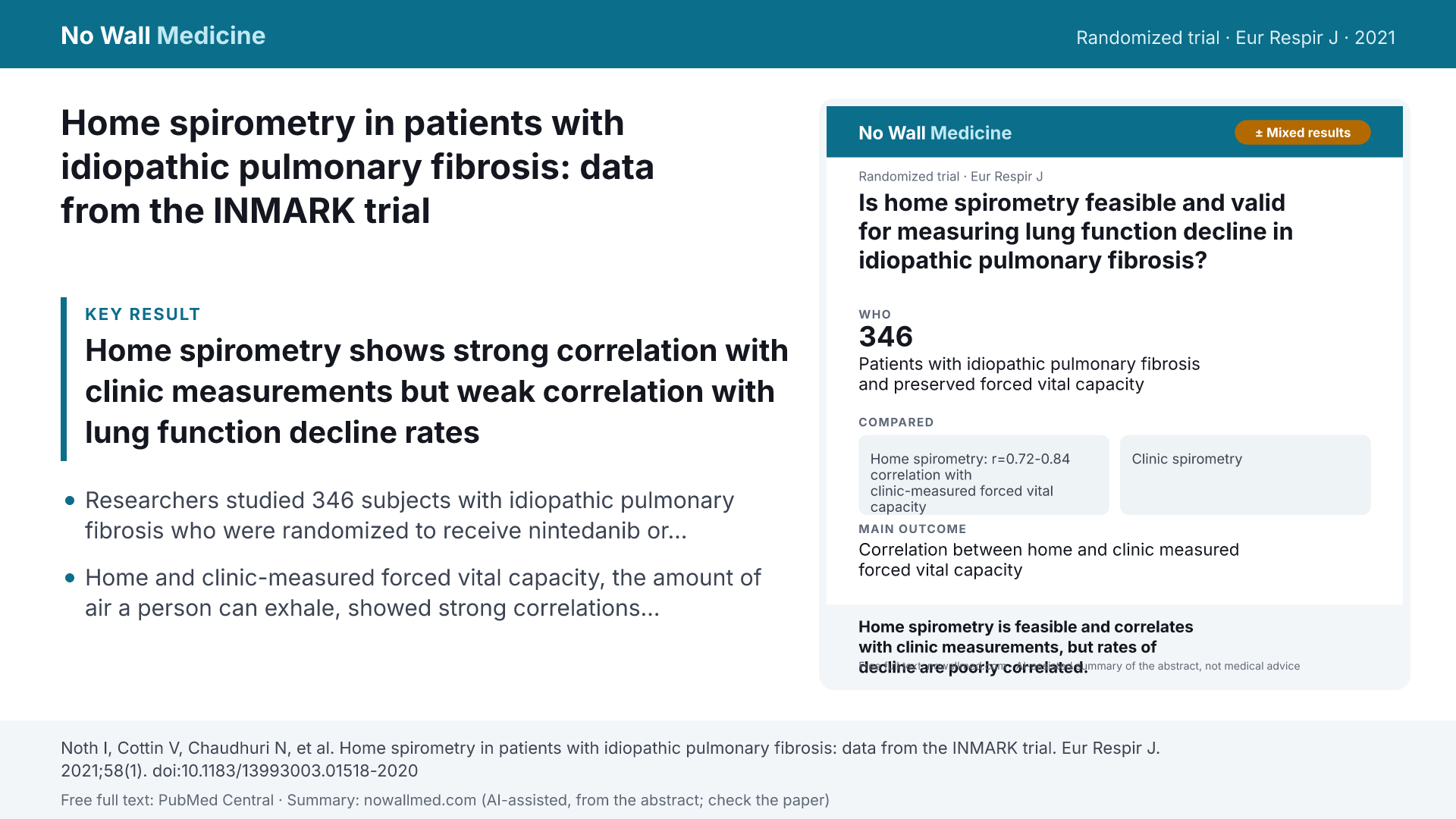
Key result: Home spirometry shows strong correlation with clinic measurements but weak correlation with lung function decline rates
Randomized trialMixed results
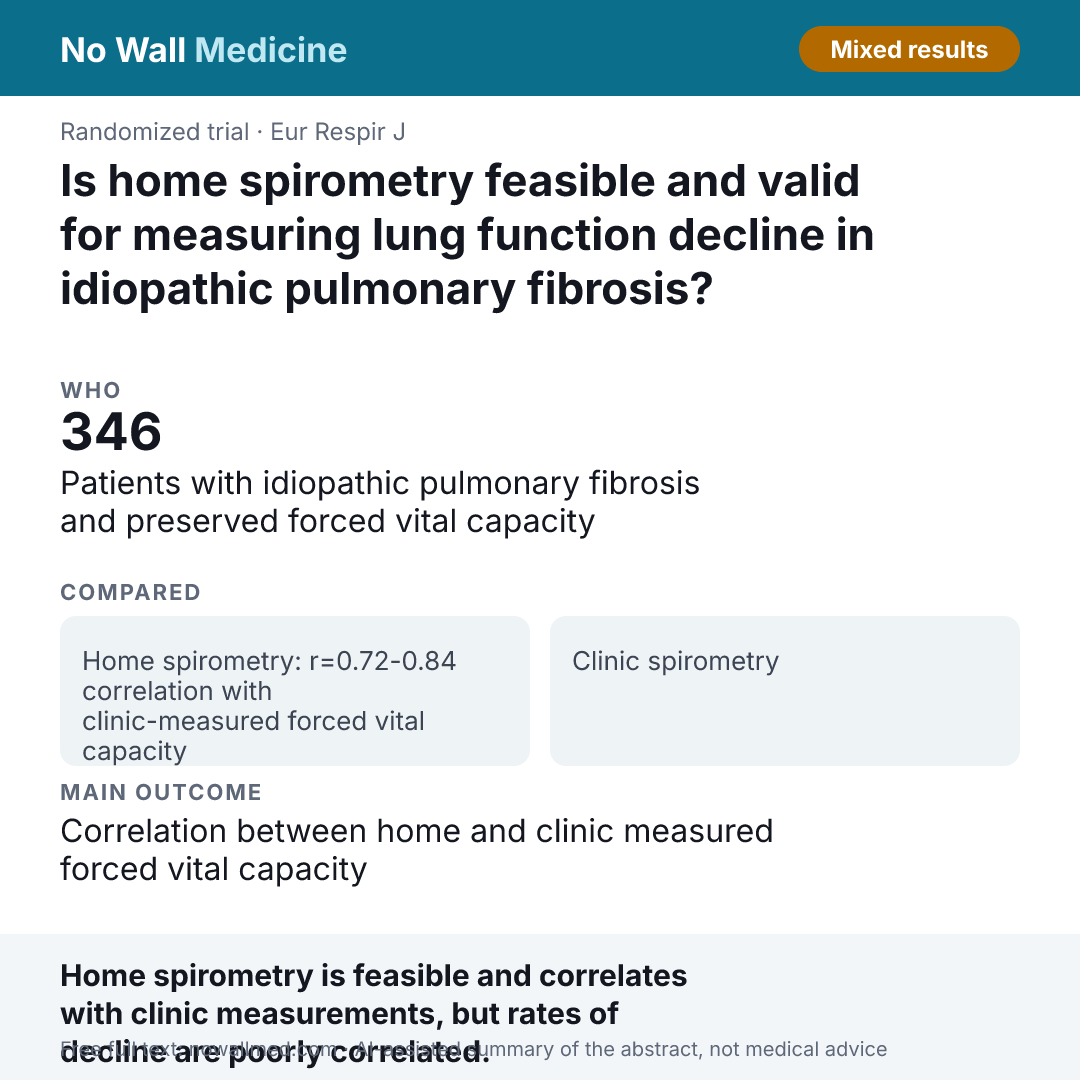
Is home spirometry feasible and valid for measuring lung function decline in idiopathic pulmonary fibrosis?
Who
346
Patients with idiopathic pulmonary fibrosis and preserved forced vital capacity
Compared
Home spirometry: r=0.72-0.84 correlation with clinic-measured forced vital capacity
Clinic spirometry
Main outcome
Correlation between home and clinic measured forced vital capacity
Result: r=0.26 for rate of decline in forced vital capacity over 52 weeks
Bottom line: Home spirometry is feasible and correlates with clinic measurements, but rates of decline are poorly correlated.
Eur Respir J · 2021-07-08 · Save PNG
Key points
- Researchers studied 346 subjects with idiopathic pulmonary fibrosis who were randomized to receive nintedanib or a placebo.
- Home and clinic-measured forced vital capacity, the amount of air a person can exhale, showed strong correlations of r=0.72-0.84 at all time-points.
- The correlation between home and clinic measurements for the rate of decline in forced vital capacity over 52 weeks was weak at r=0.26.
Discussion prompts
- Would these patients look like yours? Who was left out?
- Is the main outcome one that matters to patients?
- Is the difference large enough to change what you do?
Cite: Noth I, Cottin V, Chaudhuri N, et al. Home spirometry in patients with idiopathic pulmonary fibrosis: data from the INMARK trial. Eur Respir J. 2021;58(1). doi:10.1183/13993003.01518-2020
Free full text: PubMed Central · Summary and visual abstract: nowallmed.com/a/home-spirometry-in-patients-with-idiopathic-pulmonary-fibrosis-data-1mgl8aa/ (AI-assisted from the abstract; check the paper before relying on it).