Sedentary behavior was linked to spinal pain in children but not to new pain onset
Does sedentary behaviour cause spinal pain in children and adolescents? A systematic review with meta-analysis
Systematic review with meta-analysisMixed results
Does sedentary behaviour cause spinal pain in children and adolescents?
Who
Children and adolescents aged 19 years or younger
Compared
Cross-sectional association: adjusted odds ratio 1.25 (95% CI 1.17 to 1.33)
Longitudinal risk of onset: adjusted risk ratio 1.07 (95% CI 0.84 to 1.35)
Main outcome
Spinal pain association, onset risk, and prognosis
Result: adjusted risk ratio 1.07 (95% CI 0.84 to 1.35)
Bottom line: Sedentary behaviour shows a small association with spinal pain cross-sectionally but does not increase onset risk longitudinally.
Limitation: Low certainty of evidence and no studies assessed spinal pain prognosis.
Br J Sports Med · 2025-03-03Download image
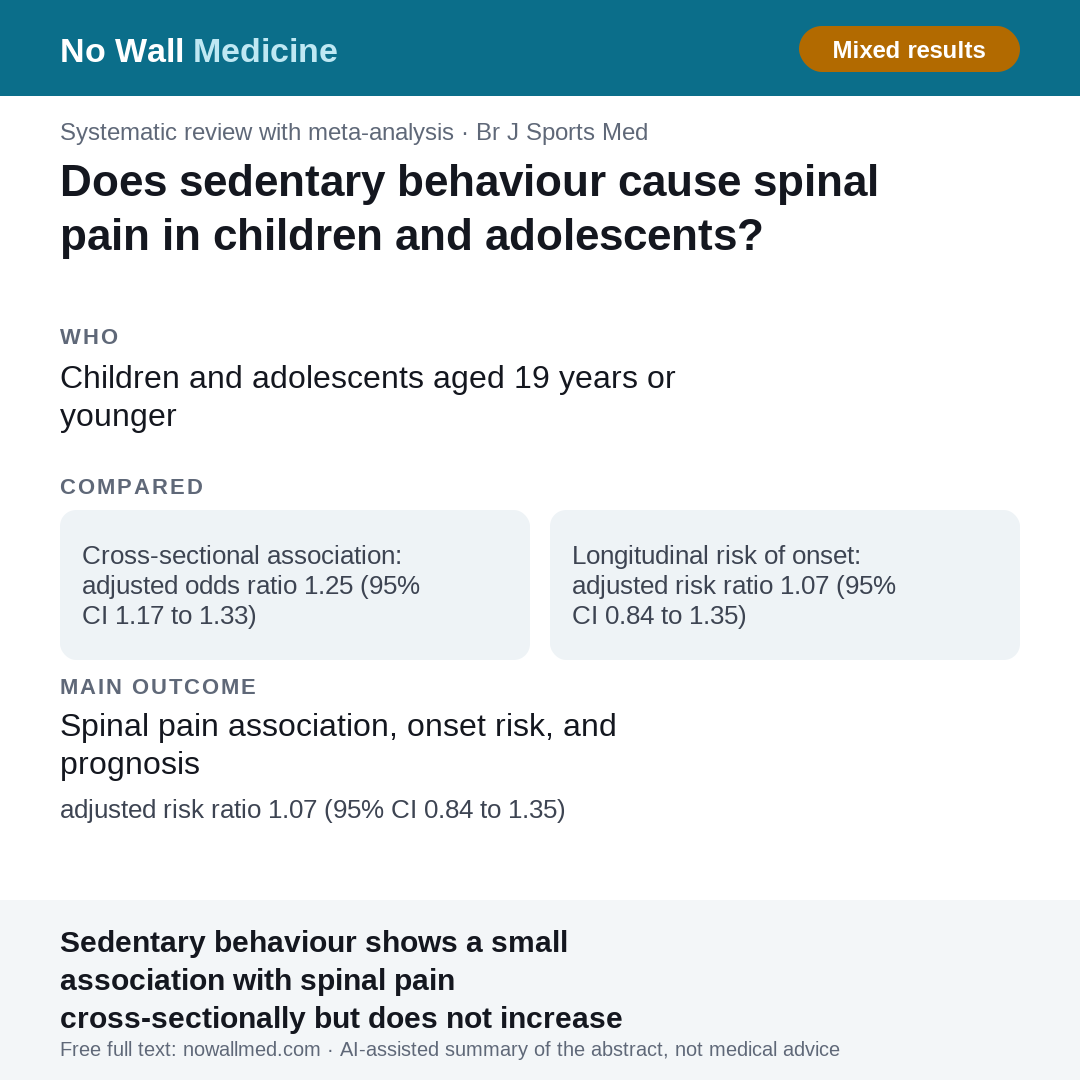
Clinical question: Does sedentary behaviour cause spinal pain in children and adolescents?
Why it matters: It is unknown if sedentary behavior acts as a risk factor for the onset of spinal pain or how it affects the prognosis of spinal pain in young people.
Key points
- Researchers analyzed 129 reports involving 8,433 participants in longitudinal studies and over 697,590 in cross-sectional studies comparing sedentary behavior and spinal pain.
- Cross-sectional data showed a small association between sedentary behavior and spinal pain with an adjusted odds ratio of 1.25 (95% CI 1.17 to 1.33).
- Longitudinal data showed no increased risk for the onset of spinal pain from sedentary behavior with an adjusted risk ratio of 1.07 (95% CI 0.84 to 1.35).
Limitation the authors note: The authors state that the findings must be interpreted with caution due to the low certainty of evidence.
Headline and key points written with AI from the paper’s abstract, with every number checked against it. Read the paper before relying on them.
Was this summary helpful?
Abstract
Objective
To evaluate whether sedentary behaviour is a risk or prognostic factor for spinal pain in children and adolescents. Specifically, to estimate the (1) direction and strength of the association; (2) risk of spinal pain onset and (3) effect on spinal pain prognosis. Design
Systematic review with meta-analysis. Data sources
Electronic searches of MEDLINE, Embase, CINAHL and Web of Science up to 23 March 2023. Eligibility criteria for selecting studies
Reports estimating the effect of sedentary behaviour on spinal pain in young people (≤19 years). Results
We included 129 reports, 14 were longitudinal (n = 8 433) and 115 were cross-sectional (n > 697 590). We incorporated 86 studies into meta-analyses. (1) From cross-sectional data, we found low certainty evidence of a small positive association between sedentary behaviour and spinal pain (adjusted odds ratio 1.25 (95% CI 1.17 to 1.33), k = 44, n > 92 617). (2) From longitudinal data, we found low certainty evidence of no increased risk for the onset of spinal pain due to sedentary behaviour (adjusted risk ratio 1.07 (95% CI 0.84 to 1.35), k = 4, n = 1 292). (3) No studies assessed prognosis. Conclusion
Cross-sectional data suggest minimally higher odds of spinal pain for children and adolescents who engage in greater sedentary behaviours. However, longitudinal data do not support a causal relationship, indicating that sedentary behaviour does not increase the risk for onset of spinal pain. Due to the low certainty of evidence, these findings must be interpreted with caution. We found no evidence of the effect sedentary behaviour has on spinal pain prognosis in children and adolescents, highlighting a considerable gap in the literature.
Abstract reproduced under the article’s CC BY NC licence.
Subject terms
Cite this article
Montgomery LRC, Swain M, Dario AB, O'Keeffe M, Yamato TP, Hartvigsen J. Does sedentary behaviour cause spinal pain in children and adolescents? A systematic review with meta-analysis. Br J Sports Med. 2025. doi:10.1136/bjsports-2024-108648
Spotted a mistake? Suggest a correction
Top studies every Monday
The week’s key trials and guidelines in your specialties, plus any topics you follow. By email, free.
Get the weekly digest