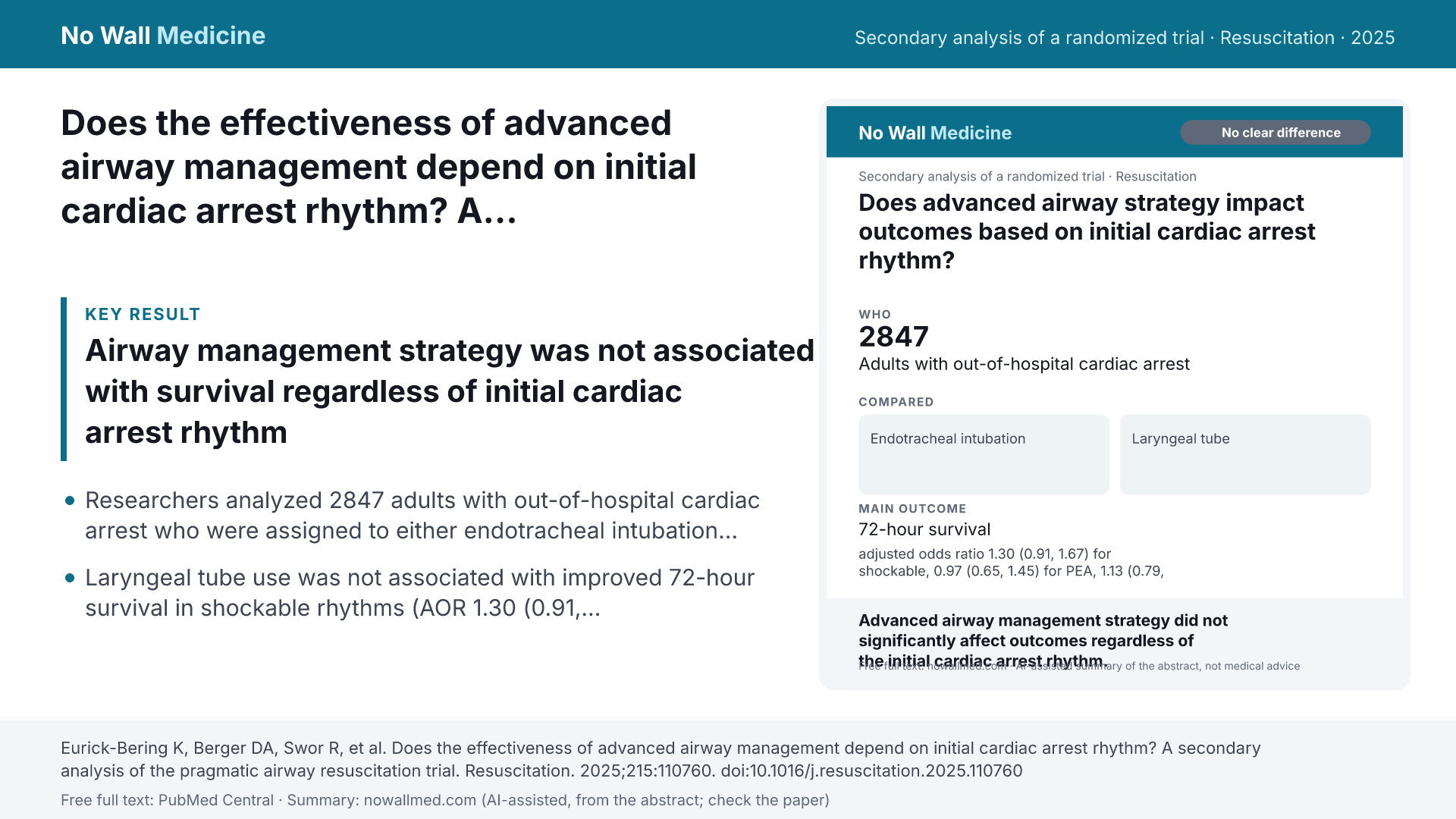
Does the effectiveness of advanced airway management depend on initial cardiac arrest rhythm? A secondary analysis of the pragmatic airway resuscitation trial
Key result: Airway management strategy was not associated with survival regardless of initial cardiac arrest rhythm
Key points
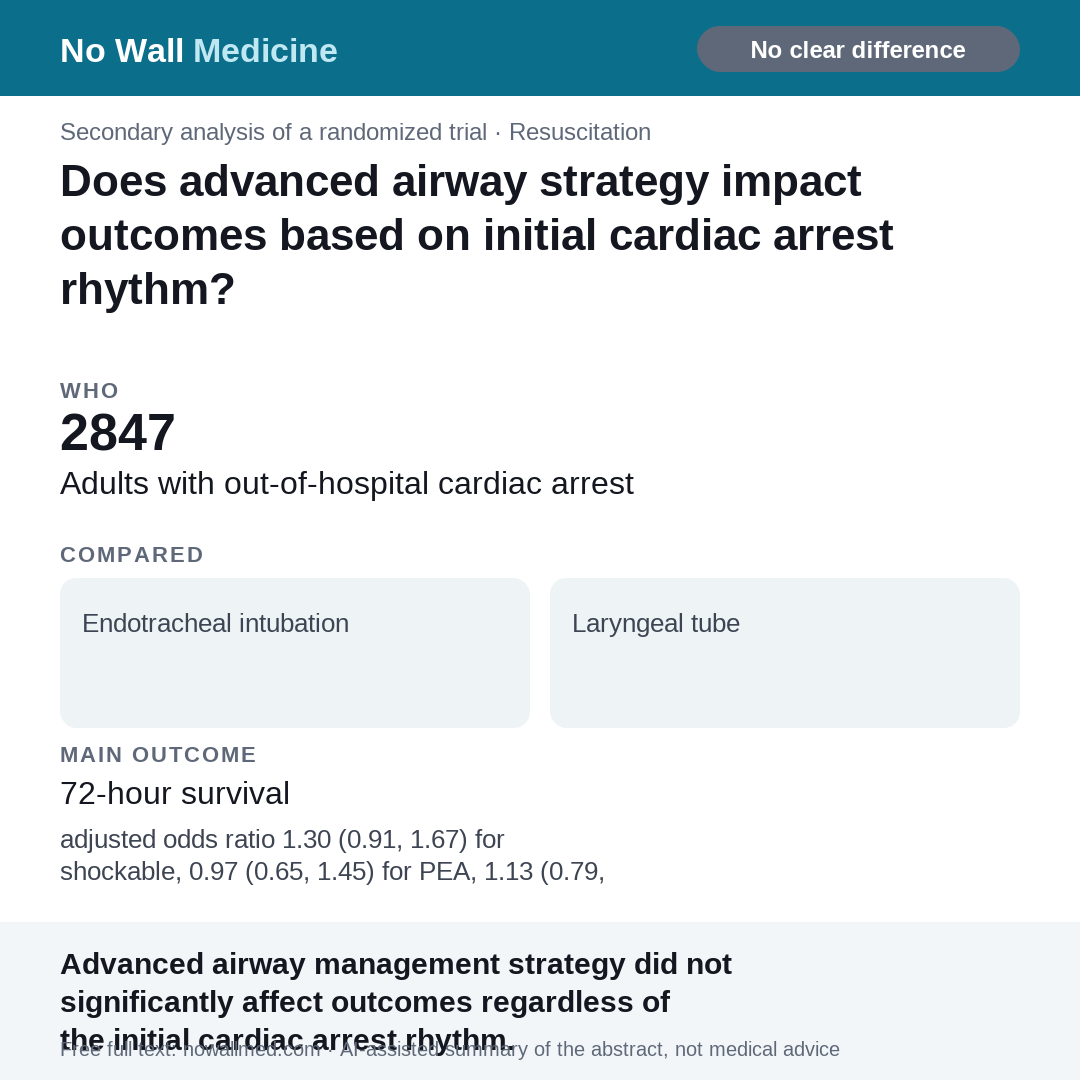
- Researchers analyzed 2847 adults with out-of-hospital cardiac arrest who were assigned to either endotracheal intubation or laryngeal tube placement.
- Laryngeal tube use was not associated with improved 72-hour survival in shockable rhythms (AOR 1.30 (0.91, 1.67)), pulseless electrical activity (AOR 0.97 (0.65, 1.45)), or asystole (AOR 1.13 (0.79, 1.64)).
- No significant interaction was found between airway strategy and initial rhythm for return of spontaneous circulation, survival to discharge, or survival with good neurological function.
Why it matters: The impact of advanced airway management and oxygen delivery based on different presenting cardiac rhythms is incompletely defined.
Discussion prompts
- Would these patients look like yours? Who was left out?
- Is the main outcome one that matters to patients?
- Is the difference large enough to change what you do?
Cite: Eurick-Bering K, Berger DA, Swor R, et al. Does the effectiveness of advanced airway management depend on initial cardiac arrest rhythm? A secondary analysis of the pragmatic airway resuscitation trial. Resuscitation. 2025. doi:10.1016/j.resuscitation.2025.110760
Free full text: PubMed Central · Summary and visual abstract: nowallmed.com/a/does-the-effectiveness-of-advanced-airway-management-depend-on-hi6yf8/ (AI-assisted from the abstract; check the paper before relying on it).