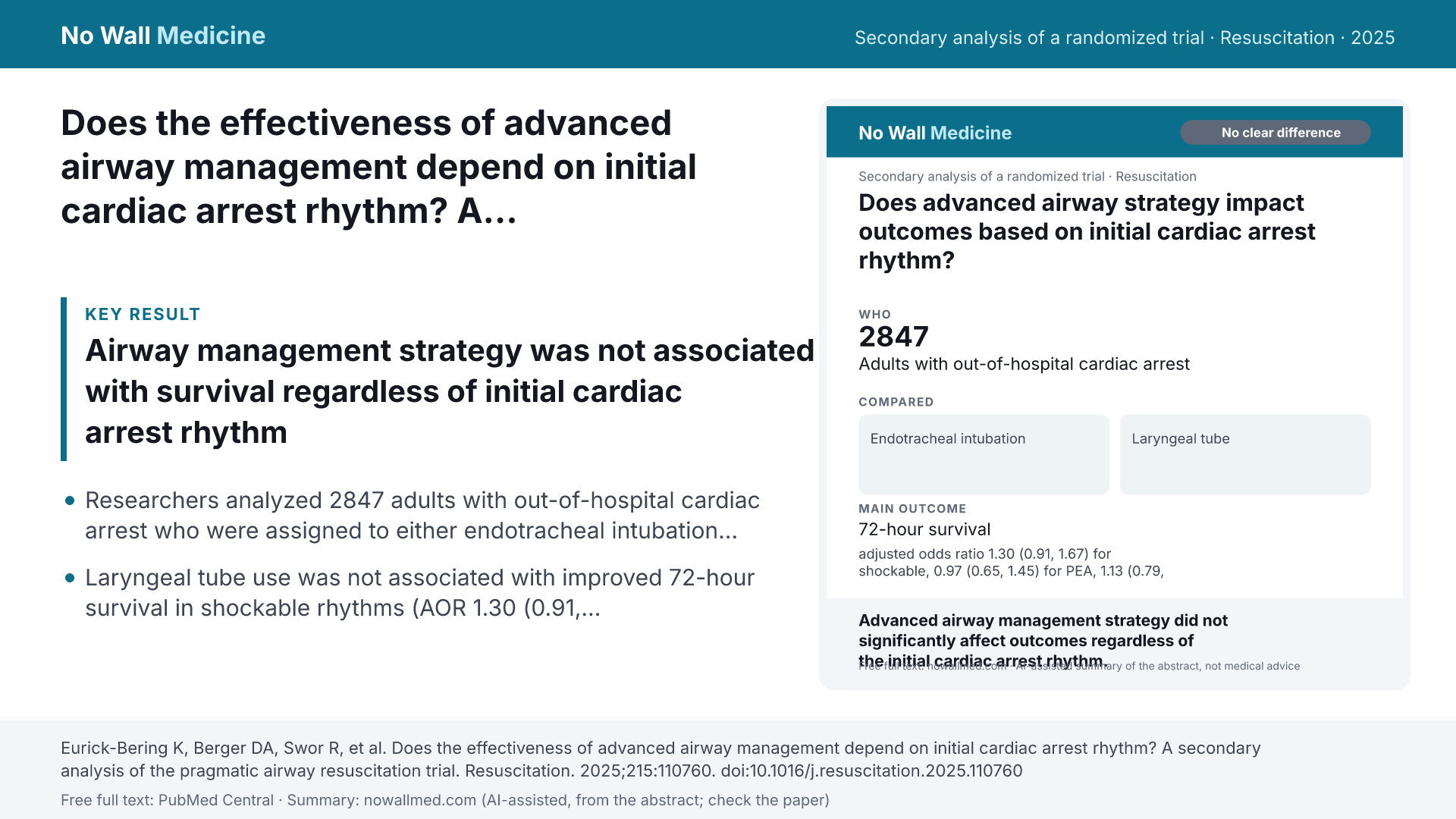
Airway management strategy was not associated with survival regardless of initial cardiac arrest rhythm
Does the effectiveness of advanced airway management depend on initial cardiac arrest rhythm? A secondary analysis of the pragmatic airway resuscitation trial
Secondary analysis of a randomized trialNo clear difference
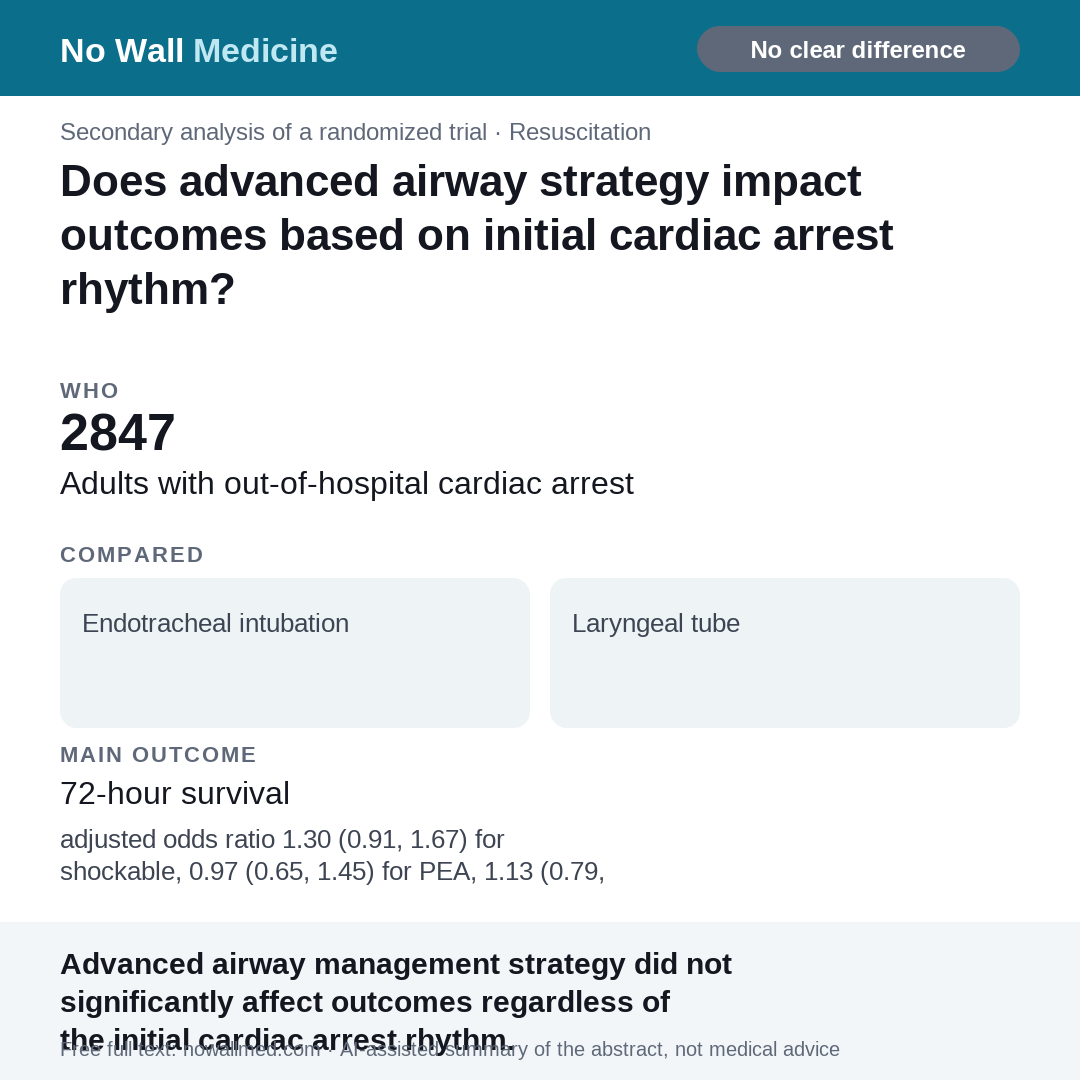
Does advanced airway strategy impact outcomes based on initial cardiac arrest rhythm?
Who
2847
Adults with out-of-hospital cardiac arrest
Compared
Endotracheal intubation
Laryngeal tube
Main outcome
72-hour survival
Result: adjusted odds ratio 1.30 (0.91, 1.67) for shockable, 0.97 (0.65, 1.45) for PEA, 1.13 (0.79, 1.64) for asystole
Bottom line: Advanced airway management strategy did not significantly affect outcomes regardless of the initial cardiac arrest rhythm.
Resuscitation · 2025-08-07Download image
Clinical question: Does advanced airway strategy impact outcomes based on initial cardiac arrest rhythm?
Why it matters: The impact of advanced airway management and oxygen delivery based on different presenting cardiac rhythms is incompletely defined.
Key points
- Researchers analyzed 2847 adults with out-of-hospital cardiac arrest who were assigned to either endotracheal intubation or laryngeal tube placement.
- Laryngeal tube use was not associated with improved 72-hour survival in shockable rhythms (AOR 1.30 (0.91, 1.67)), pulseless electrical activity (AOR 0.97 (0.65, 1.45)), or asystole (AOR 1.13 (0.79, 1.64)).
- No significant interaction was found between airway strategy and initial rhythm for return of spontaneous circulation, survival to discharge, or survival with good neurological function.
Headline and key points written with AI from the paper’s abstract, with every number checked against it. Read the paper before relying on them.
Was this summary helpful?
Subject terms
Cite this article
Eurick-Bering K, Berger DA, Swor R, Nichol G, Idris A, Daya MR. Does the effectiveness of advanced airway management depend on initial cardiac arrest rhythm? A secondary analysis of the pragmatic airway resuscitation trial. Resuscitation. 2025. doi:10.1016/j.resuscitation.2025.110760
Spotted a mistake? Suggest a correction
Top studies every Monday
The week’s key trials and guidelines in your specialties, plus any topics you follow. By email, free.
Get the weekly digest