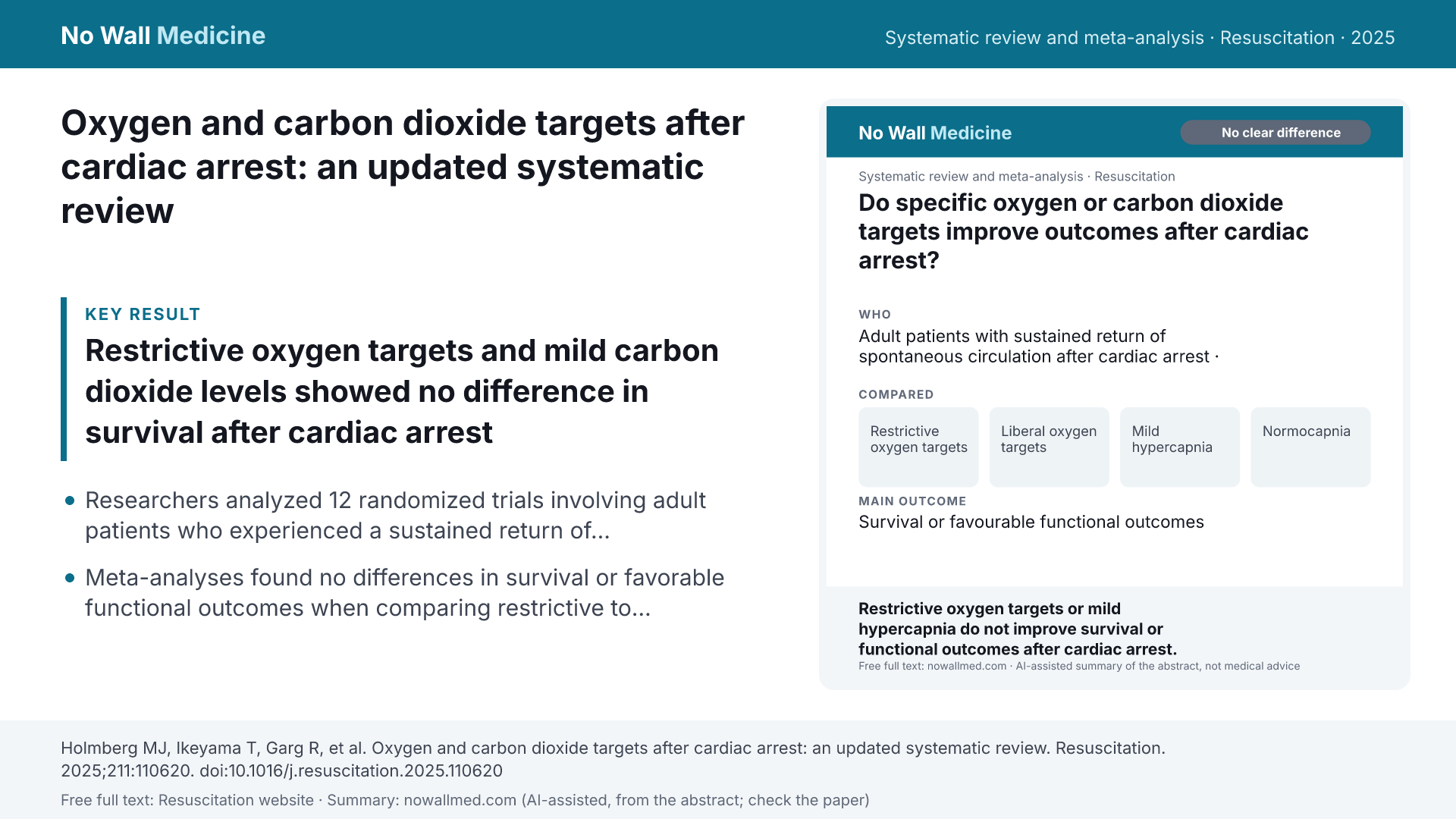
Restrictive oxygen targets and mild carbon dioxide levels showed no difference in survival after cardiac arrest
Oxygen and carbon dioxide targets after cardiac arrest: an updated systematic review
Systematic review and meta-analysisNo clear difference
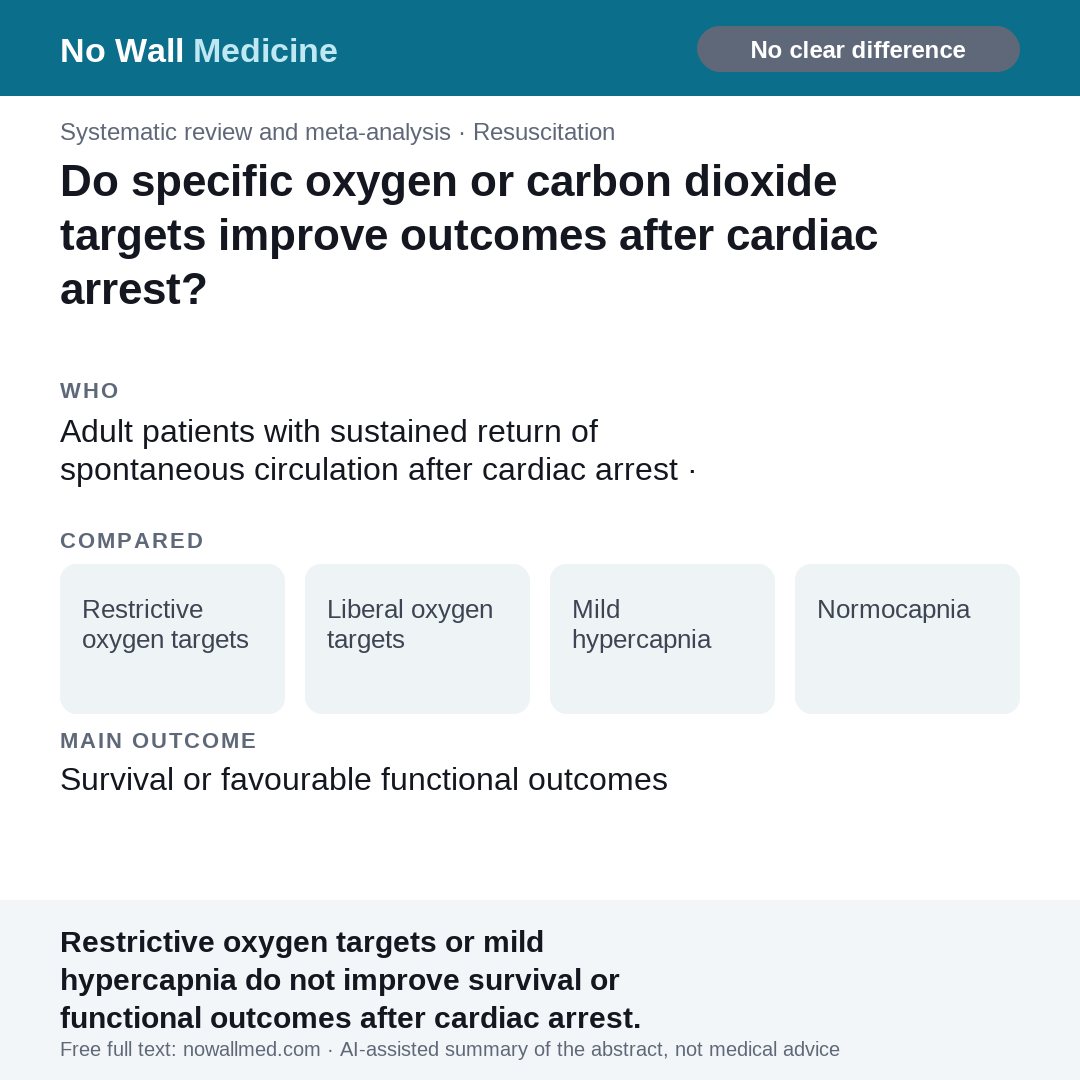
Do specific oxygen or carbon dioxide targets improve outcomes after cardiac arrest?
Who
Adult patients with sustained return of spontaneous circulation after cardiac arrest · Prehospital and intensive care unit settings
Compared
Restrictive oxygen targets
Liberal oxygen targets
Mild hypercapnia
Normocapnia
Main outcome
Survival or favourable functional outcomes
Bottom line: Restrictive oxygen targets or mild hypercapnia do not improve survival or functional outcomes after cardiac arrest.
Limitation: The certainty of evidence was rated as low to moderate.
Resuscitation · 2025-04-23Download image
Clinical question: Do specific oxygen or carbon dioxide targets improve outcomes after cardiac arrest?
Why it matters: Clinicians need to know if specific oxygen or carbon dioxide targets improve survival or functional outcomes for patients resuscitated from cardiac arrest.
Key points
- Researchers analyzed 12 randomized trials involving adult patients who experienced a sustained return of spontaneous circulation after cardiac arrest.
- Meta-analyses found no differences in survival or favorable functional outcomes when comparing restrictive to liberal oxygen targets in prehospital or intensive care settings.
- Comparing mild hypercapnia, or elevated carbon dioxide levels, to normocapnia also showed no difference in patient outcomes.
Limitation the authors note: The certainty of evidence for these findings was rated as low to moderate.
Headline and key points written with AI from the paper’s abstract, with every number checked against it. Read the paper before relying on them.
Was this summary helpful?
Subject terms
Cite this article
Holmberg MJ, Ikeyama T, Garg R, et al. Oxygen and carbon dioxide targets after cardiac arrest: an updated systematic review. Resuscitation. 2025. doi:10.1016/j.resuscitation.2025.110620
Spotted a mistake? Suggest a correction