Patient selection criteria for extracorporeal cardiopulmonary resuscitation vary significantly across different medical systems
Variability in patient selection criteria across extracorporeal cardiopulmonary resuscitation (ECPR) systems: A systematic review
Systematic reviewMixed results
How do patient selection criteria for extracorporeal cardiopulmonary resuscitation vary across systems?
Who
93
Extracorporeal cardiopulmonary resuscitation systems
Compared
Age criteria: n=75, 80.7%
Arrest witnessed status: n=64, 68.8%
Any initial rhythm: n=55, 59.1%
Bystander cardiopulmonary resuscitation: n=33, 35.5%
Main outcome
Variability in patient eligibility criteria
Bottom line: There is marked variability in patient eligibility criteria across different extracorporeal cardiopulmonary resuscitation systems.
Resuscitation · 2024-09-24Download image
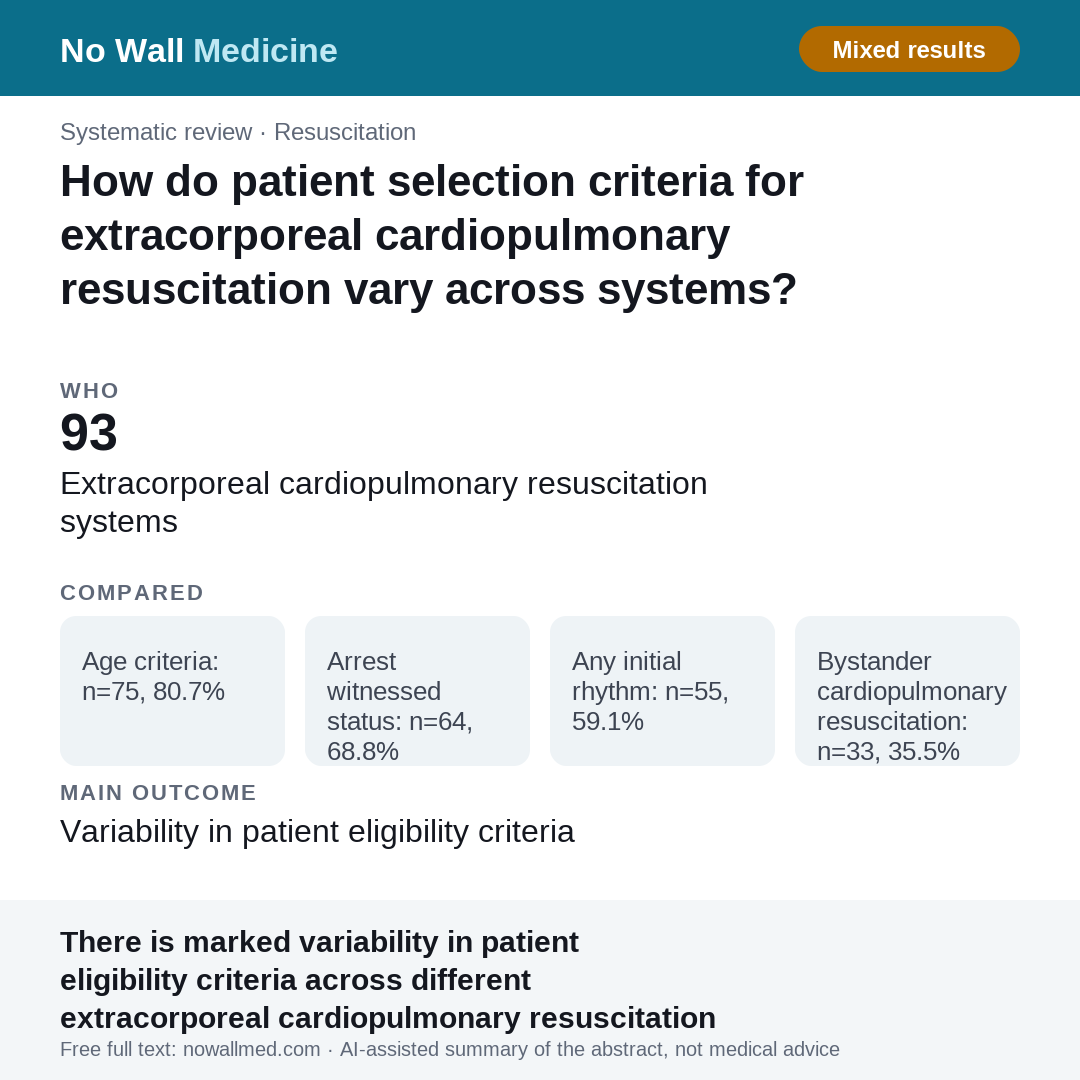
Clinical question: How do patient selection criteria for extracorporeal cardiopulmonary resuscitation vary across systems?
Why it matters: There are currently no universally accepted criteria for selecting patients to receive extracorporeal cardiopulmonary resuscitation during refractory cardiac arrest.
Key points
- Researchers reviewed 90 studies describing 93 extracorporeal cardiopulmonary resuscitation systems to identify how patients are chosen for treatment.
- Eligibility criteria varied widely, with age cut-offs ranging from 50 to 80 years and 18 (19.3%) systems having no age limit.
- Other common criteria included witnessed arrest status (n=64, 68.8%), any initial heart rhythm (n=55, 59.1%), and bystander cardiopulmonary resuscitation (n=33, 35.5%).
Headline and key points written with AI from the paper’s abstract, with every number checked against it. Read the paper before relying on them.
Was this summary helpful?
Subject terms
Cite this article
Alenazi A, Aljanoubi M, Yeung J, Madan J, Johnson S, Couper K. Variability in patient selection criteria across extracorporeal cardiopulmonary resuscitation (ECPR) systems: A systematic review. Resuscitation. 2024. doi:10.1016/j.resuscitation.2024.110403
Spotted a mistake? Suggest a correction
Top studies every Monday
The week’s key trials and guidelines in your specialties, plus any topics you follow. By email, free.
Get the weekly digest