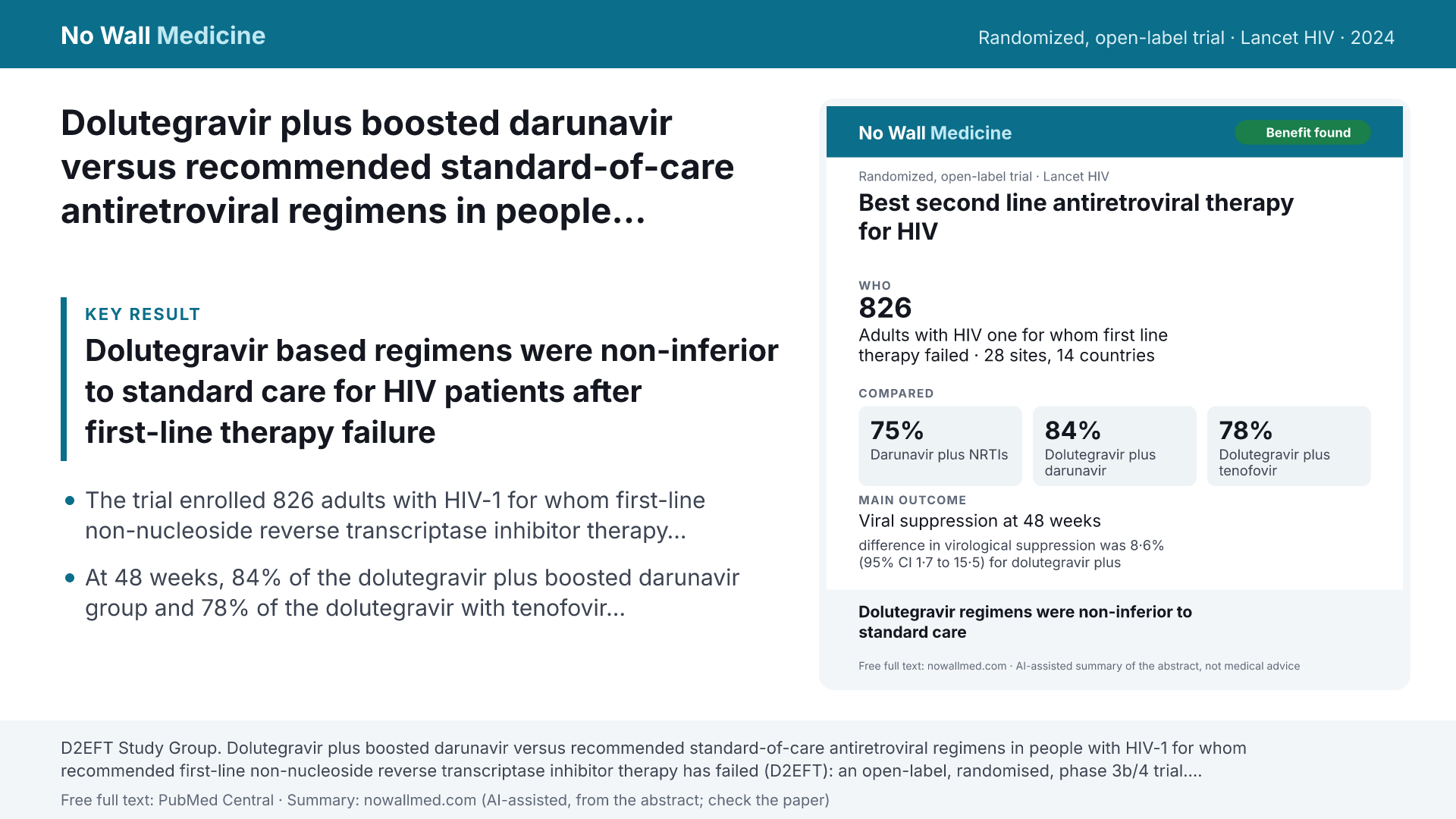
Dolutegravir based regimens were non-inferior to standard care for HIV patients after first-line therapy failure
Dolutegravir plus boosted darunavir versus recommended standard-of-care antiretroviral regimens in people with HIV-1 for whom recommended first-line non-nucleoside reverse transcriptase inhibitor therapy has failed (D2EFT): an open-label, randomised, phase 3b/4 trial
Randomized, open-label trialBenefit found
Best second line antiretroviral therapy for HIV
Who
826
Adults with HIV one for whom first line therapy failed · 28 sites, 14 countries
Compared
75%Darunavir plus NRTIs (194/257)
84%Dolutegravir plus darunavir (222/264)
78%Dolutegravir plus tenofovir (227/291)
Main outcome
Viral suppression at 48 weeks
Result: difference in virological suppression was 8·6% (95% CI 1·7 to 15·5) for dolutegravir plus ritonavir-boosted darunavir
Bottom line: Dolutegravir regimens were non-inferior to standard care
Funded by: UNITAID and others
Lancet HIV · 2024-05-21 · Save PNG

Why it matters: Comparative data on the efficacy and safety of second-line antiretroviral therapy after non-nucleoside reverse transcriptase inhibitor failure across diverse geographical settings were scarce.
Key points
- The trial enrolled 826 adults with HIV-1 for whom first-line non-nucleoside reverse transcriptase inhibitor therapy had failed.
- At 48 weeks, 84% of the dolutegravir plus boosted darunavir group and 78% of the dolutegravir with tenofovir disoproxil fumarate group achieved viral suppression compared to 75% in the standard care group.
- The difference in viral suppression was 8.6% for dolutegravir plus boosted darunavir and 6.7% for the dolutegravir with tenofovir disoproxil fumarate group compared to standard care.
Headline and key points written with AI from the paper’s abstract, with every number checked against it. Read the paper before relying on them.
Was this summary helpful?
Subject terms
Headline, design, result, key points, caveat and citation as plain text.
Cite this article
D2EFT Study Group. Dolutegravir plus boosted darunavir versus recommended standard-of-care antiretroviral regimens in people with HIV-1 for whom recommended first-line non-nucleoside reverse transcriptase inhibitor therapy has failed (D2EFT): an open-label, randomised, phase 3b/4 trial. Lancet HIV. 2024;11(7):e436-e448. doi:10.1016/S2352-3018(24)00089-4
Spotted a mistake? Suggest a correction