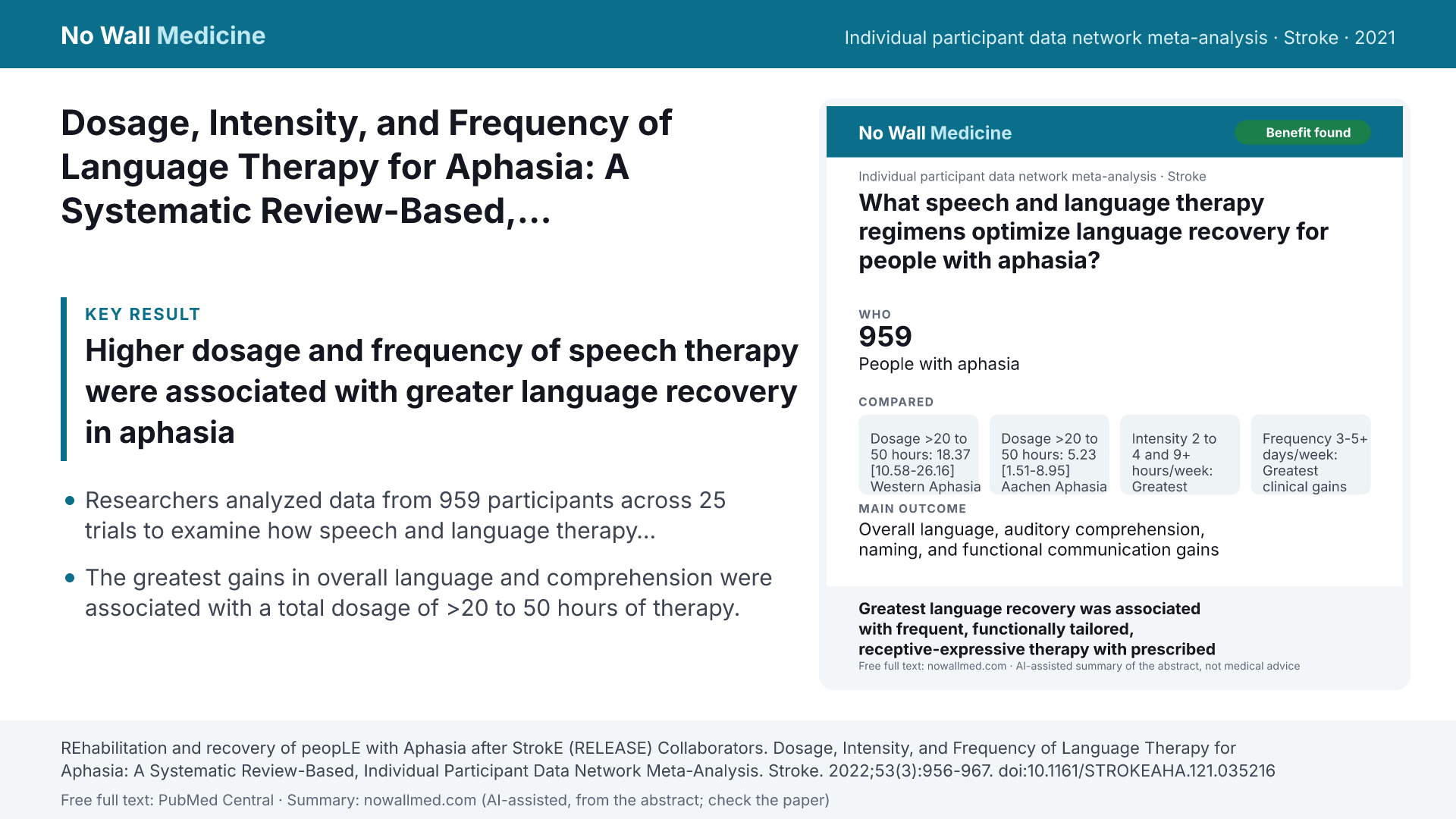
Higher dosage and frequency of speech therapy were associated with greater language recovery in aphasia
Dosage, Intensity, and Frequency of Language Therapy for Aphasia: A Systematic Review-Based, Individual Participant Data Network Meta-Analysis
Individual participant data network meta-analysisBenefit found
What speech and language therapy regimens optimize language recovery for people with aphasia?
Who
959
People with aphasia
Compared
Dosage >20 to 50 hours: 18.37 [10.58-26.16] Western Aphasia Battery-Aphasia Quotient
Dosage >20 to 50 hours: 5.23 [1.51-8.95] Aachen Aphasia Test-Token Test
Intensity 2 to 4 and 9+ hours/week: Greatest clinical gains
Frequency 3-5+ days/week: Greatest clinical gains
Main outcome
Overall language, auditory comprehension, naming, and functional communication gains
Bottom line: Greatest language recovery was associated with frequent, functionally tailored, receptive-expressive therapy with prescribed home practice.
Limitation: These are exploratory findings suggesting critical therapeutic ranges.
Stroke · 2021-12-01Download image
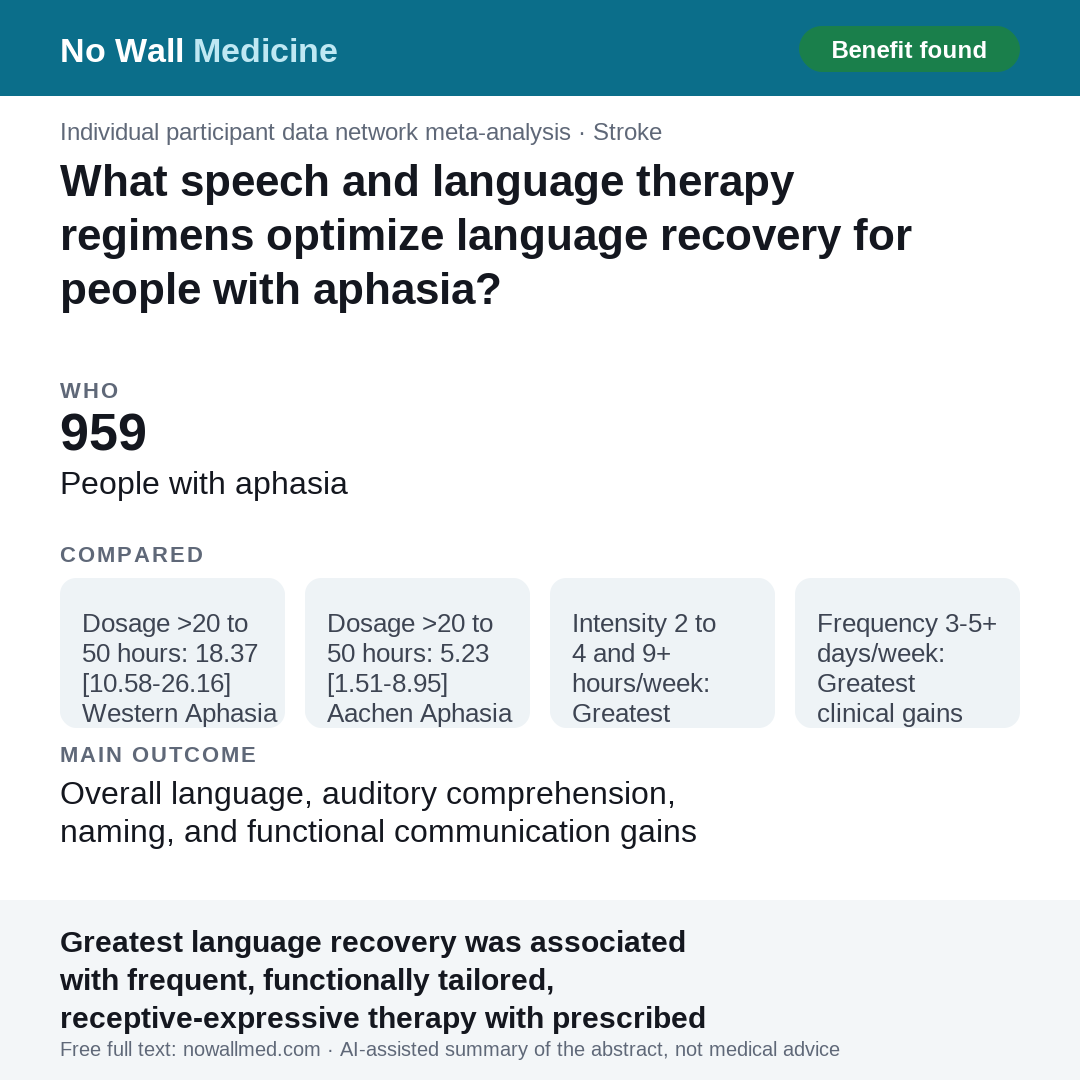
Clinical question: What speech and language therapy regimens optimize language recovery for people with aphasia?
Key points
- Researchers analyzed data from 959 participants across 25 trials to examine how speech and language therapy intensity, dosage, and frequency relate to language outcomes.
- The greatest gains in overall language and comprehension were associated with a total dosage of >20 to 50 hours of therapy.
- Greatest clinical gains in communication and comprehension were associated with 2 to 4 hours per week and 3 to 5+ days per week of therapy.
Headline and key points written with AI from the paper’s abstract, with every number checked against it. Read the paper before relying on them.
Was this summary helpful?
Subject terms
Headline, design, result, key points, caveat and citation as plain text.
Cite this article
REhabilitation and recovery of peopLE with Aphasia after StrokE (RELEASE) Collaborators. Dosage, Intensity, and Frequency of Language Therapy for Aphasia: A Systematic Review-Based, Individual Participant Data Network Meta-Analysis. Stroke. 2021. doi:10.1161/STROKEAHA.121.035216
Spotted a mistake? Suggest a correction