Dosage, Intensity, and Frequency of Language Therapy for Aphasia: A Systematic Review-Based, Individual Participant Data Network Meta-Analysis
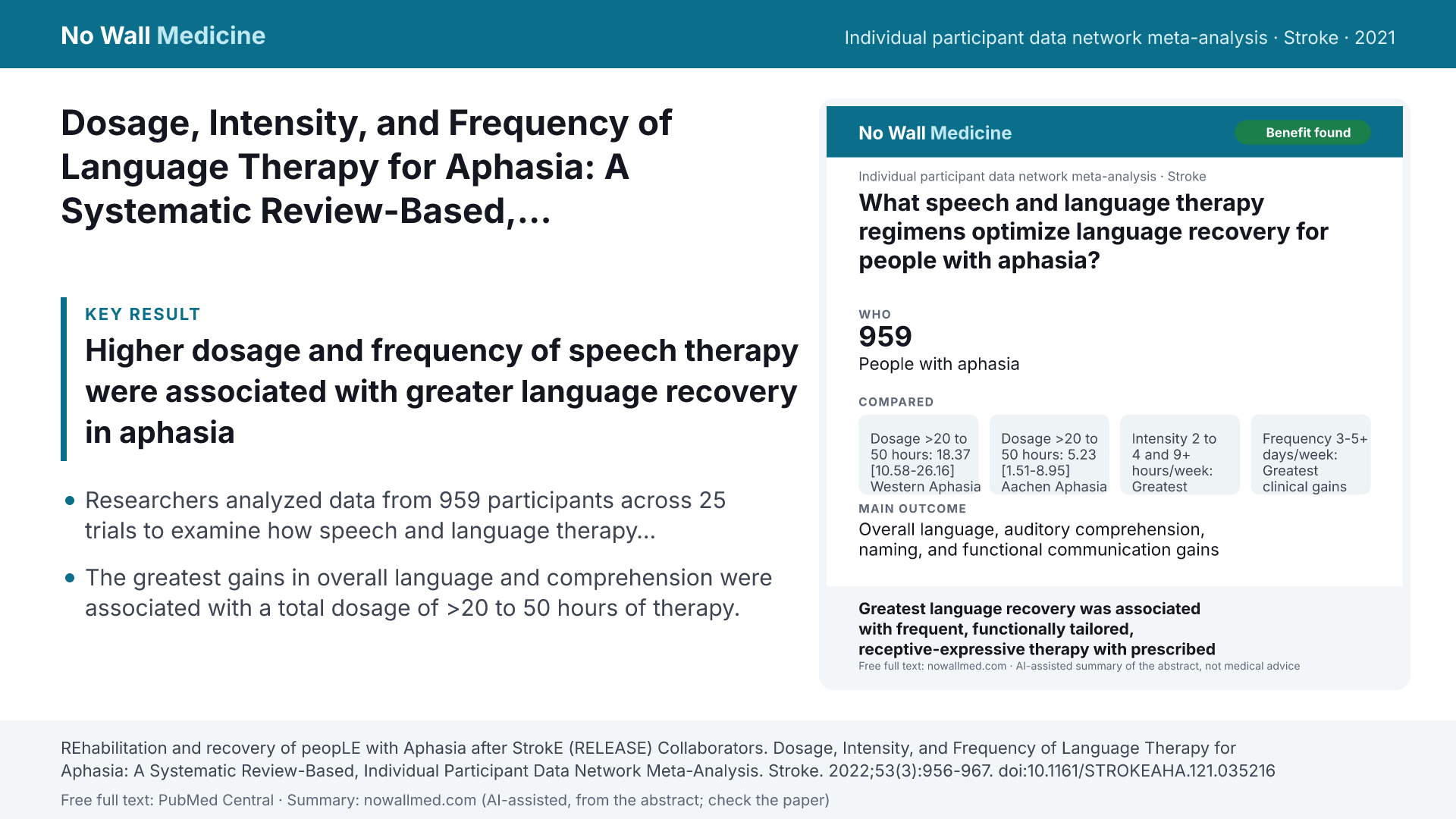
Key result: Higher dosage and frequency of speech therapy were associated with greater language recovery in aphasia
Individual participant data network meta-analysisBenefit found
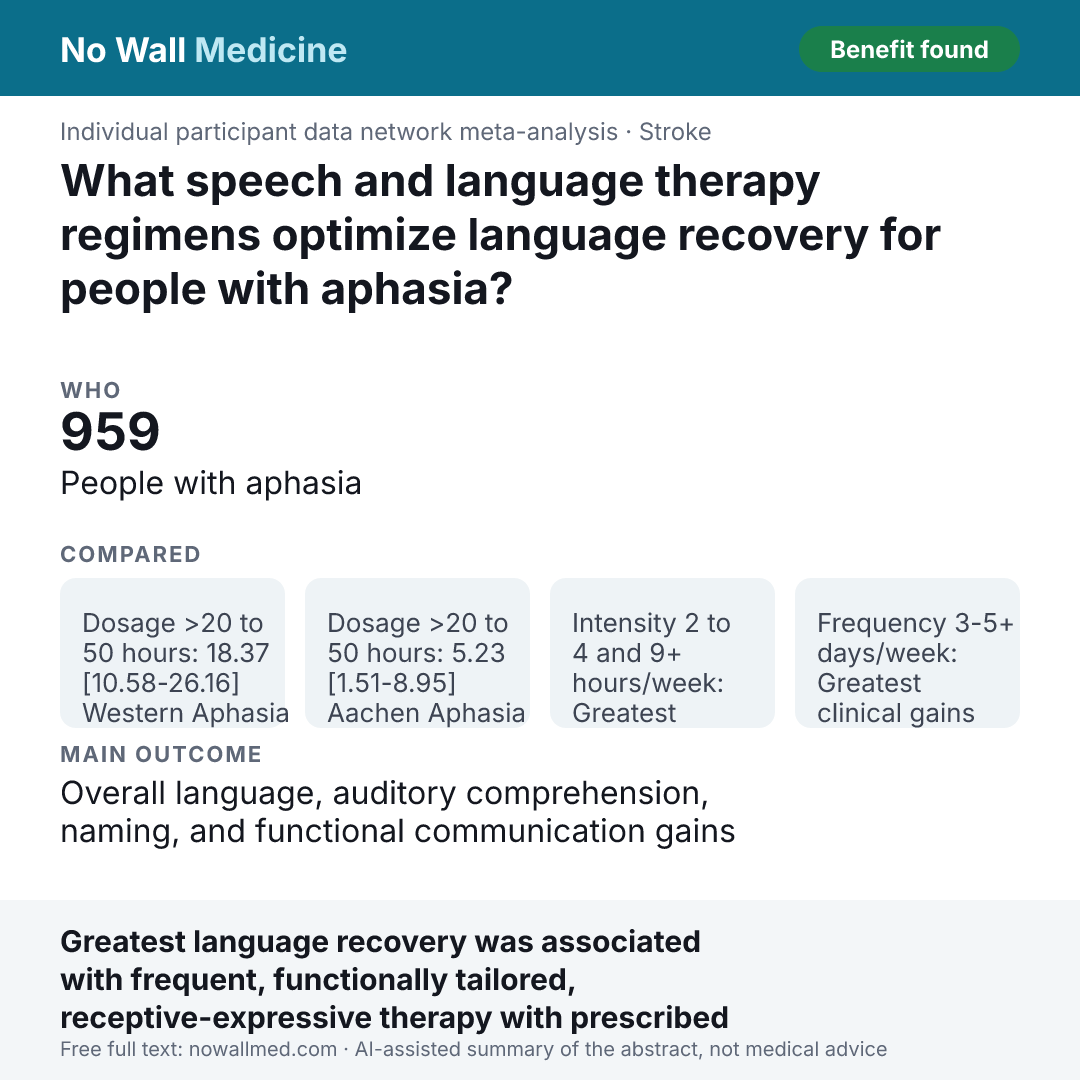
What speech and language therapy regimens optimize language recovery for people with aphasia?
Who
959
People with aphasia
Compared
Dosage >20 to 50 hours: 18.37 [10.58-26.16] Western Aphasia Battery-Aphasia Quotient
Dosage >20 to 50 hours: 5.23 [1.51-8.95] Aachen Aphasia Test-Token Test
Intensity 2 to 4 and 9+ hours/week: Greatest clinical gains
Frequency 3-5+ days/week: Greatest clinical gains
Main outcome
Overall language, auditory comprehension, naming, and functional communication gains
Bottom line: Greatest language recovery was associated with frequent, functionally tailored, receptive-expressive therapy with prescribed home practice.
Limitation: These are exploratory findings suggesting critical therapeutic ranges.
Stroke · 2021-12-01 · Save PNG
Key points
- Researchers analyzed data from 959 participants across 25 trials to examine how speech and language therapy intensity, dosage, and frequency relate to language outcomes.
- The greatest gains in overall language and comprehension were associated with a total dosage of >20 to 50 hours of therapy.
- Greatest clinical gains in communication and comprehension were associated with 2 to 4 hours per week and 3 to 5+ days per week of therapy.
Discussion prompts
- Would these patients look like yours? Who was left out?
- Is the main outcome one that matters to patients?
- Is the difference large enough to change what you do?
Cite: REhabilitation and recovery of peopLE with Aphasia after StrokE (RELEASE) Collaborators. Dosage, Intensity, and Frequency of Language Therapy for Aphasia: A Systematic Review-Based, Individual Participant Data Network Meta-Analysis. Stroke. 2022;53(3):956-967. doi:10.1161/STROKEAHA.121.035216
Free full text: PubMed Central · Summary and visual abstract: nowallmed.com/a/dosage-intensity-and-frequency-of-language-therapy-for-aphasia-a-s1lvot/ (AI-assisted from the abstract; check the paper before relying on it).