Simultaneous integrated boost radiotherapy showed non-inferior local control compared to sequential boost in breast cancer
Dose-escalated simultaneous integrated boost radiotherapy in early breast cancer (IMPORT HIGH): a multicentre, phase 3, non-inferiority, open-label, randomised controlled trial
Phase 3, non-inferiority, open-label, randomised controlled trialBenefit found
Is simultaneous integrated boost non-inferior to sequential boost for early breast cancer?
Who
2617
Women after breast-conserving surgery for invasive carcinoma · Radiotherapy and referral centres in the United Kingdom
Compared
1.9%Sequential photon tumour-bed boost (95% CI 1.2 to 3.1)
2.0%Simultaneous integrated boost 48 Gy (1.2 to 3.2)
3.2%Simultaneous integrated boost 53 Gy (2.2 to 4.7)
Main outcome
Ipsilateral breast tumour relapse
Result: absolute difference 0.1% (-0.8 to 1.7) for test group 1; 1.4% (0.03 to 3.8) for test group 2
Bottom line: Simultaneous integrated boost was safe and non-inferior to sequential boost, reducing patient visits for early breast cancer.
Funded by: Cancer Research UK
Lancet · 2023-06-08Download image
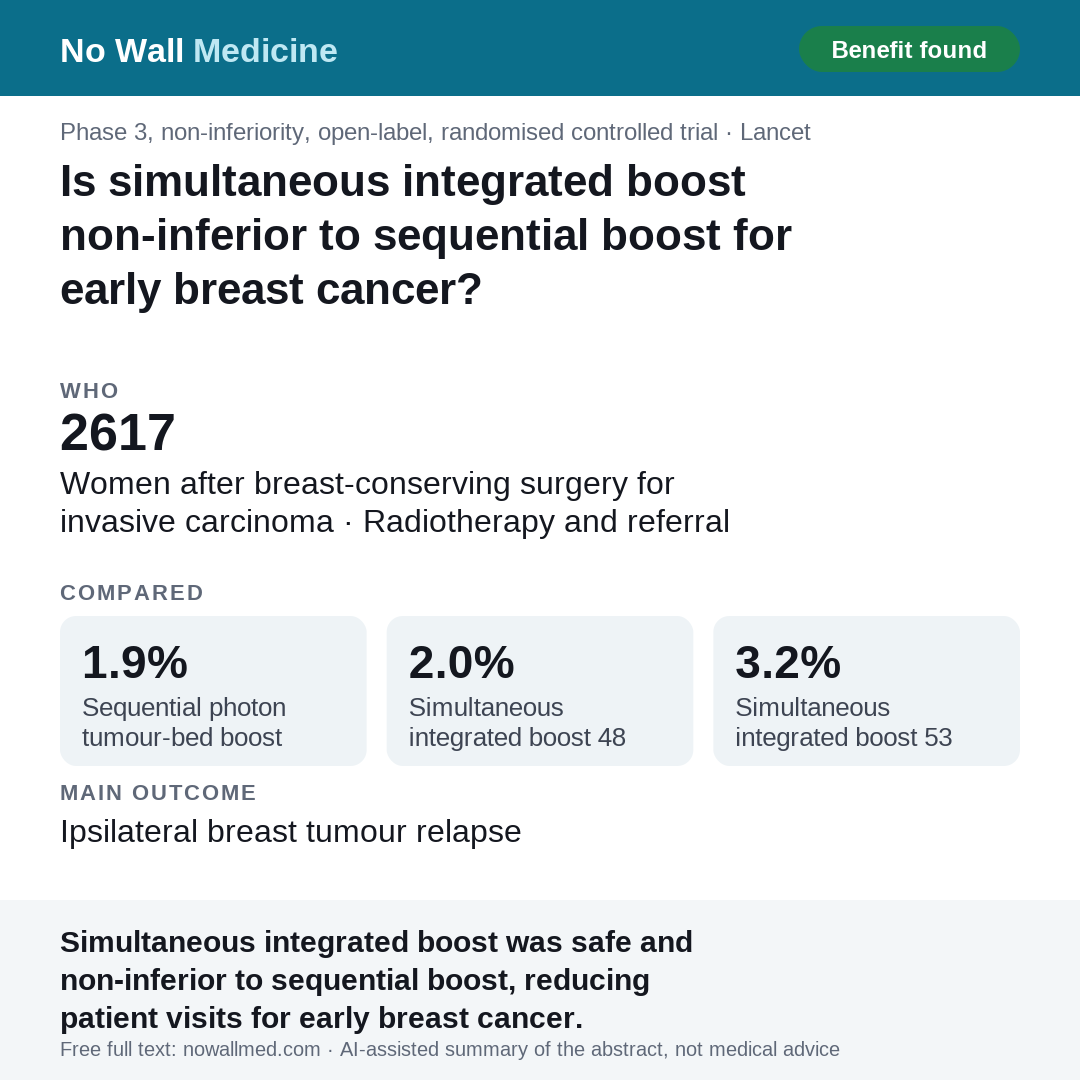
Clinical question: Is simultaneous integrated boost non-inferior to sequential boost for early breast cancer?
Why it matters: Sequential tumour-bed boost radiation requires more patient visits and can increase breast hardness compared to simultaneous integrated boost methods.
Key points
- The trial studied 2617 women with invasive breast cancer, comparing a sequential boost to two different simultaneous integrated boost radiation methods.
- At a median follow-up of 74 months, the 5-year ipsilateral breast tumour relapse incidence was 1.9% for the control group, 2.0% for test group 1, and 3.2% for test group 2.
- Test group 1 met non-inferiority for local control, while test group 2 was associated with a higher 5-year incidence of moderate or marked breast hardness at 15.5%.
Headline and key points written with AI from the paper’s abstract, with every number checked against it. Read the paper before relying on them.
Abstract
Background
A tumour-bed boost delivered after whole-breast radiotherapy increases local cancer-control rates but requires more patient visits and can increase breast hardness. IMPORT HIGH tested simultaneous integrated boost against sequential boost with the aim of reducing treatment duration while maintaining excellent local control and similar or reduced toxicity. Methods
IMPORT HIGH is a phase 3, non-inferiority, open-label, randomised controlled trial that recruited women after breast-conserving surgery for pT1-3pN0-3aM0 invasive carcinoma from radiotherapy and referral centres in the UK. Patients were randomly allocated to receive one of three treatments in a 1:1:1 ratio, with computer-generated random permuted blocks used to stratify patients by centre. The control group received 40 Gy in 15 fractions to the whole breast and 16 Gy in 8 fractions sequential photon tumour-bed boost. Test group 1 received 36 Gy in 15 fractions to the whole breast, 40 Gy in 15 fractions to the partial breast, and 48 Gy in 15 fractions concomitant photon boost to the tumour-bed volume. Test group 2 received 36 Gy in 15 fractions to the whole breast, 40 Gy in 15 fractions to the partial breast, and 53 Gy in 15 fractions concomitant photon boost to the tumour-bed volume. The boost clinical target volume was the clip-defined tumour bed. Patients and clinicians were not masked to treatment allocation. The primary endpoint was ipsilateral breast tumour relapse (IBTR) analysed by intention to treat; assuming 5% 5-year incidence with the control group, non-inferiority was predefined as 3% or less absolute excess in the test groups (upper limit of two-sided 95% CI). Adverse events were assessed by clinicians, patients, and photographs. This trial is registered with the ISRCTN registry, ISRCTN47437448, and is closed to new participants. Findings
Between March 4, 2009, and Sept 16, 2015, 2617 patients were recruited. 871 individuals were assigned to the control group, 874 to test group 1, and 872 to test group 2. Median boost clinical target volume was 13 cm3 (IQR 7 to 22). At a median follow-up of 74 months there were 76 IBTR events (20 for the control group, 21 for test group 1, and 35 for test group 2). 5-year IBTR incidence was 1·9% (95% CI 1·2 to 3·1) for the control group, 2·0% (1·2 to 3·2) for test group 1, and 3·2% (2·2 to 4·7) for test group 2. The estimated absolute differences versus the control group were 0·1% (-0·8 to 1·7) for test group 1 and 1·4% (0·03 to 3·8) for test group 2. The upper confidence limit for test group 1 versus the control group indicated non-inferiority for 48 Gy. Cumulative 5-year incidence of clinician-reported moderate or marked breast induration was 11·5% for the control group, 10·6% for test group 1 (p=0·40 vs control group), and 15·5% for test group 2 (p=0·015 vs control group). Interpretation
In all groups 5-year IBTR incidence was lower than the 5% originally expected regardless of boost sequencing. Dose-escalation is not advantageous. 5-year moderate or marked adverse event rates were low using small boost volumes. Simultaneous integrated boost in IMPORT HIGH was safe and reduced patient visits. Funding
Cancer Research UK.
Abstract reproduced under the article’s CC BY licence.
Topics
Cite this article
Coles CE, Haviland JS, Kirby AM, Griffin CL, Sydenham MA, Titley JC. Dose-escalated simultaneous integrated boost radiotherapy in early breast cancer (IMPORT HIGH): a multicentre, phase 3, non-inferiority, open-label, randomised controlled trial. Lancet. 2023. doi:10.1016/S0140-6736(23)00619-0
Spotted a mistake? Suggest a correction
Top studies every Monday
The week’s key trials and guidelines in your specialties, plus any topics you follow. By email, free.
Get the weekly digest