Ten-year results show partial-breast radiotherapy is as effective as whole-breast radiotherapy for low-risk cancer
Partial-breast radiotherapy after breast conservation surgery for women with early breast cancer (UK IMPORT LOW): 10-year outcomes from a multicentre, open-label, randomised, controlled, phase 3, non-inferiority trial
Randomised, open-label, multicentre, phase 3, non-inferiority trialNo clear difference
Are partial-breast or reduced-dose radiotherapy non-inferior to whole-breast radiotherapy for early breast cancer?
Who
2018
Women aged 50 or older with early-stage breast cancer · 30 radiotherapy centres in the UK
Compared
2.8%Whole-breast group (17/674)
1.9%Reduced-dose group (11/673)
3.0%Partial-breast group (17/669)
Main outcome
Ipsilateral breast tumour recurrence
Result: absolute difference -1.02% (95% CI -1.98 to 0.99) and 0.16% (-1.28 to 2.89)
Bottom line: Partial-breast and reduced-dose radiotherapy are as safe and effective as whole-breast radiotherapy for low-risk early breast cancer.
Funded by: Cancer Research UK
Lancet Oncol · 2025-06-11Download image
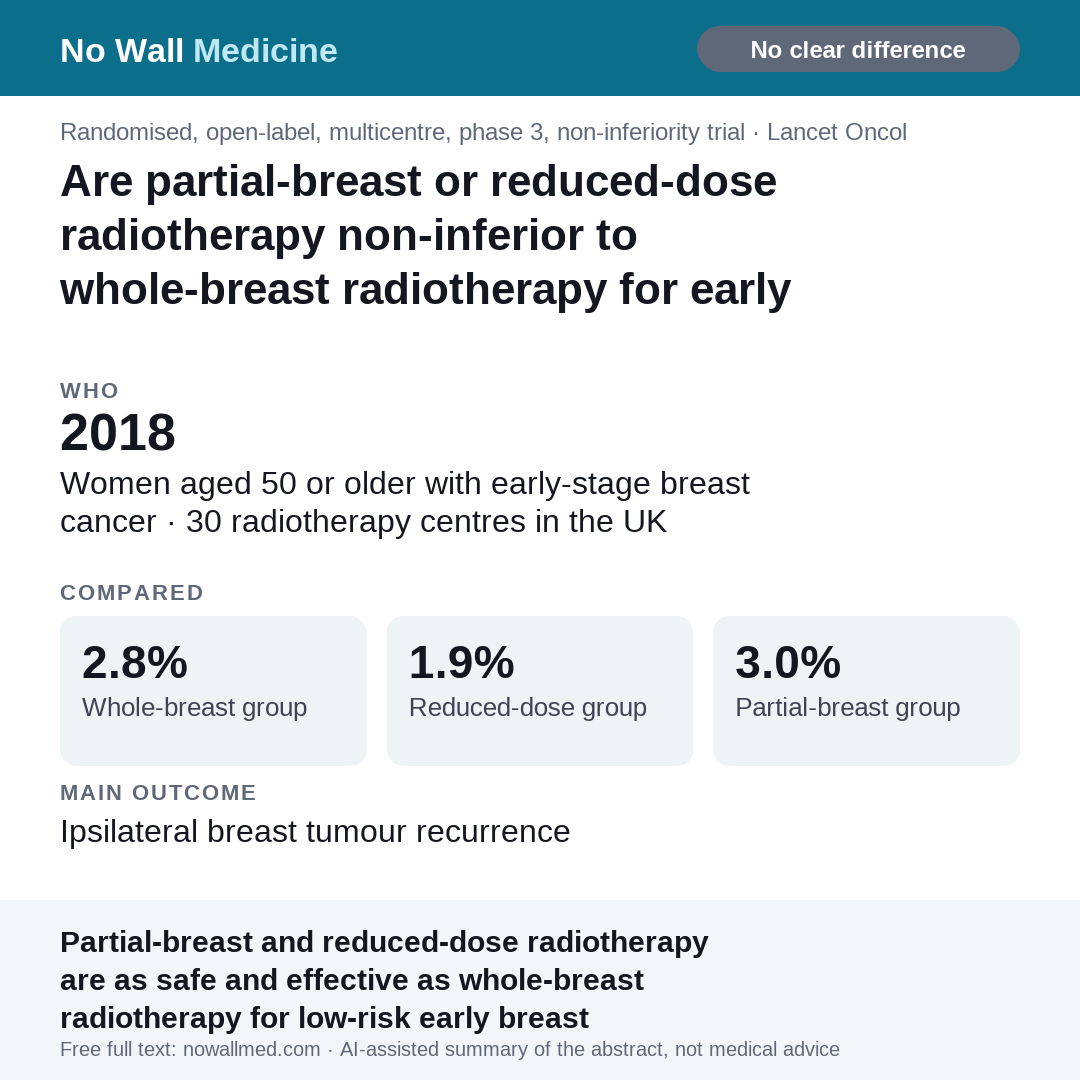
Clinical question: Are partial-breast or reduced-dose radiotherapy non-inferior to whole-breast radiotherapy for early breast cancer?
Why it matters: It was necessary to determine the long-term safety and effectiveness of partial-breast radiotherapy compared to whole-breast radiotherapy for women at below average risk of cancer recurrence.
Key points
- The trial studied 2018 women aged 50 or older with early-stage breast cancer and compared whole-breast, reduced-dose, and partial-breast radiation therapy.
- At 10 years, the cumulative incidence of ipsilateral breast tumour recurrence was 2.8% for whole-breast, 1.9% for reduced-dose, and 3.0% for partial-breast groups.
- All three groups reported similar low levels of moderate or marked adverse effects, with breast shrinkage occurring in 9% of the whole-breast and reduced-dose groups and 7% of the partial-breast group.
Headline and key points written with AI from the paper’s abstract, with every number checked against it. Read the paper before relying on them.
Abstract
Background
The IMPORT LOW trial evaluated partial-breast radiotherapy with intensity-modulated radiotherapy in women with early-stage breast cancer at below average risk of ipsilateral breast tumour recurrence (IBTR). 5-year results concluded non-inferiority of IBTR for reduced-dose and partial-breast radiotherapy, with similar or lower frequency of adverse effects compared with whole-breast radiotherapy. We report outcomes after 10 years. Methods
IMPORT LOW was a randomised, open-label, multicentre, non-inferiority, phase 3 trial. Women were eligible if they were aged 50 years or older and had had breast conservation surgery for unifocal invasive ductal adenocarcinoma, pT1-2 (tumour size of ≤3 cm), N0-1 (none to three positive axillary nodes), grades 1-3, with microscopic margins of non-cancerous tissue of 2 mm or more. Patients were ineligible if they had a previous malignancy of any kind (except non-melanomatous skin cancer), had undergone mastectomy, or had received neoadjuvant or concurrent adjuvant chemotherapy. Patients were randomly assigned (1:1:1) by randomly permuted blocks to radiotherapy regimens of 40 Gy in 15 fractions to the whole breast (whole-breast group), 36 Gy in 15 fractions to the whole breast plus 40 Gy in 15 fractions to the partial breast (reduced-dose group), or 40 Gy in 15 fractions to the partial breast (partial-breast group). Participants were stratified by treatment centre, without masking. The primary endpoint was IBTR. 10-year outcomes were analysed in the intention-to-treat population. Clinician-reported late adverse effects were evaluated in all participants with available data analysed according to allocated treatment. The study is registered in the ISRCTN registry (ISRCTN12852634) and is now complete. Findings
2018 patients were recruited between May 3, 2007, and Oct 5, 2010, from 30 radiotherapy centres in the UK and randomly assigned to the whole-breast group (n=675), reduced-dose group (n=674), or partial-breast group (n=669). Two participants subsequently withdrew consent. Median age was 63 years (IQR 58-68). 854 (42%) of 2016 patients had grade 1 tumours, 959 (48%) had grade 2 tumours, and 200 (10%) had grade 3 tumours (three tumours were ungradable); 59 (3%) had node-positive disease. Median follow-up was 120 months (IQR 119-122) for the whole-breast group, 121 months (IQR 120-122) for the reduced-dose group, and 120 months (IQR 119-122) for the partial-breast group. By 10 years, IBTR events were reported for 45 of 2016 participants: 17 of 674 in the whole-breast group, 11 of 673 in the reduced-dose group, and 17 of 669 in the partial-breast group, with cumulative incidence of 2·8% (95% CI 1·8-4·5), 1·9% (1·1-3·5), and 3·0% (1·9-4·8), respectively. The estimated absolute difference in 10-year IBTR incidence was -1·02% (95% CI -1·98 to 0·99) for the reduced-dose group and 0·16% (-1·28 to 2·89) for the partial-breast group compared with the whole-breast group. Similar low levels of moderate or marked adverse effects were recorded for participants in all three groups in 10-year clinical assessments. Breast shrinkage had the highest incidence (30 [9%] of 321 in the whole-breast group, 28 [9%] of 322 in the reduced-dose group, and 22 [7%] of 333 in the partial-breast group). Interpretation
Long-term follow-up provides further evidence that partial-breast and reduced-dose radiotherapy are as safe and effective as whole-breast radiotherapy in patients with low-risk early breast cancer. These results reaffirm the use of partial-breast radiotherapy delivered with intensity-modulated radiotherapy in this population as standard of care. Funding
Cancer Research UK.
Abstract reproduced under the article’s CC BY licence.
Topics
Cite this article
Kirby AM, Finneran L, Griffin CL, Brunt AM, Cafferty FH, Alhasso A. Partial-breast radiotherapy after breast conservation surgery for women with early breast cancer (UK IMPORT LOW): 10-year outcomes from a multicentre, open-label, randomised, controlled, phase 3, non-inferiority trial. Lancet Oncol. 2025. doi:10.1016/S1470-2045(25)00194-9
Spotted a mistake? Suggest a correction
Top studies every Monday
The week’s key trials and guidelines in your specialties, plus any topics you follow. By email, free.
Get the weekly digest