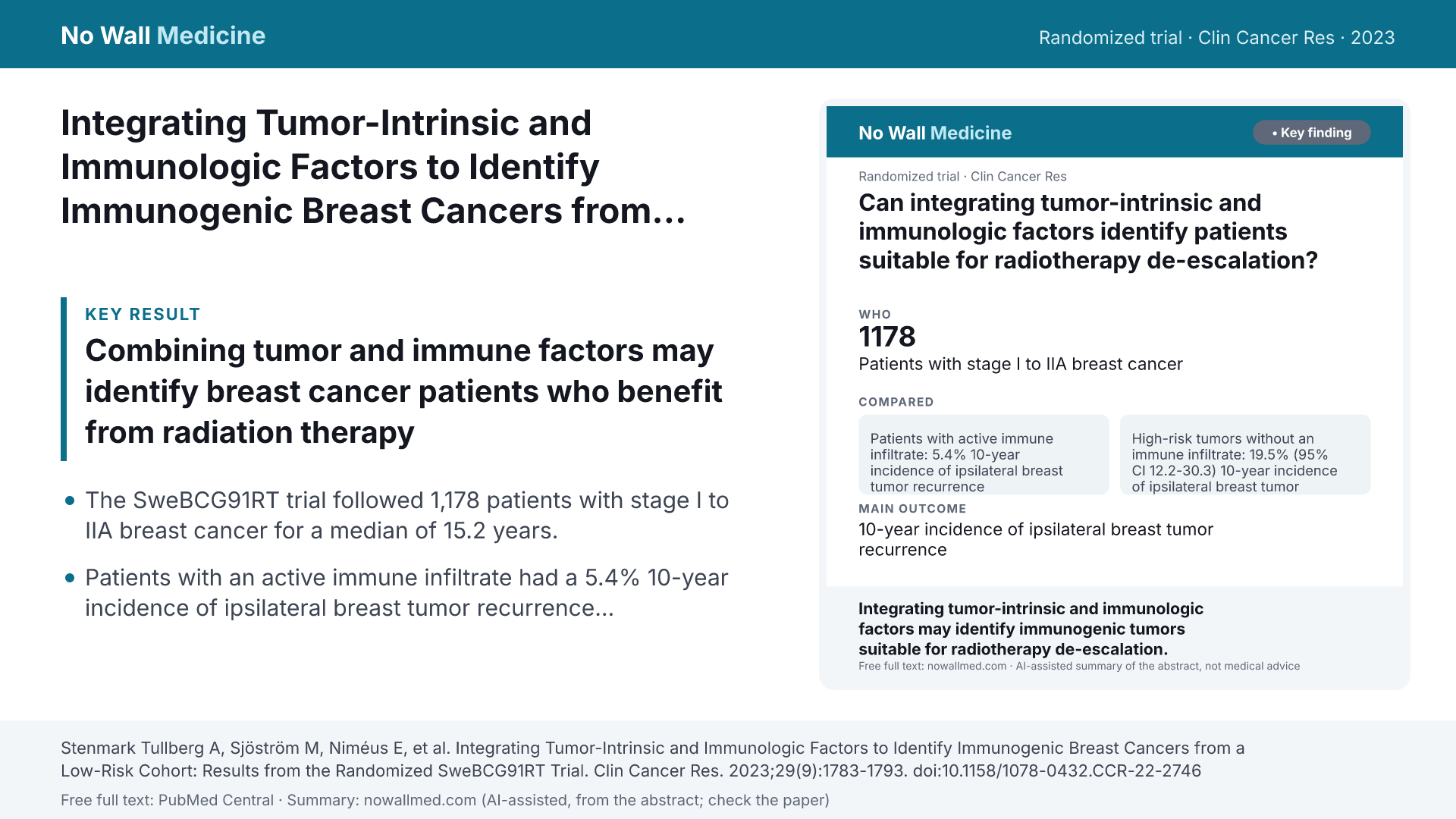
Combining tumor and immune factors may identify breast cancer patients who benefit from radiation therapy
Integrating Tumor-Intrinsic and Immunologic Factors to Identify Immunogenic Breast Cancers from a Low-Risk Cohort: Results from the Randomized SweBCG91RT Trial
Randomized trialBenefit found
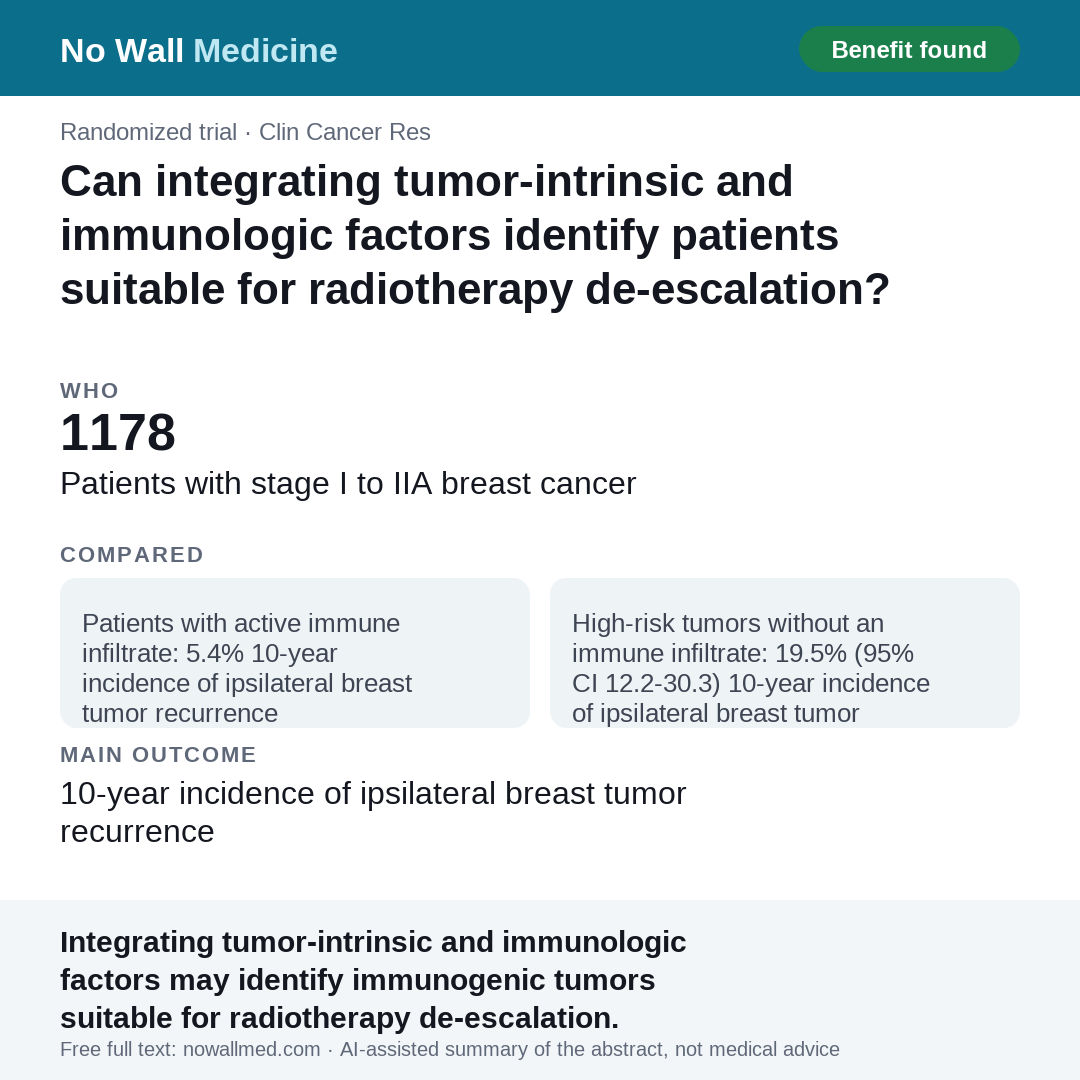
Can integrating tumor-intrinsic and immunologic factors identify patients suitable for radiotherapy de-escalation?
Who
1178
Patients with stage I to IIA breast cancer
Compared
Patients with active immune infiltrate: 5.4% 10-year incidence of ipsilateral breast tumor recurrence
High-risk tumors without an immune infiltrate: 19.5% (95% CI 12.2-30.3) 10-year incidence of ipsilateral breast tumor recurrence
Main outcome
10-year incidence of ipsilateral breast tumor recurrence
Result: hazard ratio 0.28 (95% CI 0.09-0.85)
Bottom line: Integrating tumor-intrinsic and immunologic factors may identify immunogenic tumors suitable for radiotherapy de-escalation.
Clin Cancer Res · 2023-04-19Download image
Clinical question: Can integrating tumor-intrinsic and immunologic factors identify patients suitable for radiotherapy de-escalation?
Why it matters: It is unknown if combining tumor-intrinsic and immunologic factors can identify low-risk patients suitable for reducing radiation therapy after breast-conserving surgery.
Key points
- The SweBCG91RT trial followed 1,178 patients with stage I to IIA breast cancer for a median of 15.2 years.
- Patients with an active immune infiltrate had a 5.4% 10-year incidence of ipsilateral breast tumor recurrence after radiation therapy.
- High-risk tumors lacking an immune infiltrate had a 19.5% 10-year incidence of ipsilateral breast tumor recurrence despite receiving radiation therapy.
Headline and key points written with AI from the paper’s abstract, with every number checked against it. Read the paper before relying on them.
Was this summary helpful?
Subject terms
Cite this article
Stenmark Tullberg A, Sjöström M, Niméus E, et al. Integrating Tumor-Intrinsic and Immunologic Factors to Identify Immunogenic Breast Cancers from a Low-Risk Cohort: Results from the Randomized SweBCG91RT Trial. Clin Cancer Res. 2023. doi:10.1158/1078-0432.CCR-22-2746
Spotted a mistake? Suggest a correction