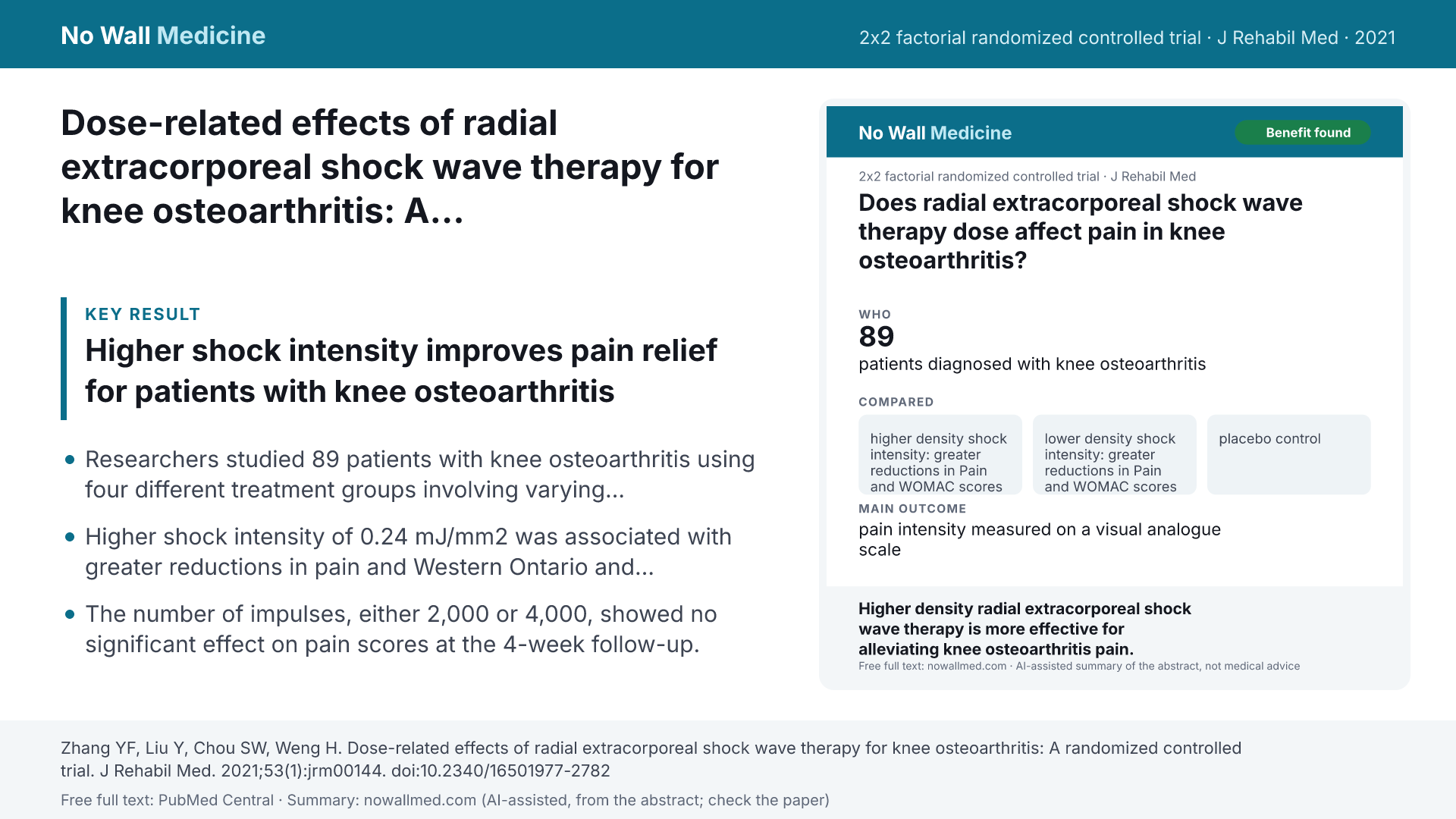
Higher shock intensity improves pain relief for patients with knee osteoarthritis
Dose-related effects of radial extracorporeal shock wave therapy for knee osteoarthritis: A randomized controlled trial
2x2 factorial randomized controlled trialBenefit found
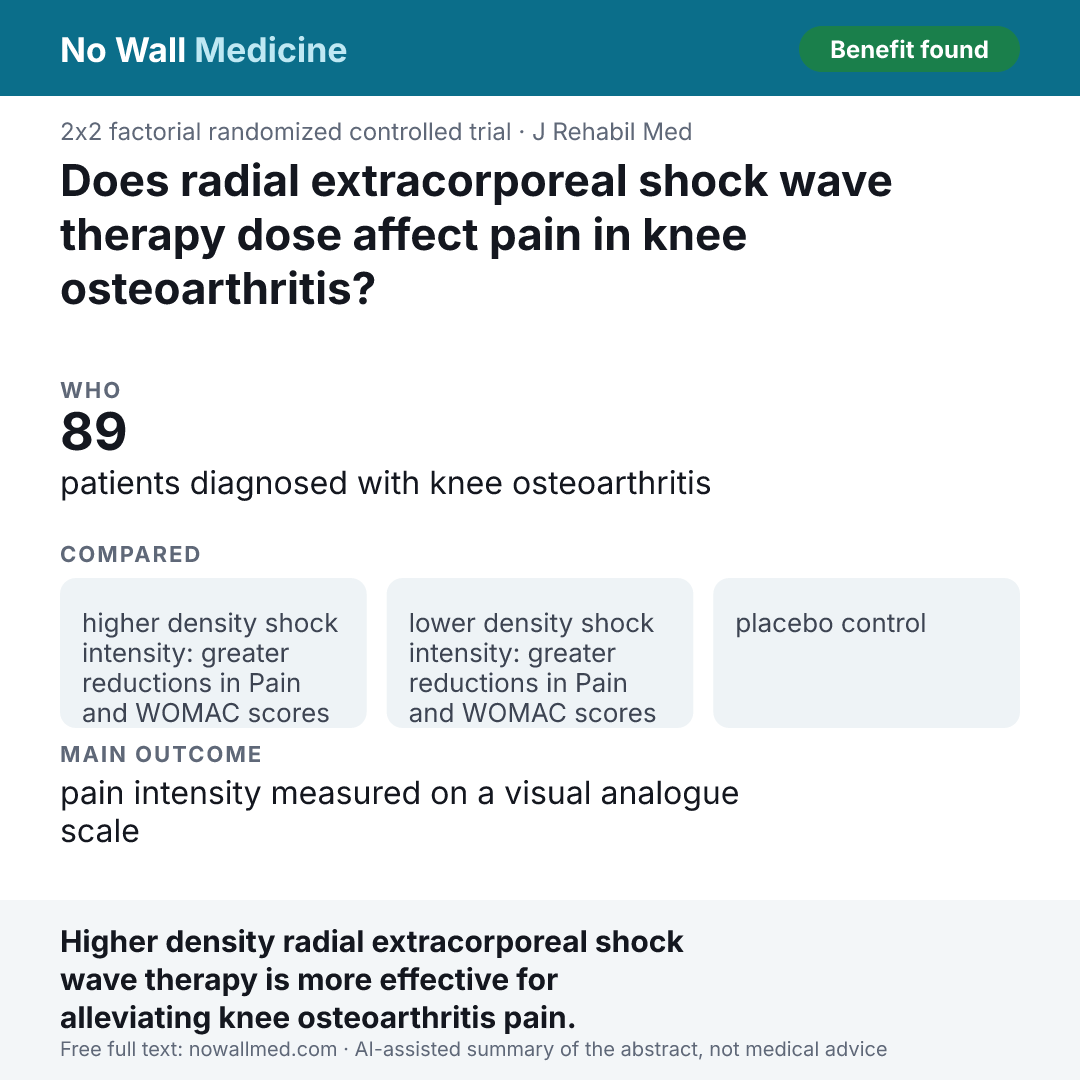
Does radial extracorporeal shock wave therapy dose affect pain in knee osteoarthritis?
Who
89
patients diagnosed with knee osteoarthritis
Compared
higher density shock intensity: greater reductions in Pain and WOMAC scores than control
lower density shock intensity: greater reductions in Pain and WOMAC scores than control
placebo control
Main outcome
pain intensity measured on a visual analogue scale
Bottom line: Higher density radial extracorporeal shock wave therapy is more effective for alleviating knee osteoarthritis pain.
J Rehabil Med · 2021-01-13 · Save PNG
Clinical question: Does radial extracorporeal shock wave therapy dose affect pain in knee osteoarthritis?
Key points
- Researchers studied 89 patients with knee osteoarthritis using four different treatment groups involving varying shock intensities and impulse numbers.
- Higher shock intensity of 0.24 mJ/mm2 was associated with greater reductions in pain and Western Ontario and McMaster Universities Osteoarthritis Index scores compared to 0.12 mJ/mm2.
- The number of impulses, either 2,000 or 4,000, showed no significant effect on pain scores at the 4-week follow-up.
Headline and key points written with AI from the paper’s abstract, with every number checked against it. Read the paper before relying on them.
Was this summary helpful?
Subject terms
Headline, design, result, key points, caveat and citation as plain text.
Cite this article
Zhang YF, Liu Y, Chou SW, Weng H. Dose-related effects of radial extracorporeal shock wave therapy for knee osteoarthritis: A randomized controlled trial. J Rehabil Med. 2021;53(1):jrm00144. doi:10.2340/16501977-2782
Spotted a mistake? Suggest a correction