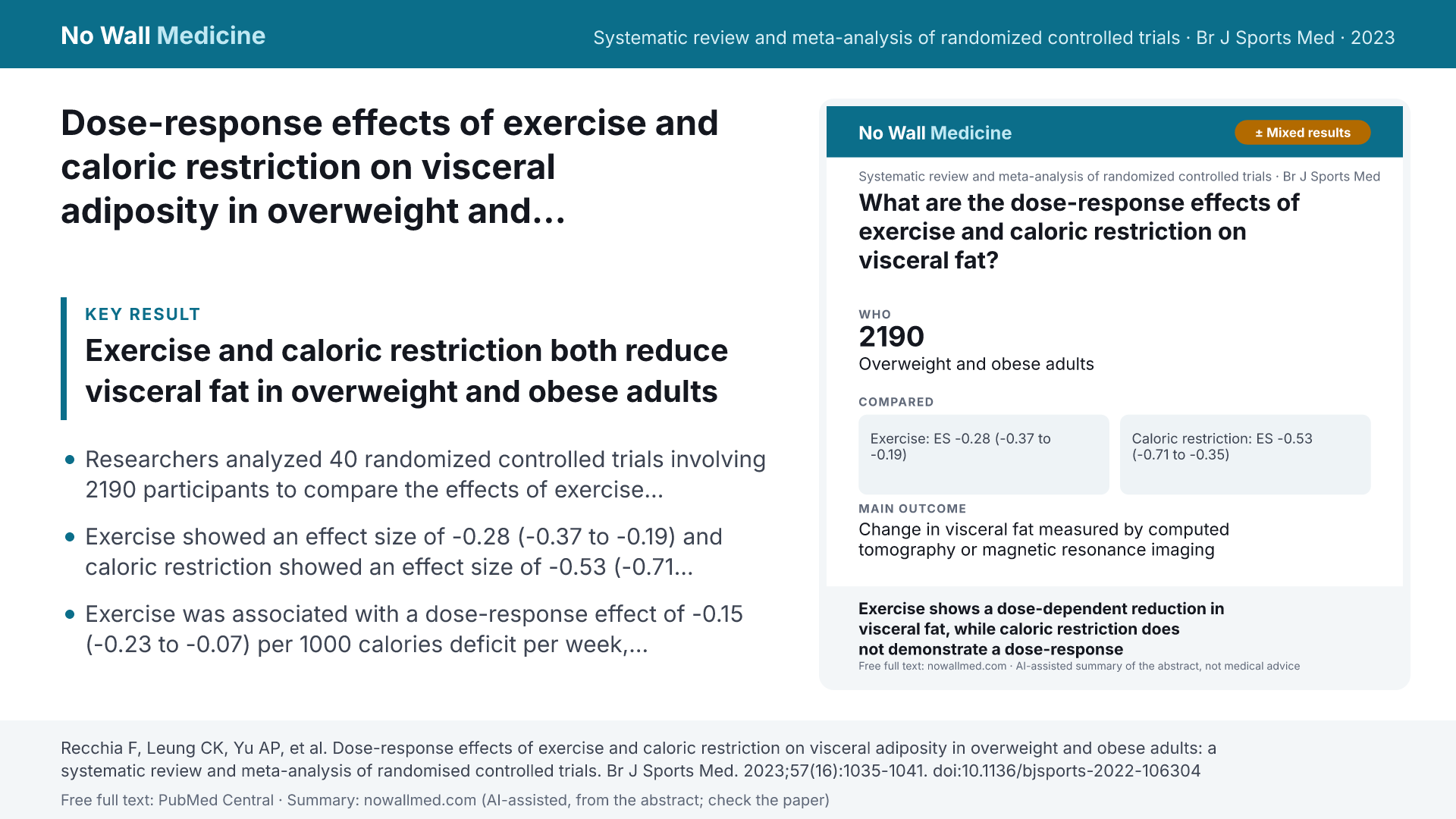
Exercise and caloric restriction both reduce visceral fat in overweight and obese adults
Dose-response effects of exercise and caloric restriction on visceral adiposity in overweight and obese adults: a systematic review and meta-analysis of randomised controlled trials
Systematic review and meta-analysis of randomized controlled trialsMixed results
What are the dose-response effects of exercise and caloric restriction on visceral fat?
Who
2190
Overweight and obese adults
Compared
Exercise: ES -0.28 (-0.37 to -0.19)
Caloric restriction: ES -0.53 (-0.71 to -0.35)
Main outcome
Change in visceral fat measured by computed tomography or magnetic resonance imaging
Bottom line: Exercise shows a dose-dependent reduction in visceral fat, while caloric restriction does not demonstrate a dose-response relationship.
Limitation: Most studies showed a moderate risk of bias and fewer studies were available for caloric restriction.
Br J Sports Med · 2023-01-20 · Save PNG
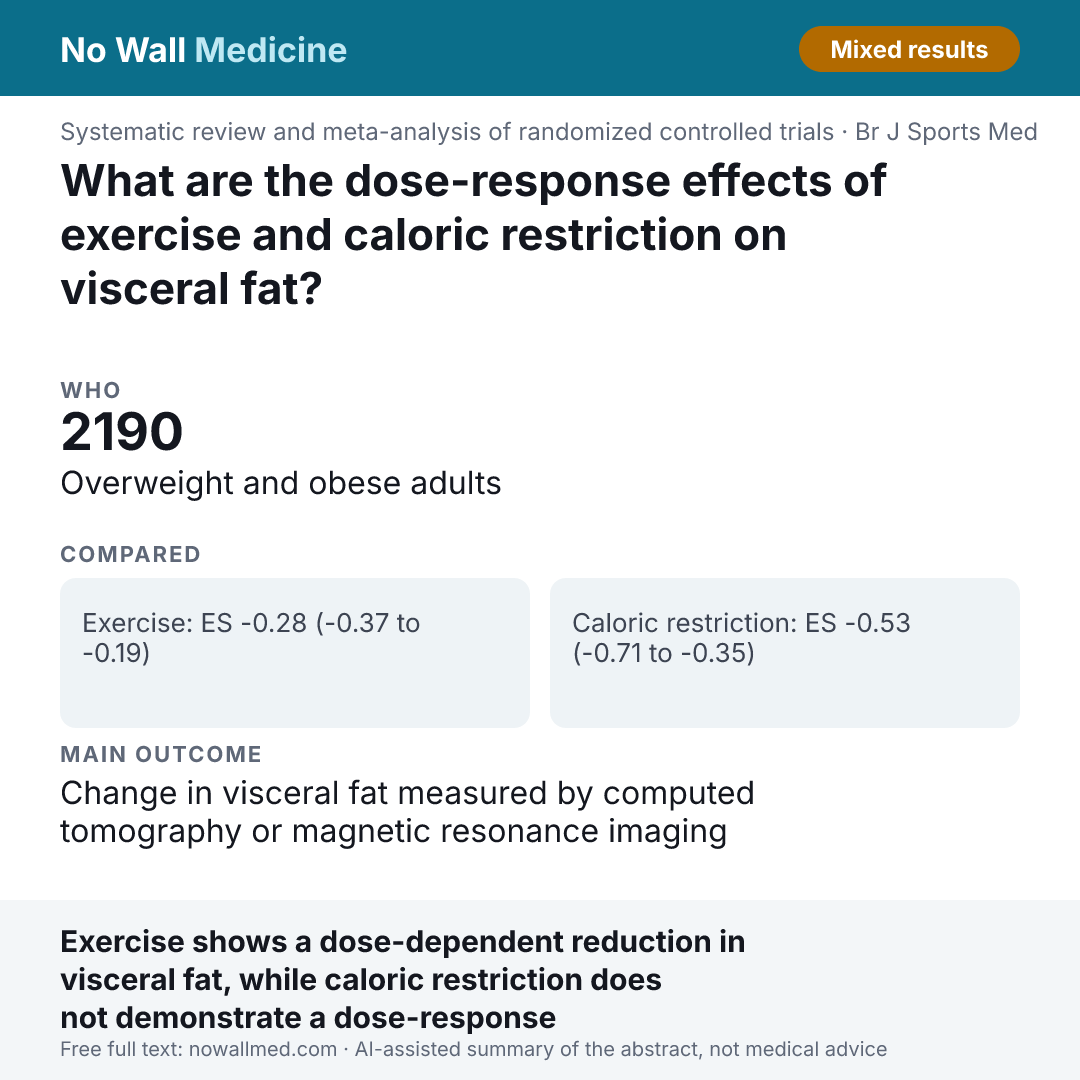
Clinical question: What are the dose-response effects of exercise and caloric restriction on visceral fat?
Key points
- Researchers analyzed 40 randomized controlled trials involving 2190 participants to compare the effects of exercise and caloric restriction on visceral fat, which is fat stored around internal organs.
- Exercise showed an effect size of -0.28 (-0.37 to -0.19) and caloric restriction showed an effect size of -0.53 (-0.71 to -0.35) compared to control groups.
- Exercise was associated with a dose-response effect of -0.15 (-0.23 to -0.07) per 1000 calories deficit per week, while caloric restriction was not dose-dependent (ES 0.03 (-0.12 to 0.18); p=0.64).
Limitation the authors note: Most of the studies included in the analysis showed a moderate risk of bias.
Headline and key points written with AI from the paper’s abstract, with every number checked against it. Read the paper before relying on them.
Was this summary helpful?
Abstract
Objective
To determine and compare the dose-response effects of exercise and caloric restriction on visceral adipose tissue in overweight and obese adults, while controlling for the weekly energy deficit induced by the interventions. Methods
PubMed, Embase, CINAHL and Web of Science were searched for randomised controlled trials comparing exercise or caloric restriction against eucaloric controls in overweight or obese adults. The primary outcome was the change in visceral fat measured by CT or MRI. Meta-analyses and meta-regressions were performed to determine the overall effect size (ES) and the dose-dependent relationship of exercise and caloric restriction on visceral fat. Heterogeneity, risk of bias and the certainty of evidence were also assessed. Results
Forty randomised controlled trials involving 2190 participants were included. Overall, exercise (ES -0.28 (-0.37 to -0.19); p<0.001; I2=25%) and caloric restriction (ES -0.53 (-0.71 to -0.35); p<0.001; I2=33%) reduced visceral fat compared with the controls. Exercise demonstrated a dose-response effect of -0.15 ((-0.23 to -0.07); p<0.001) per 1000 calories deficit per week, whereas the effect of caloric restriction was not dose-dependent (ES 0.03 (-0.12 to 0.18); p=0.64). Most of the studies showed a moderate risk of bias. Conclusions
These findings support the dose-dependent effects of exercise to reduce visceral fat in overweight and obese adults. Caloric restriction did not demonstrate a dose-response relationship, although this may be attributed to the smaller number of studies available for analysis, compared with exercise studies. Prospero registration number
CRD42020210096.
Abstract reproduced under the article’s CC BY licence.
Subject terms
Headline, design, result, key points, caveat and citation as plain text.
Cite this article
Recchia F, Leung CK, Yu AP, et al. Dose-response effects of exercise and caloric restriction on visceral adiposity in overweight and obese adults: a systematic review and meta-analysis of randomised controlled trials. Br J Sports Med. 2023;57(16):1035-1041. doi:10.1136/bjsports-2022-106304
Spotted a mistake? Suggest a correction