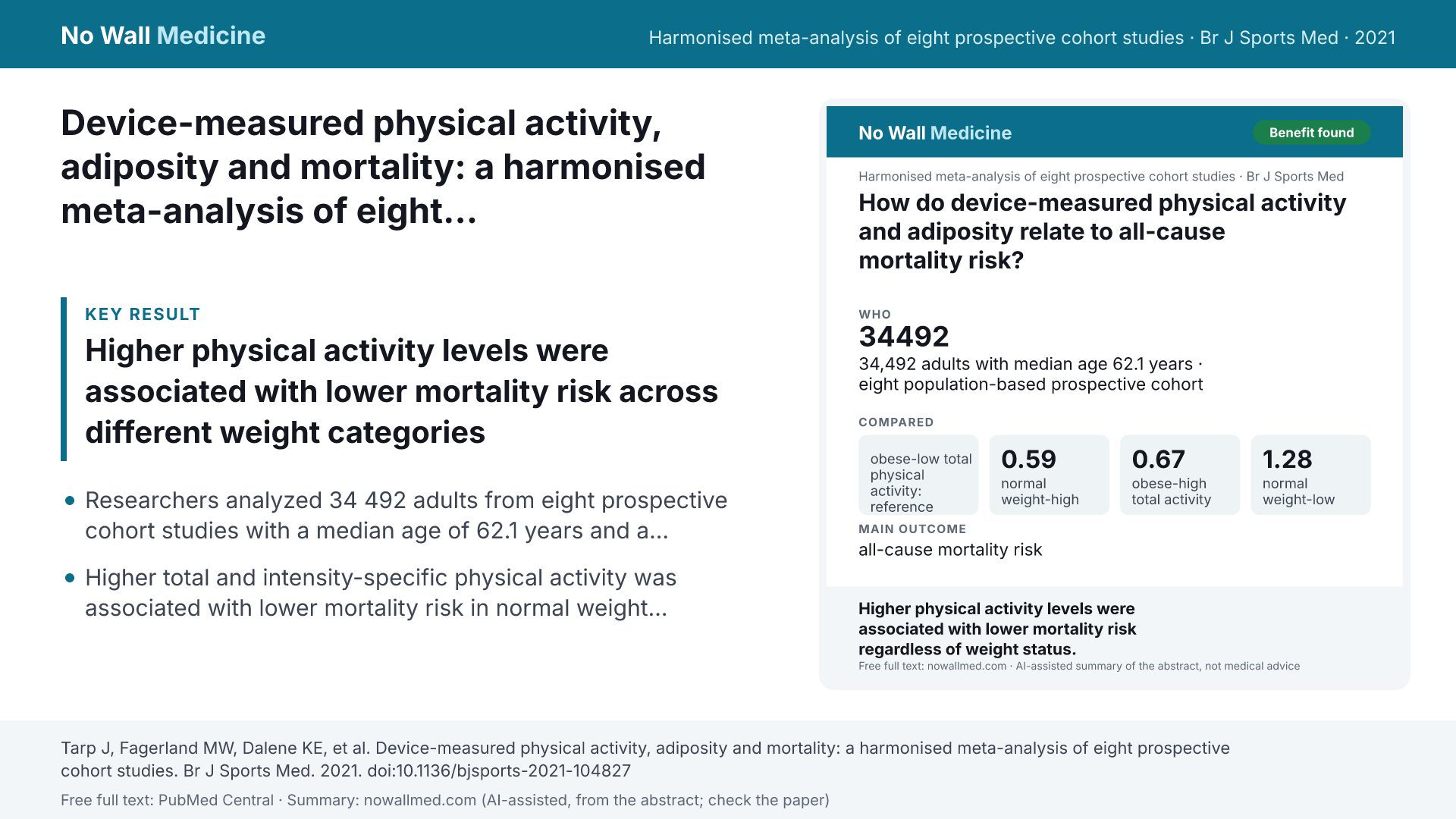
Higher physical activity levels were associated with lower mortality risk across different weight categories
Device-measured physical activity, adiposity and mortality: a harmonised meta-analysis of eight prospective cohort studies
Harmonised meta-analysis of eight prospective cohort studiesBenefit found
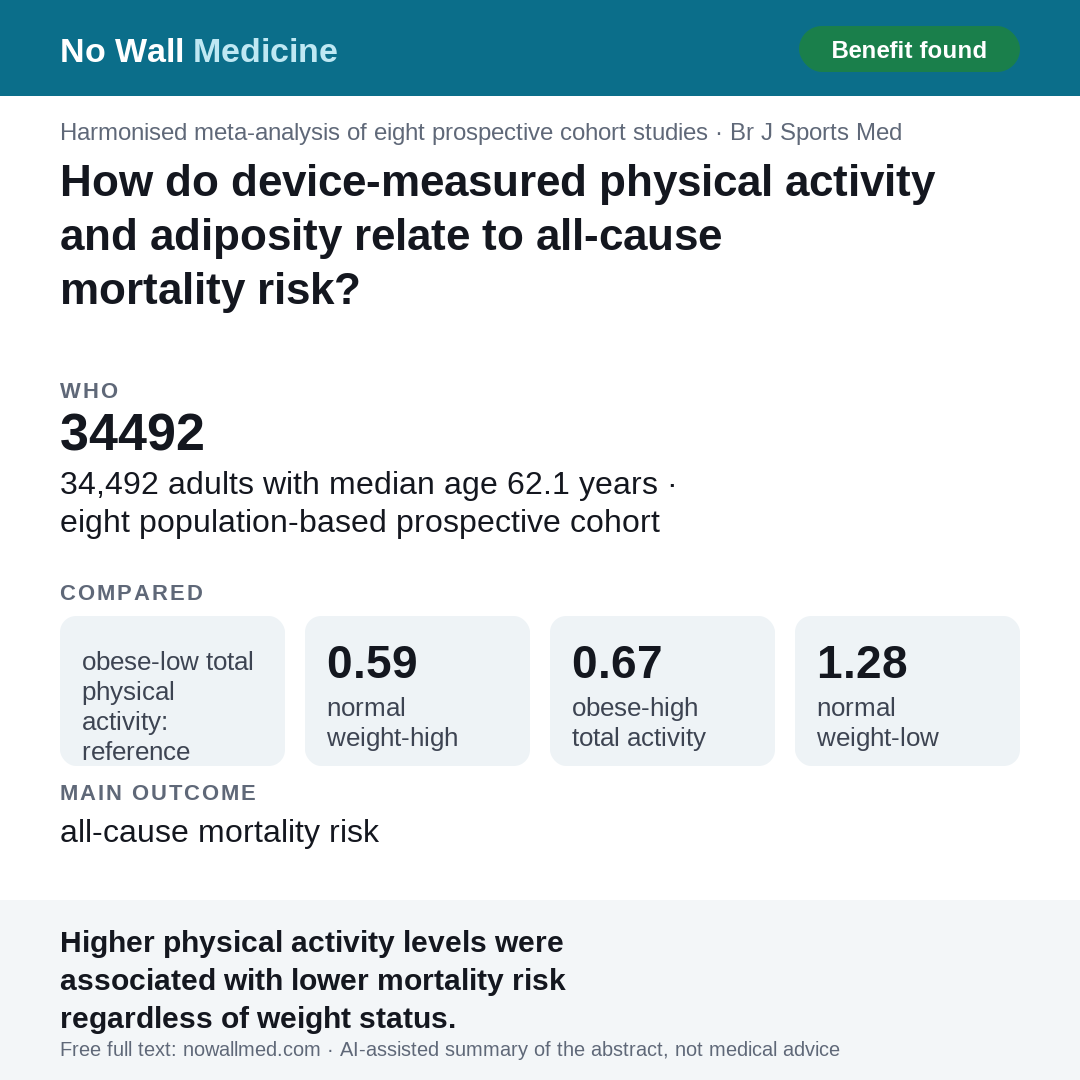
How do device-measured physical activity and adiposity relate to all-cause mortality risk?
Who
34492
34,492 adults with median age 62.1 years · eight population-based prospective cohort studies
Compared
obese-low total physical activity: reference
0.59normal weight-high total activity (95% CI 0.44 to 0.79)
0.67obese-high total activity (95% CI 0.48 to 0.94)
1.28normal weight-low total physical activity (95% CI 0.99 to 1.67)
Main outcome
all-cause mortality risk
Bottom line: Higher physical activity levels were associated with lower mortality risk regardless of weight status.
Br J Sports Med · 2021-12-07Download image
Clinical question: How do device-measured physical activity and adiposity relate to all-cause mortality risk?
Key points
- Researchers analyzed 34 492 adults from eight prospective cohort studies with a median age of 62.1 years and a follow-up period of 6.0 to 14.5 years.
- Higher total and intensity-specific physical activity was associated with lower mortality risk in normal weight and overweight individuals, while only total physical activity showed this link in people with obesity.
- Compared to obese individuals with low total activity, the hazard ratio for mortality was 0.59 for normal weight individuals with high total activity and 0.67 for obese individuals with high total activity.
Headline and key points written with AI from the paper’s abstract, with every number checked against it. Read the paper before relying on them.
Was this summary helpful?
Abstract
Background
The joint associations of total and intensity-specific physical activity with obesity in relation to all-cause mortality risk are unclear. Methods
We included 34 492 adults (72% women, median age 62.1 years, 2034 deaths during follow-up) in a harmonised meta-analysis of eight population-based prospective cohort studies with mean follow-up ranging from 6.0 to 14.5 years. Standard body mass index categories were cross-classified with sample tertiles of device-measured total, light-to-vigorous and moderate-to-vigorous physical activity and sedentary time. In five cohorts with waist circumference available, high and low waist circumference was combined with tertiles of moderate-to-vigorous physical activity. Results
There was an inverse dose-response relationship between higher levels of total and intensity-specific physical activity and mortality risk in those who were normal weight and overweight. In individuals with obesity, the inverse dose-response relationship was only observed for total physical activity. Similarly, lower levels of sedentary time were associated with lower mortality risk in normal weight and overweight individuals but there was no association between sedentary time and risk of mortality in those who were obese. Compared with the obese-low total physical activity reference, the HRs were 0.59 (95% CI 0.44 to 0.79) for normal weight-high total activity and 0.67 (95% CI 0.48 to 0.94) for obese-high total activity. In contrast, normal weight-low total physical activity was associated with a higher risk of mortality compared with the obese-low total physical activity reference (1.28; 95% CI 0.99 to 1.67). Conclusions
Higher levels of physical activity were associated with lower risk of mortality irrespective of weight status. Compared with obesity-low physical activity, there was no survival benefit of being normal weight if physical activity levels were low.
Abstract reproduced under the article’s CC BY NC licence.
Subject terms
Cite this article
Tarp J, Fagerland MW, Dalene KE, et al. Device-measured physical activity, adiposity and mortality: a harmonised meta-analysis of eight prospective cohort studies. Br J Sports Med. 2021. doi:10.1136/bjsports-2021-104827
Spotted a mistake? Suggest a correction