Double ovarian stimulation yields more good quality blastocysts than single stimulation in young patients
Double versus single stimulation in young low prognosis patients followed by a fresh embryo transfer: a randomized controlled trial (DUOSTIM-fresh)
Randomized, superiority clinical trialBenefit found
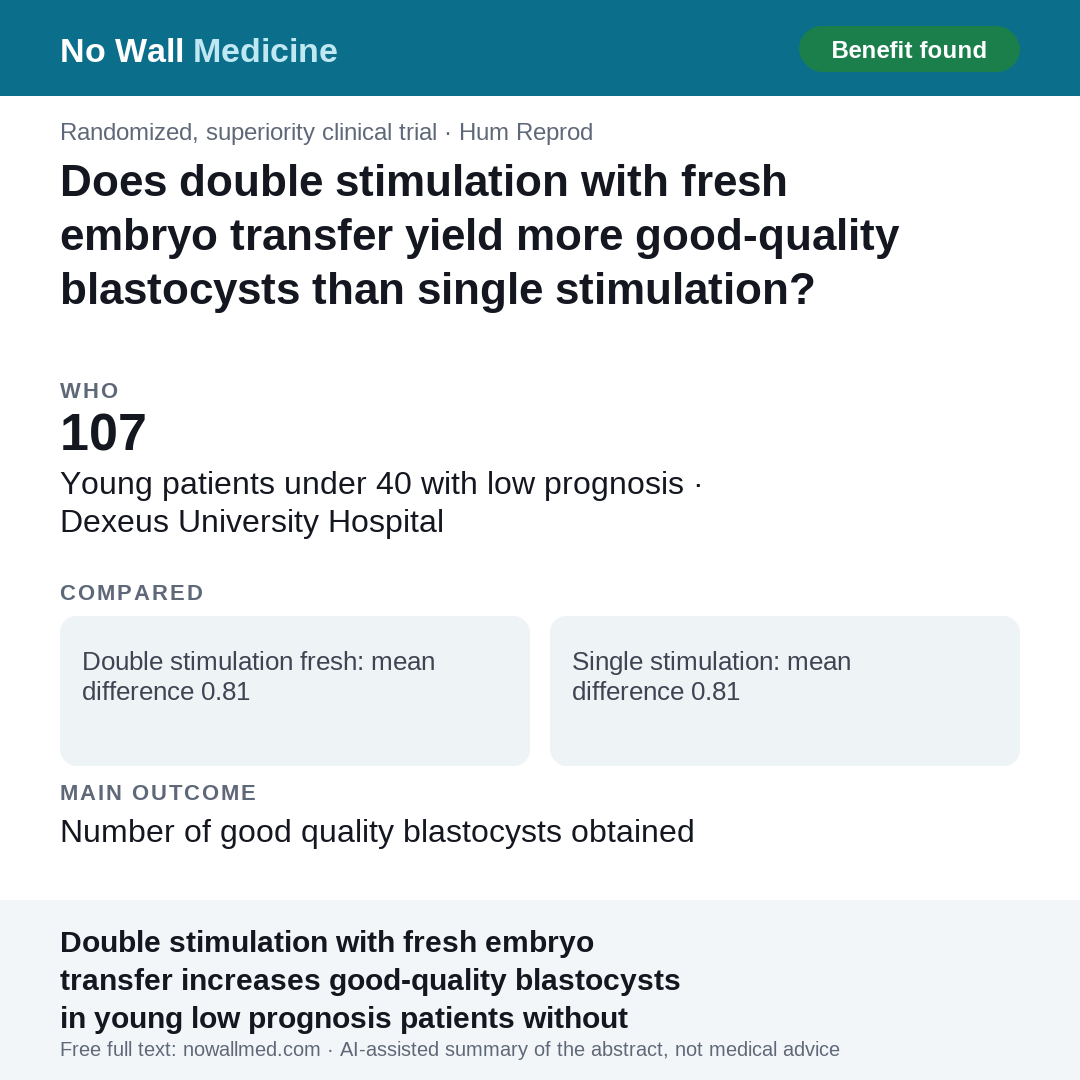
Does double stimulation with fresh embryo transfer yield more good-quality blastocysts than single stimulation?
Who
107
Young patients under 40 with low prognosis · Dexeus University Hospital
Compared
Double stimulation fresh: mean difference 0.81
Single stimulation: mean difference 0.81
Main outcome
Number of good quality blastocysts obtained
Result: difference of mean 0.81, 95% CI 0.12-1.49
Bottom line: Double stimulation with fresh embryo transfer increases good-quality blastocysts in young low prognosis patients without hindering pregnancy outcomes.
Limitation: Secondary outcomes like embryo transfer and pregnancy rates should be interpreted with caution as exploratory findings.
Hum Reprod · 2024-06-06Download image
Clinical question: Does double stimulation with fresh embryo transfer yield more good-quality blastocysts than single stimulation?
Why it matters: It was unknown if double ovarian stimulation, which involves stimulating the ovaries in both the follicular and luteal phases, increases the number of good quality blastocysts in young patients with low ovarian reserve.
Key points
- The study compared 53 women receiving double ovarian stimulation with 54 women receiving single stimulation in a randomized trial.
- Double stimulation resulted in a higher mean number of good quality blastocysts with a difference of 0.81 (95% CI 0.12-1.49).
- Clinical pregnancy rates were 24.5% for double stimulation and 22.2% for single stimulation, which was not a significant difference.
Limitation the authors note: The sample size was calculated to detect differences in the number of good quality blastocysts, so secondary outcomes like pregnancy rates should be interpreted with caution.
Headline and key points written with AI from the paper’s abstract, with every number checked against it. Read the paper before relying on them.
Was this summary helpful?
Cite this article
Racca A, Rodriguez I, Garcia S, Arroyo G, Polyzos NP. Double versus single stimulation in young low prognosis patients followed by a fresh embryo transfer: a randomized controlled trial (DUOSTIM-fresh). Hum Reprod. 2024. doi:10.1093/humrep/deae104
Spotted a mistake? Suggest a correction
Top studies every Monday
The week’s key trials and guidelines in your specialties, plus any topics you follow. By email, free.
Get the weekly digest