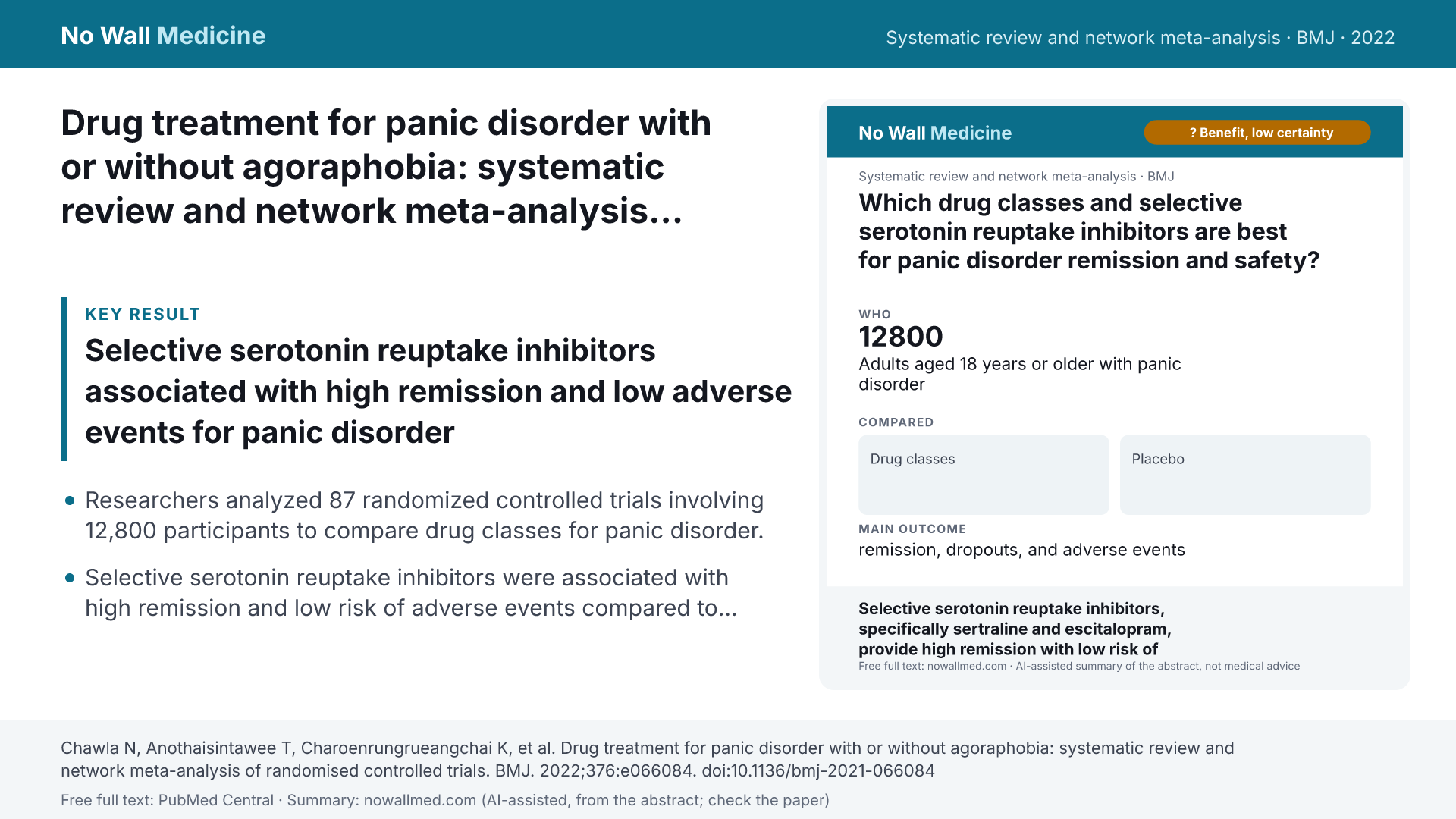
Selective serotonin reuptake inhibitors associated with high remission and low adverse events for panic disorder
Drug treatment for panic disorder with or without agoraphobia: systematic review and network meta-analysis of randomised controlled trials
Systematic review and network meta-analysisBenefit, low certainty
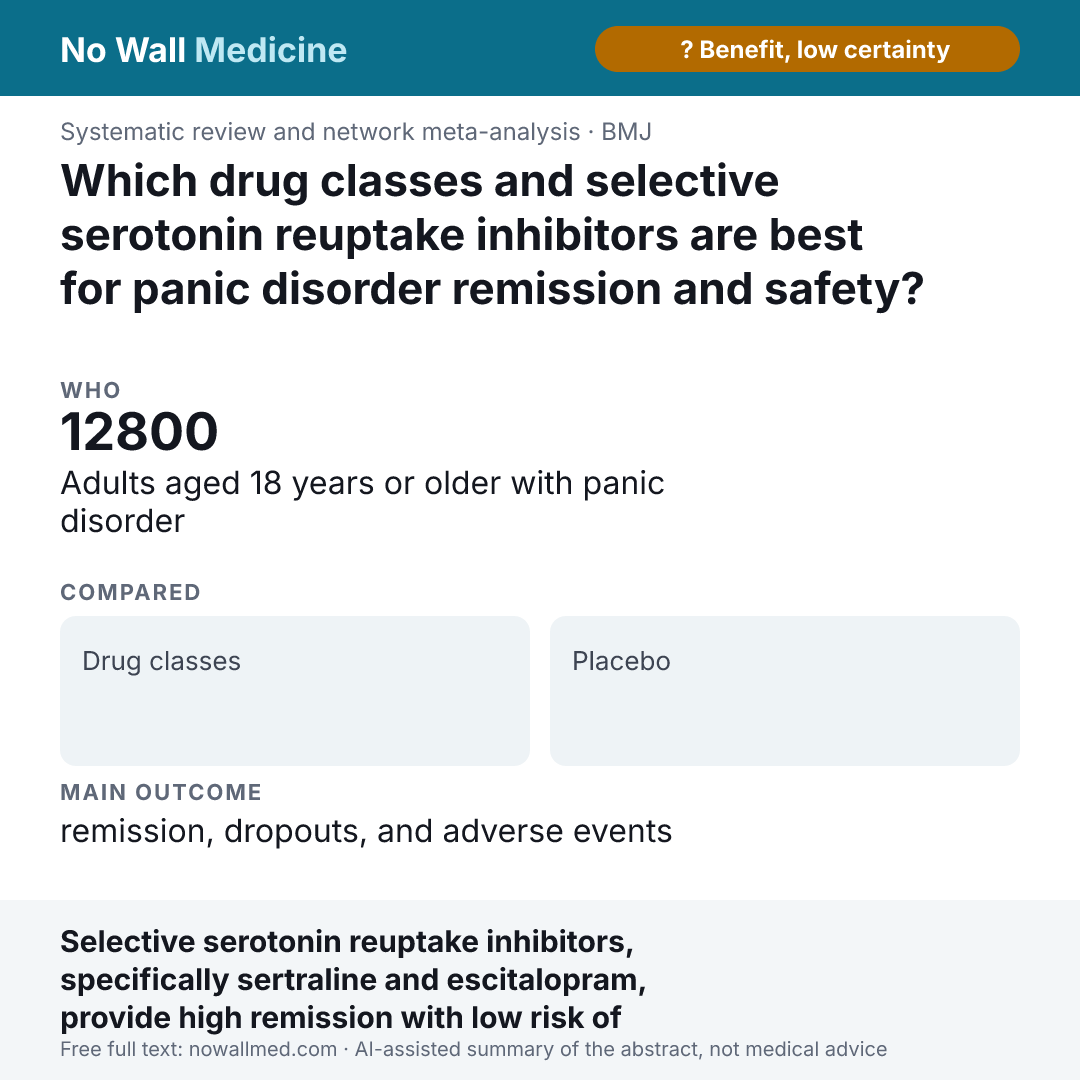
Which drug classes and selective serotonin reuptake inhibitors are best for panic disorder remission and safety?
Who
12800
Adults aged 18 years or older with panic disorder
Compared
Drug classes
Placebo
Main outcome
remission, dropouts, and adverse events
Result: risk ratios for remission: tricyclic antidepressants 1.39 (95% CI 1.26 to 1.54), benzodiazepines 1.47 (1.36 to 1.60), monoamine oxidase inhibitors 1.30 (1.00 to 1.69), selective serotonin reuptake inhibitors 1.38 (1.26 to 1.50), and serotonin-noradrenaline reuptake inhibitors 1.27 (1.12 to 1.45)
Bottom line: Selective serotonin reuptake inhibitors, specifically sertraline and escitalopram, provide high remission with low risk of adverse events.
Limitation: Findings based on moderate to very low certainty levels of evidence due to bias, inconsistency, and imprecision.
BMJ · 2022-01-19 · Save PNG
Clinical question: Which drug classes and selective serotonin reuptake inhibitors are best for panic disorder remission and safety?
Key points
- Researchers analyzed 87 randomized controlled trials involving 12,800 participants to compare drug classes for panic disorder.
- Selective serotonin reuptake inhibitors were associated with high remission and low risk of adverse events compared to other drug classes.
- Among individual selective serotonin reuptake inhibitors, sertraline and escitalopram were associated with high remission and acceptable risk of adverse events.
Limitation the authors note: The findings were based on moderate to very low certainty levels of evidence due to within study bias, inconsistency, and imprecision.
Headline and key points written with AI from the paper’s abstract, with every number checked against it. Read the paper before relying on them.
Was this summary helpful?
Abstract
Objective
To identify drug classes and individual selective serotonin reuptake inhibitors (SSRIs) with high rates of remission and low risk of adverse events in the treatment of panic disorder with or without agoraphobia. Design
Systematic review and network meta-analysis. Data sources
Embase, Medline, and ClinicalTrials.gov from inception to 17 June 2021. Eligibility criteria for study selection
Randomised controlled trials that included adults aged ≥18 years with a diagnosis of panic disorder, compared drugs used to treat the panic disorder, and measured the outcomes of interest, including remissions, dropouts, and adverse events. Methods
Risk of bias in the included studies was assessed using the revised Cochrane risk of bias tool for randomised trials. Direct meta-analyses were performed using random effects models. A two stage network meta-analysis with surface under the cumulative ranking curve (SUCRA) was used to estimate the comparative efficacy of drug classes and individual SSRIs. Results
87 studies including a total of 12 800 participants and 12 drug classes were eligible for inclusion. Almost all the studies (86/87) had some concern or were at high risk of bias. Network meta-analysis of remission with consistent results indicated that tricyclic antidepressants, benzodiazepines, monoamine oxidase inhibitors, SSRIs, and serotonin-noradrenaline reuptake inhibitors (SNRIs) were associated with significantly higher remission rates than placebo, with risk ratios of 1.39 (95% confidence interval 1.26 to 1.54), 1.47 (1.36 to 1.60), 1.30 (1.00 to 1.69), 1.38 (1.26 to 1.50), and 1.27 (1.12 to 1.45), respectively. SUCRAs identified benzodiazepines (84.5%, mean rank=2.4), tricyclic antidepressants (68.7%, 3.8), and SSRIs (66.4%, 4.0) as the top three best treatments for remission. However, tricyclic antidepressants, benzodiazepines, and SSRIs were also significantly associated with increased risk of adverse events compared with placebo, with risk ratios of 1.79 (1.47 to 2.19), 1.76 (1.50 to 2.06), and 1.19 (1.01 to 1.41), respectively. Consistency assumption of adverse events was upheld but could still be present on removal of studies with high percentages of women participants and those with agoraphobia. A SUCRA cluster ranking plot considering both remission and adverse events among all drug classes indicated that SSRIs were associated with high remission and low risk of adverse events. Among individual SSRIs, sertraline and escitalopram provided high remission with an acceptable risk of adverse events. Conclusion
The findings suggest that SSRIs provide high rates of remission with low risk of adverse events for the treatment of panic disorder. Among SSRIs, sertraline and escitalopram were associated with high remission and low risk of adverse events. The findings were, however, based on studies of moderate to very low certainty levels of evidence, mostly as a result of within study bias, inconsistency, and imprecision of the findings reported. Systematic review registration
PROSPERO CRD42020180638.
Abstract reproduced under the article’s CC BY NC licence.
Subject terms
Headline, design, result, key points, caveat and citation as plain text.
Cite this article
Chawla N, Anothaisintawee T, Charoenrungrueangchai K, et al. Drug treatment for panic disorder with or without agoraphobia: systematic review and network meta-analysis of randomised controlled trials. BMJ. 2022;376:e066084. doi:10.1136/bmj-2021-066084
Spotted a mistake? Suggest a correction