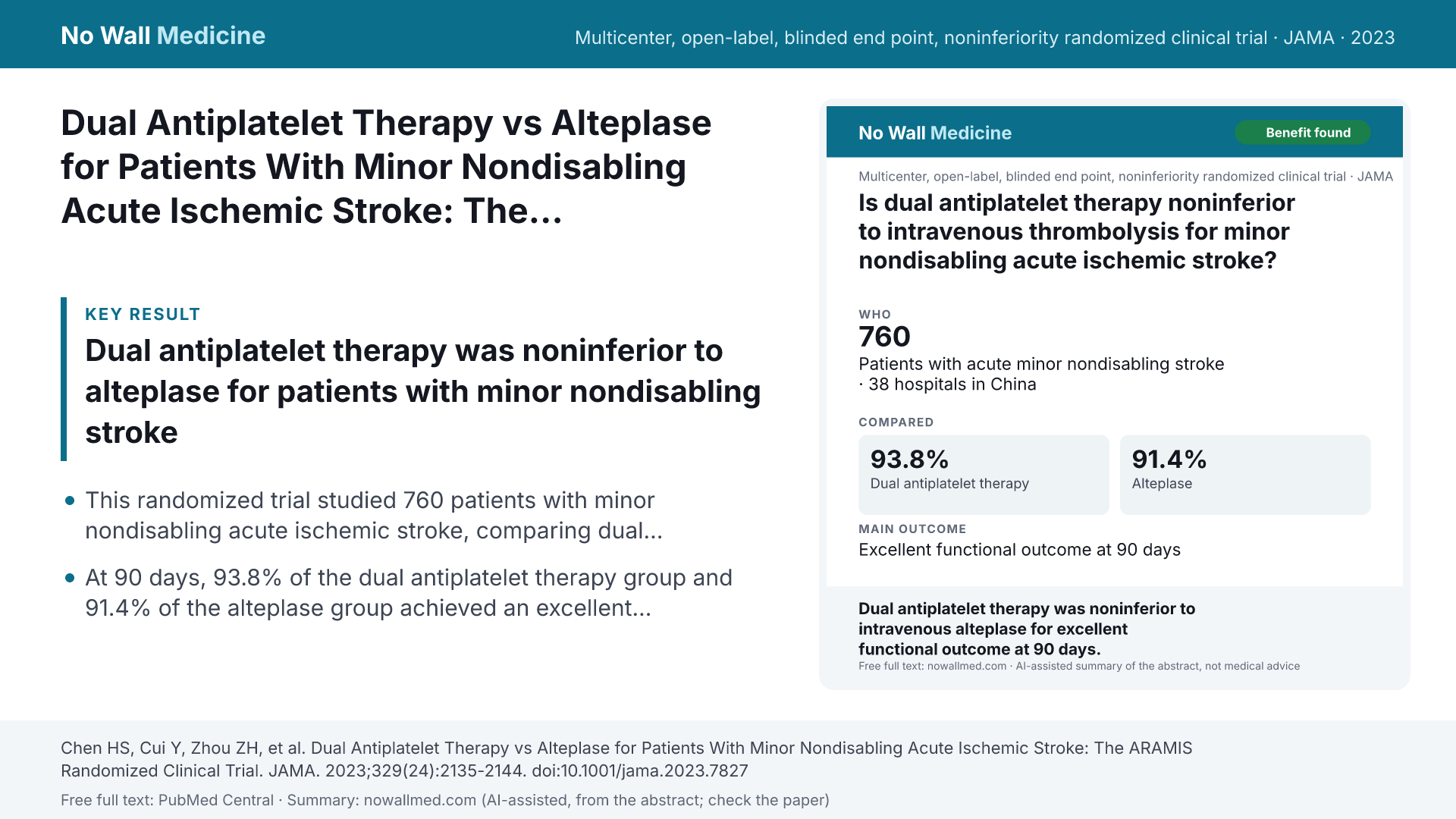
Dual antiplatelet therapy was noninferior to alteplase for patients with minor nondisabling stroke
Dual Antiplatelet Therapy vs Alteplase for Patients With Minor Nondisabling Acute Ischemic Stroke: The ARAMIS Randomized Clinical Trial
Multicenter, open-label, blinded end point, noninferiority randomized clinical trialBenefit found
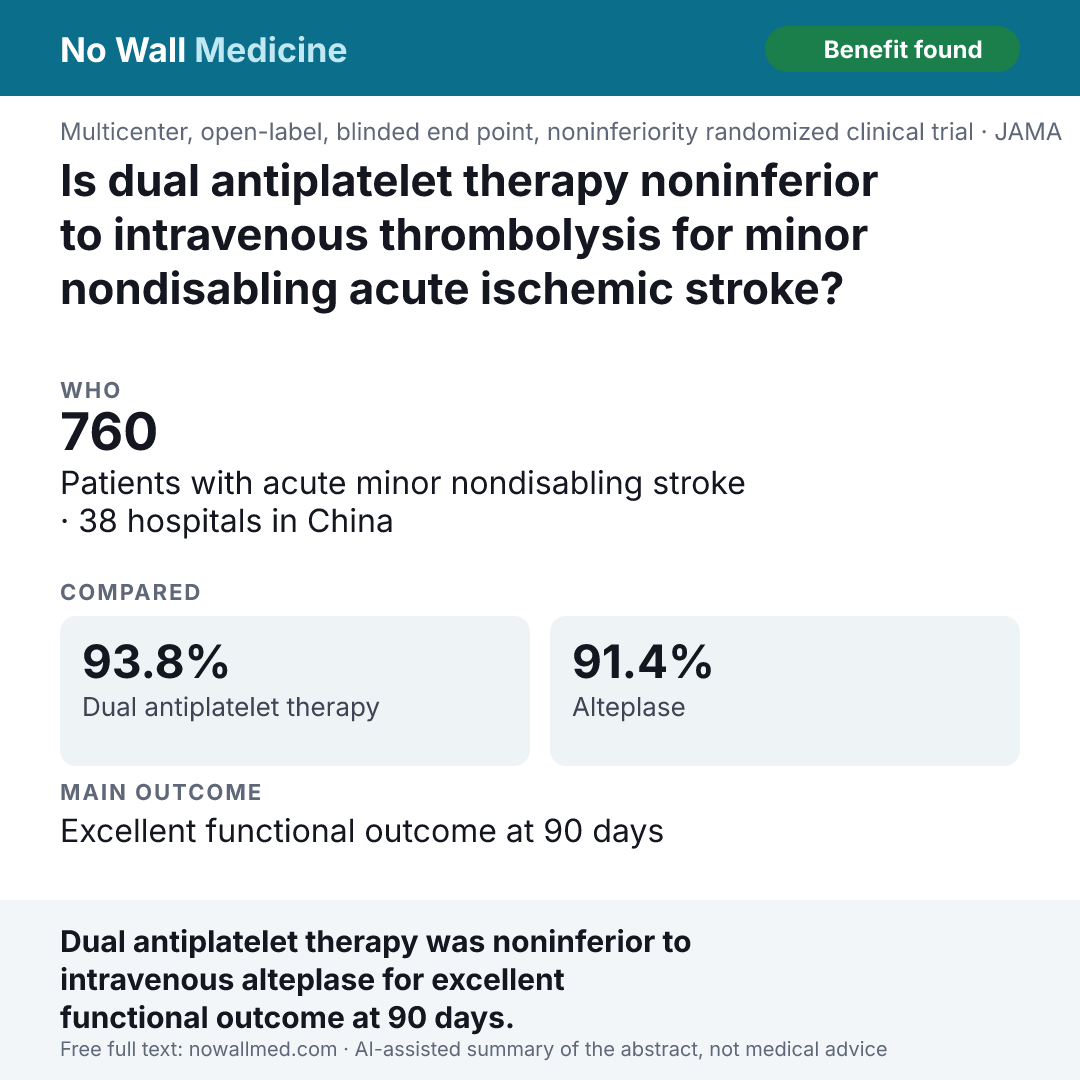
Is dual antiplatelet therapy noninferior to intravenous thrombolysis for minor nondisabling acute ischemic stroke?
Who
760
Patients with acute minor nondisabling stroke · 38 hospitals in China
Compared
93.8%Dual antiplatelet therapy (346/369)
91.4%Alteplase (320/350)
Main outcome
Excellent functional outcome at 90 days
Result: risk difference, 2.3% (95% CI, -1.5% to 6.2%)
Bottom line: Dual antiplatelet therapy was noninferior to intravenous alteplase for excellent functional outcome at 90 days.
JAMA · 2023-06-27 · Save PNG
Same trial (NCT03661411)
Papers we list that report this registered trial, oldest first. Read a secondary analysis alongside the main results.
- Main results Benefit found
This paper JAMA 2023-06 - Secondary analysis Benefit found
Dual antiplatelet therapy was associated with less neurological decline in minor strokes without large vessel occlusion Stroke 2024-10 - Secondary analysis Mixed results
Dual antiplatelet therapy was associated with lower neurological deterioration risk if started within 3 hours J Am Heart Assoc 2025-10
Clinical question: Is dual antiplatelet therapy noninferior to intravenous thrombolysis for minor nondisabling acute ischemic stroke?
Why it matters: The benefit of intravenous thrombolysis, a treatment to dissolve blood clots, is unknown for patients experiencing minor nondisabling strokes.
Key points
- This randomized trial studied 760 patients with minor nondisabling acute ischemic stroke, comparing dual antiplatelet therapy to intravenous alteplase.
- At 90 days, 93.8% of the dual antiplatelet therapy group and 91.4% of the alteplase group achieved an excellent functional outcome.
- Symptomatic intracerebral hemorrhage, or bleeding in the brain, occurred in 0.3% of the dual antiplatelet therapy group and 0.9% of the alteplase group.
Headline and key points written with AI from the paper’s abstract, with every number checked against it. Read the paper before relying on them.
Was this summary helpful?
Subject terms
Headline, design, result, key points, caveat and citation as plain text.
Cite this article
Chen HS, Cui Y, Zhou ZH, et al. Dual Antiplatelet Therapy vs Alteplase for Patients With Minor Nondisabling Acute Ischemic Stroke: The ARAMIS Randomized Clinical Trial. JAMA. 2023;329(24):2135-2144. doi:10.1001/jama.2023.7827
Spotted a mistake? Suggest a correction