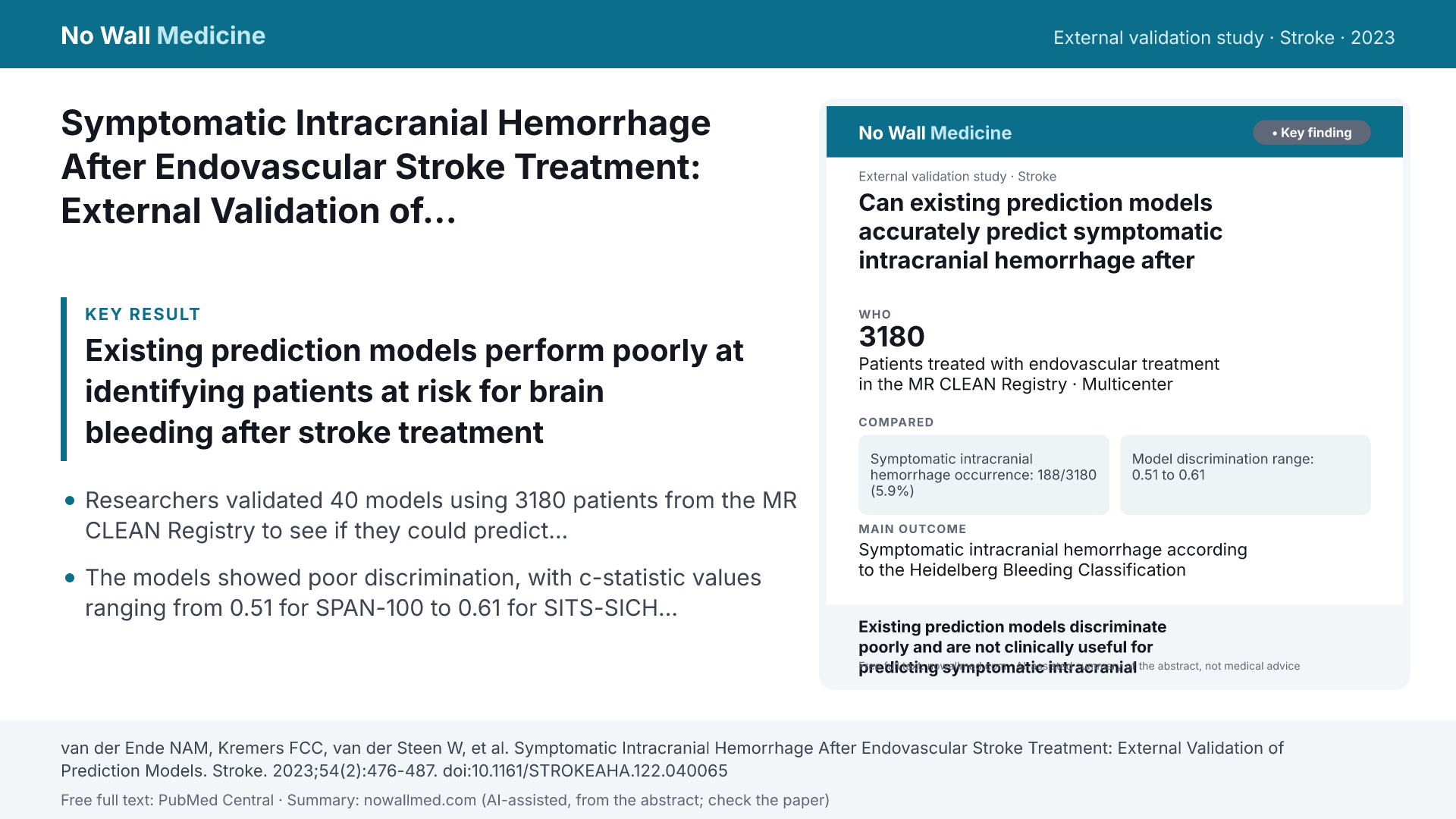
Existing prediction models perform poorly at identifying patients at risk for brain bleeding after stroke treatment
Symptomatic Intracranial Hemorrhage After Endovascular Stroke Treatment: External Validation of Prediction Models
External validation studyHarm found
Can existing prediction models accurately predict symptomatic intracranial hemorrhage after endovascular treatment?
Who
3180
Patients treated with endovascular treatment in the MR CLEAN Registry · Multicenter Randomized Clinical Trial in the Netherlands
Compared
Symptomatic intracranial hemorrhage occurrence: 188/3180 (5.9%)
Model discrimination range: 0.51 to 0.61
Main outcome
Symptomatic intracranial hemorrhage according to the Heidelberg Bleeding Classification
Bottom line: Existing prediction models discriminate poorly and are not clinically useful for predicting symptomatic intracranial hemorrhage after endovascular treatment.
Stroke · 2023-01-23Download image
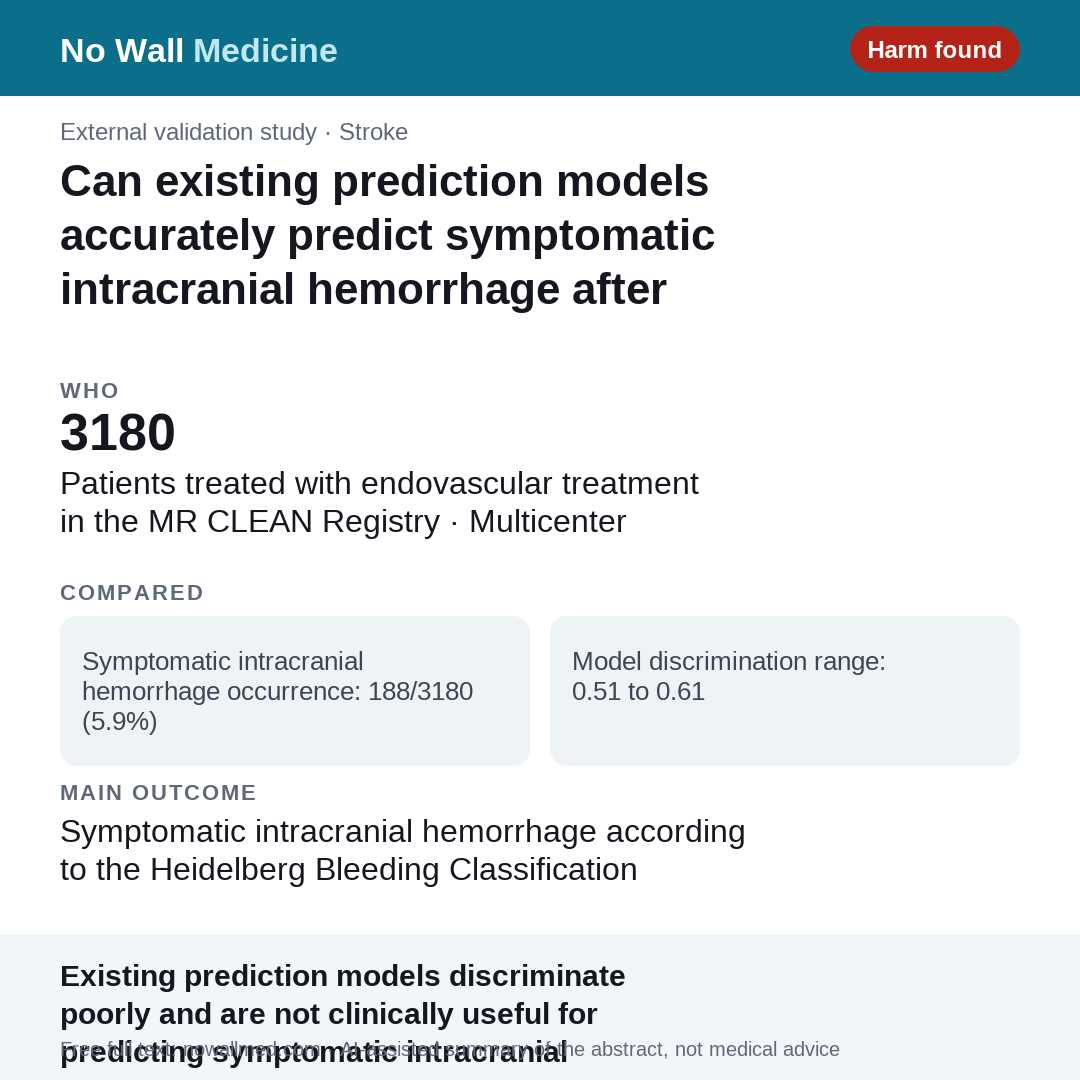
Clinical question: Can existing prediction models accurately predict symptomatic intracranial hemorrhage after endovascular treatment?
Why it matters: It is unknown if existing prediction models can accurately identify patients at risk for symptomatic intracranial hemorrhage following endovascular treatment in routine clinical practice.
Key points
- Researchers validated 40 models using 3180 patients from the MR CLEAN Registry to see if they could predict symptomatic intracranial hemorrhage, which is bleeding in the brain.
- The models showed poor discrimination, with c-statistic values ranging from 0.51 for SPAN-100 to 0.61 for SITS-SICH and STARTING-SICH.
- Symptomatic intracranial hemorrhage occurred in 188/3180 (5.9%) patients in the registry used for validation.
Headline and key points written with AI from the paper’s abstract, with every number checked against it. Read the paper before relying on them.
Was this summary helpful?
Subject terms
Cite this article
van der Ende NAM, Kremers FCC, van der Steen W, Venema E, Kappelhof M, Majoie CBLM. Symptomatic Intracranial Hemorrhage After Endovascular Stroke Treatment: External Validation of Prediction Models. Stroke. 2023. doi:10.1161/STROKEAHA.122.040065
Spotted a mistake? Suggest a correction
Top studies every Monday
The week’s key trials and guidelines in your specialties, plus any topics you follow. By email, free.
Get the weekly digest