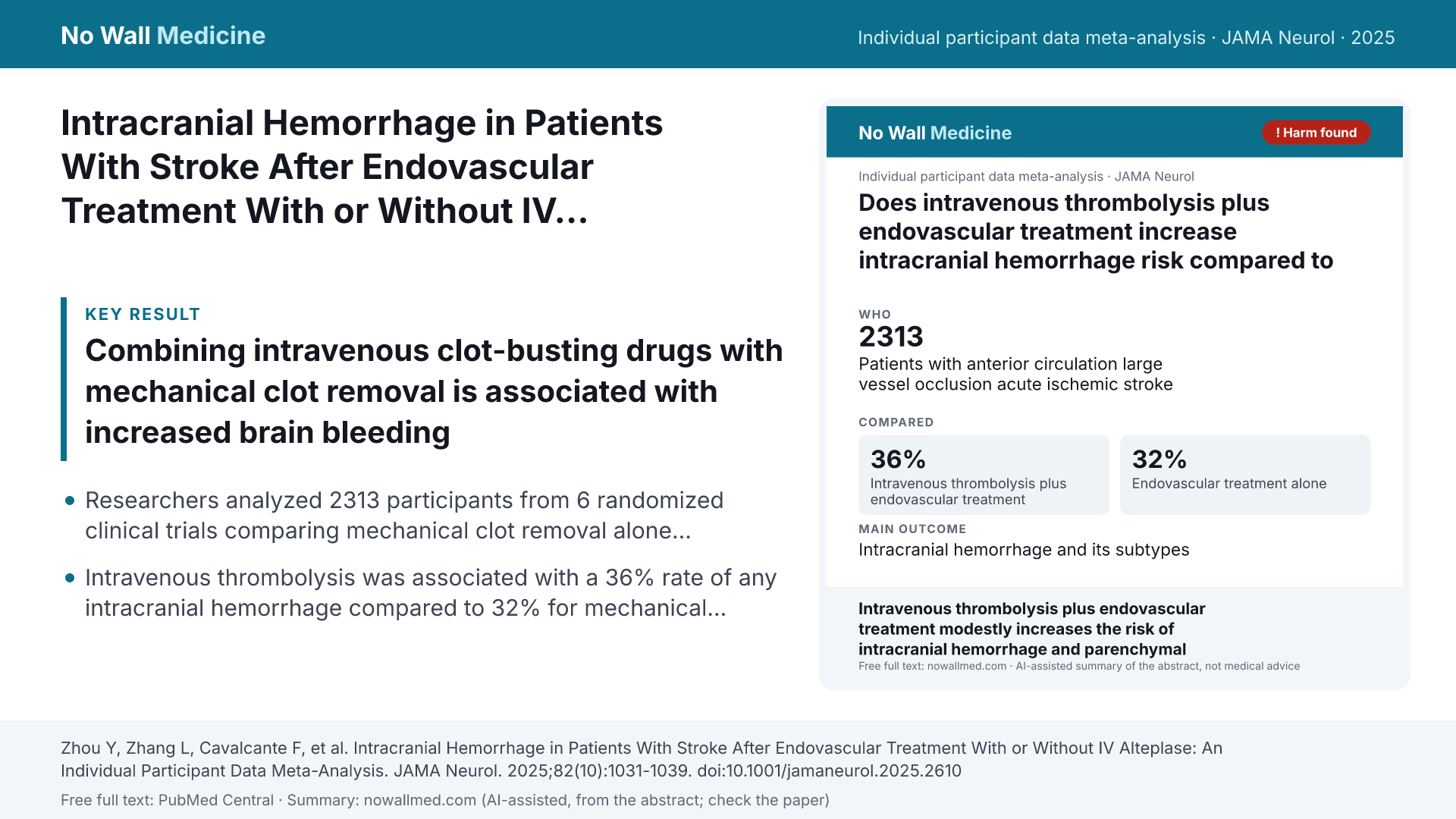
Combining intravenous clot-busting drugs with mechanical clot removal is associated with increased brain bleeding
Intracranial Hemorrhage in Patients With Stroke After Endovascular Treatment With or Without IV Alteplase: An Individual Participant Data Meta-Analysis
Individual participant data meta-analysisHarm found
Does intravenous thrombolysis plus endovascular treatment increase intracranial hemorrhage risk compared to endovascular treatment alone?
Who
2313
Patients with anterior circulation large vessel occlusion acute ischemic stroke
Compared
36%Intravenous thrombolysis plus endovascular treatment (411 of 1133)
32%Endovascular treatment alone (357 of 1128)
Main outcome
Intracranial hemorrhage and its subtypes
Result: adjusted odds ratio 1.23 (95% CI 1.02-1.49)
Bottom line: Intravenous thrombolysis plus endovascular treatment modestly increases the risk of intracranial hemorrhage and parenchymal hematoma.
JAMA Neurol · 2025-08-11 · Save PNG
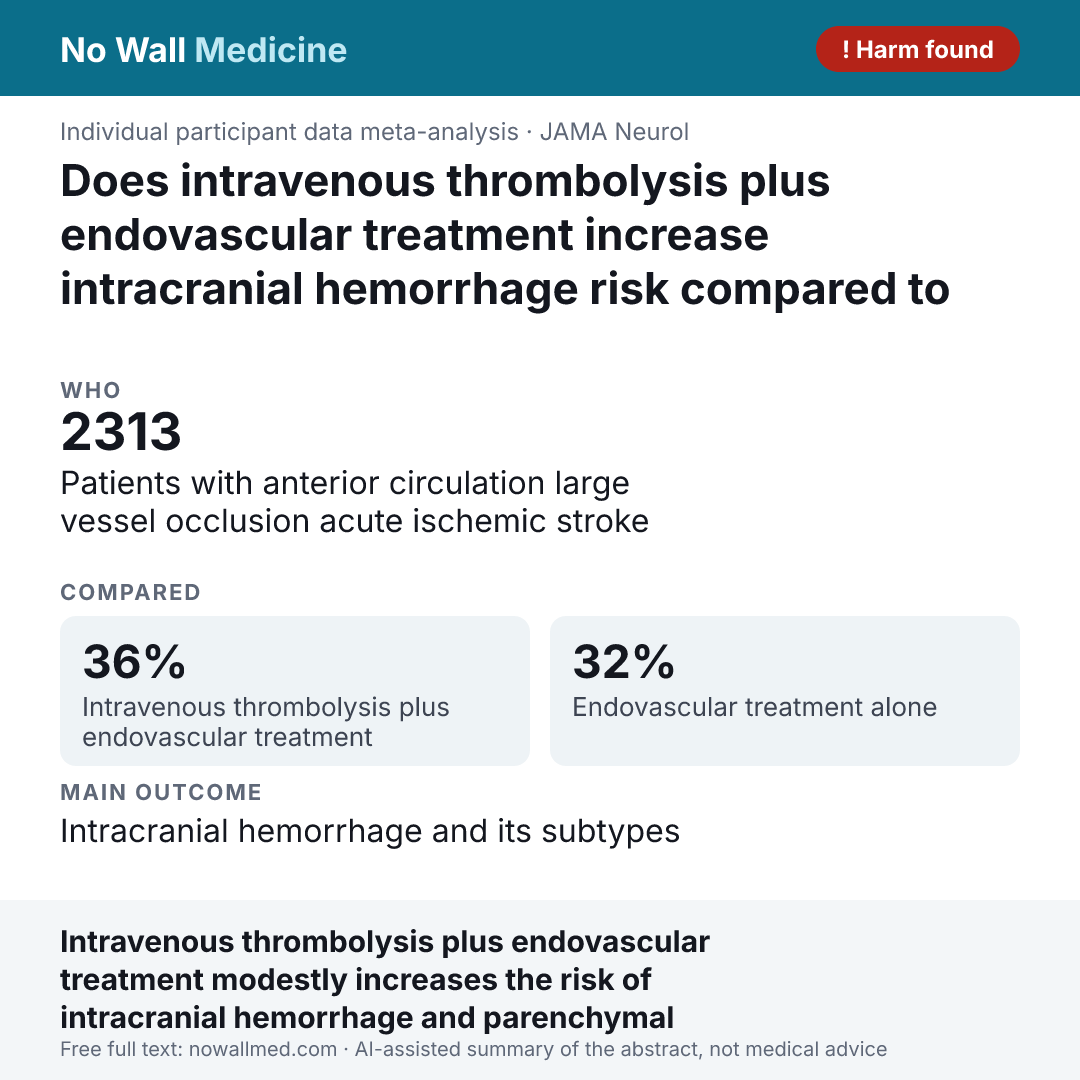
Clinical question: Does intravenous thrombolysis plus endovascular treatment increase intracranial hemorrhage risk compared to endovascular treatment alone?
Why it matters: It is not well understood how adding intravenous clot-busting drugs to mechanical clot removal affects the frequency and subtypes of brain bleeding in stroke patients.
Key points
- Researchers analyzed 2313 participants from 6 randomized clinical trials comparing mechanical clot removal alone to mechanical clot removal plus intravenous thrombolysis.
- Intravenous thrombolysis was associated with a 36% rate of any intracranial hemorrhage compared to 32% for mechanical clot removal alone.
- The use of intravenous thrombolysis was also associated with a higher rate of parenchymal hematoma, which is a type of brain bleed, at 7% versus 5%.
Headline and key points written with AI from the paper’s abstract, with every number checked against it. Read the paper before relying on them.
Was this summary helpful?
Subject terms
Headline, design, result, key points, caveat and citation as plain text.
Cite this article
Zhou Y, Zhang L, Cavalcante F, et al. Intracranial Hemorrhage in Patients With Stroke After Endovascular Treatment With or Without IV Alteplase: An Individual Participant Data Meta-Analysis. JAMA Neurol. 2025;82(10):1031-1039. doi:10.1001/jamaneurol.2025.2610
Spotted a mistake? Suggest a correction