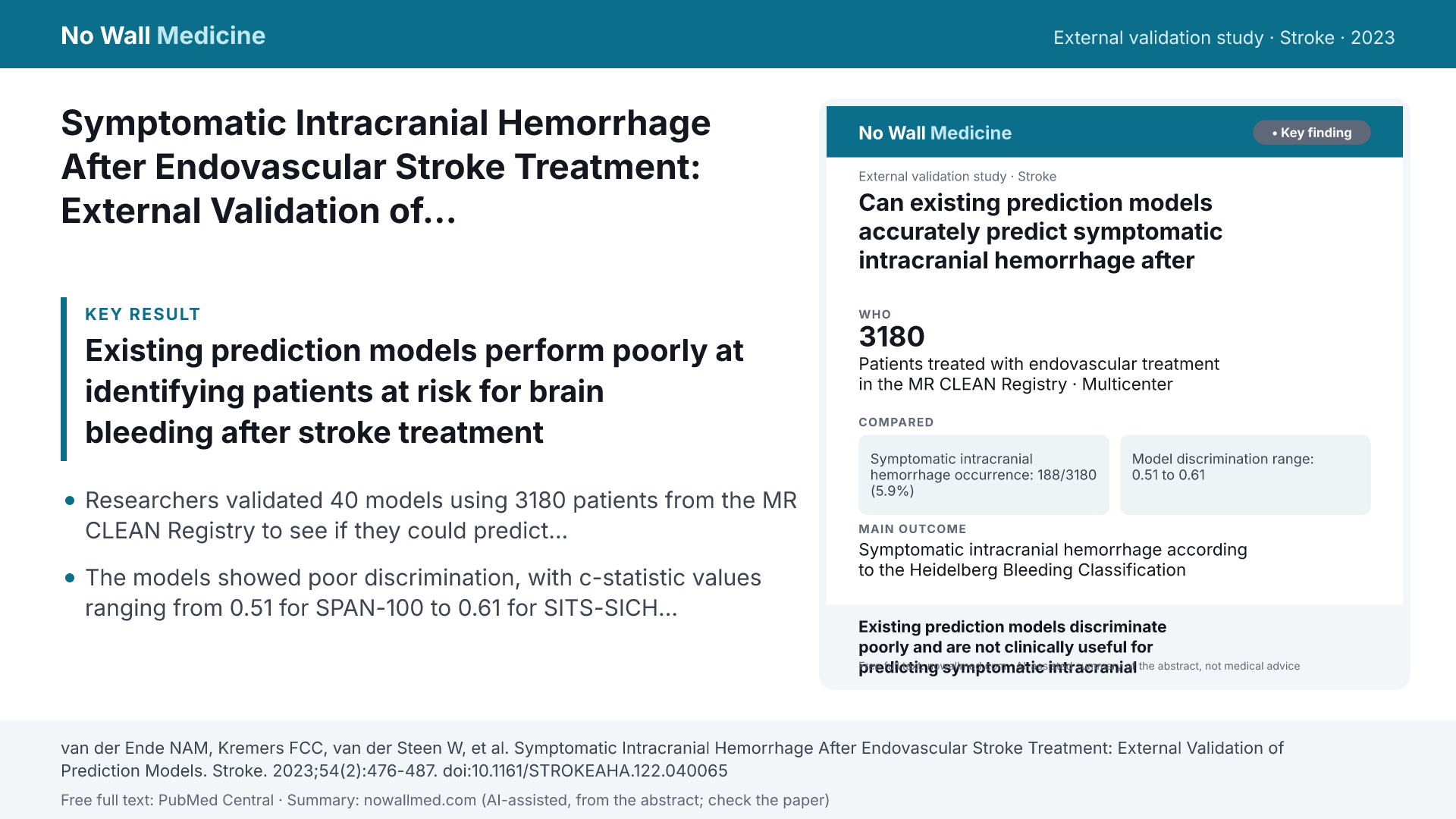
Symptomatic Intracranial Hemorrhage After Endovascular Stroke Treatment: External Validation of Prediction Models
Key result: Existing prediction models perform poorly at identifying patients at risk for brain bleeding after stroke treatment
External validation studyKey finding
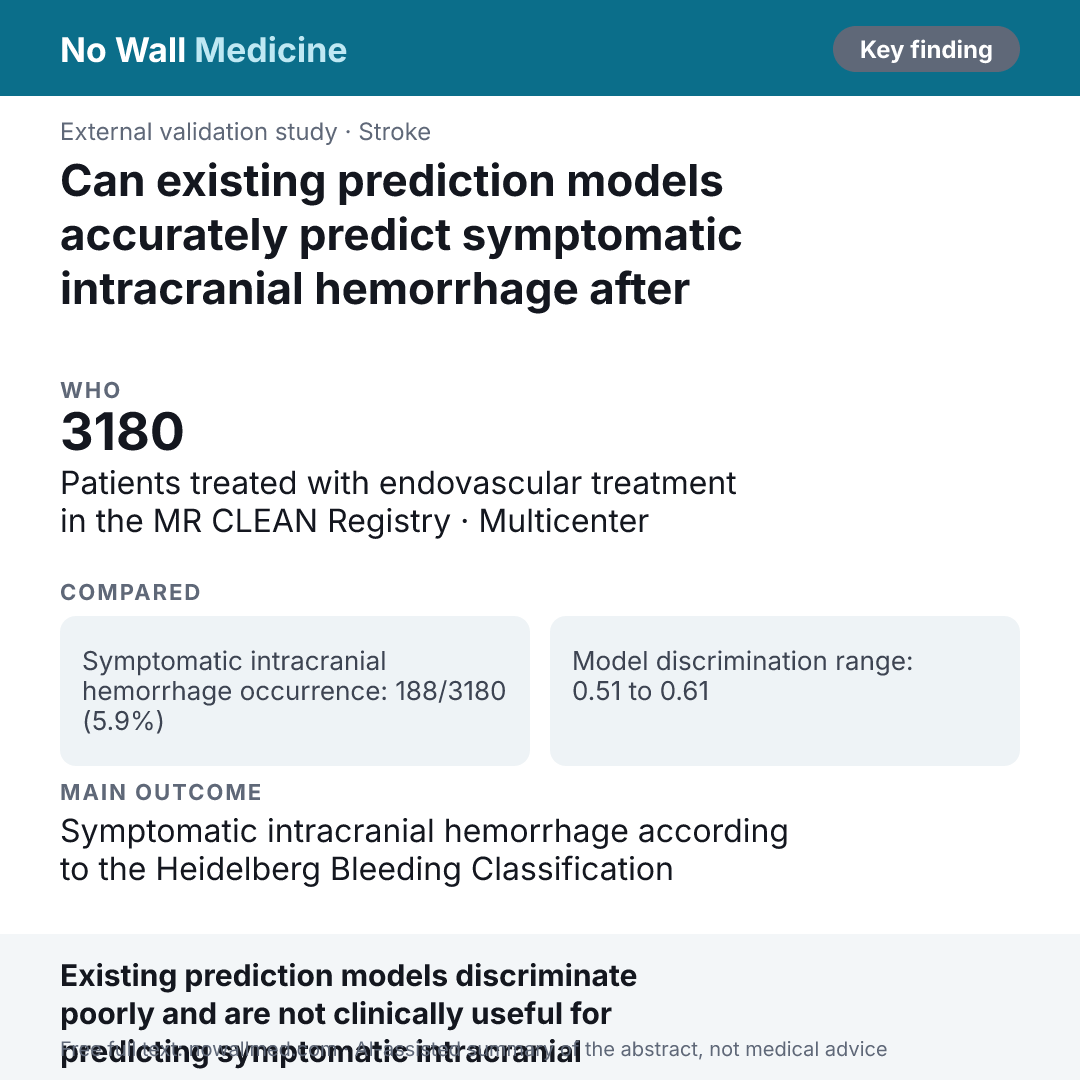
Can existing prediction models accurately predict symptomatic intracranial hemorrhage after endovascular treatment?
Who
3180
Patients treated with endovascular treatment in the MR CLEAN Registry · Multicenter Randomized Clinical Trial in the Netherlands
Compared
Symptomatic intracranial hemorrhage occurrence: 188/3180 (5.9%)
Model discrimination range: 0.51 to 0.61
Main outcome
Symptomatic intracranial hemorrhage according to the Heidelberg Bleeding Classification
Bottom line: Existing prediction models discriminate poorly and are not clinically useful for predicting symptomatic intracranial hemorrhage after endovascular treatment.
Stroke · 2023-01-23 · Save PNG
Key points
- Researchers validated 40 models using 3180 patients from the MR CLEAN Registry to see if they could predict symptomatic intracranial hemorrhage, which is bleeding in the brain.
- The models showed poor discrimination, with c-statistic values ranging from 0.51 for SPAN-100 to 0.61 for SITS-SICH and STARTING-SICH.
- Symptomatic intracranial hemorrhage occurred in 188/3180 (5.9%) patients in the registry used for validation.
Discussion prompts
- Would these patients look like yours? Who was left out?
- Is the main outcome one that matters to patients?
- Is the difference large enough to change what you do?
Cite: van der Ende NAM, Kremers FCC, van der Steen W, et al. Symptomatic Intracranial Hemorrhage After Endovascular Stroke Treatment: External Validation of Prediction Models. Stroke. 2023;54(2):476-487. doi:10.1161/STROKEAHA.122.040065
Free full text: PubMed Central · Summary and visual abstract: nowallmed.com/a/symptomatic-intracranial-hemorrhage-after-endovascular-stroke-1vtawv2/ (AI-assisted from the abstract; check the paper before relying on it).