Dual sensory impairment is linked to a 72% higher risk of cognitive decline
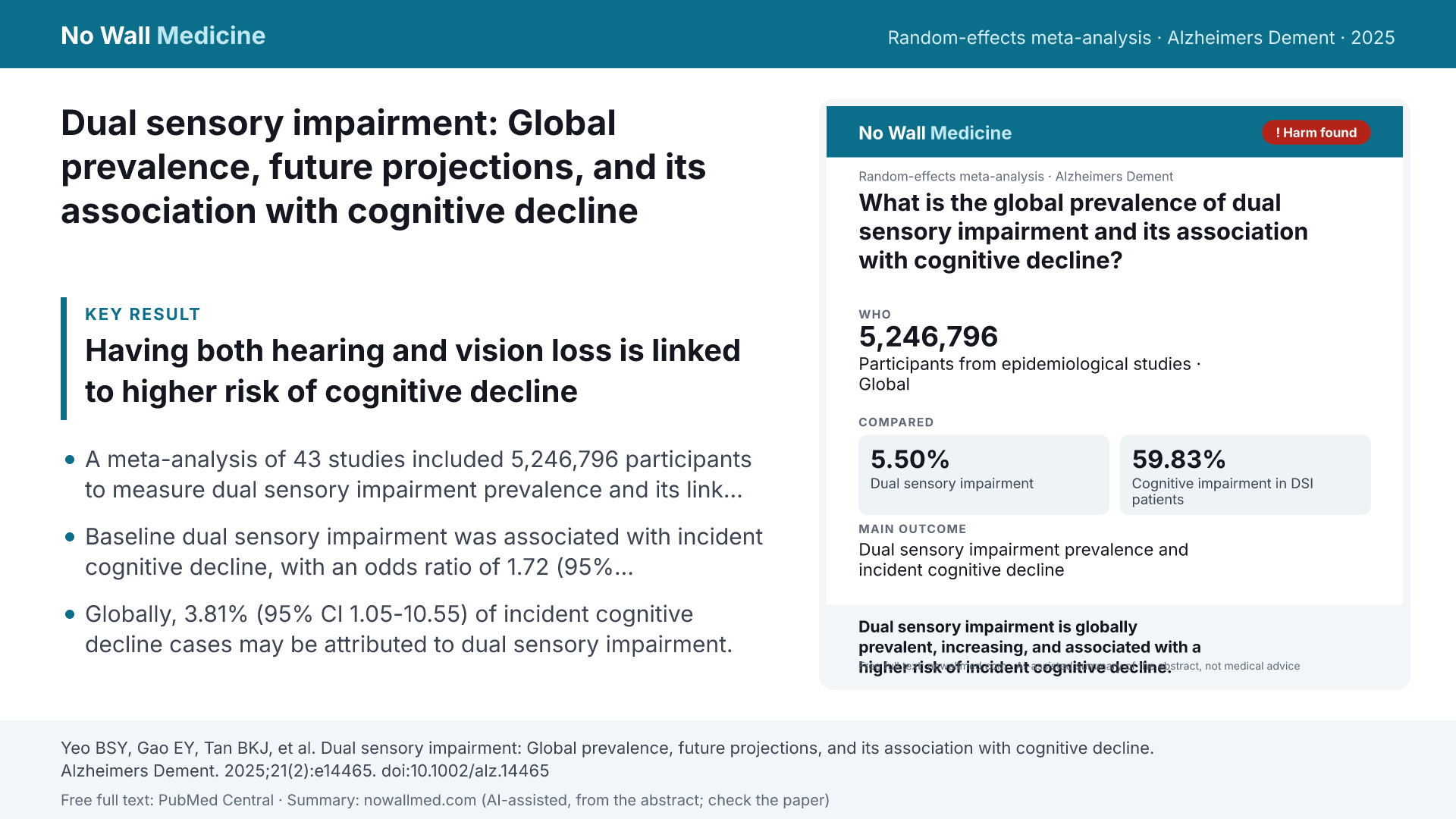
Dual sensory impairment: Global prevalence, future projections, and its association with cognitive decline
Random-effects meta-analysisHarm found
What is the global prevalence of dual sensory impairment and its association with cognitive decline?
Who
5,246,796
Participants from epidemiological studies · Global
Compared
5.50%Dual sensory impairment (95% confidence interval 2.88%-10.26%)
59.83%Cognitive impairment in DSI patients (95%CI 41.03-76.12)
Main outcome
Dual sensory impairment prevalence and incident cognitive decline
Result: odds ratio 1.72 (95%CI 1.37-2.15)
Bottom line: Dual sensory impairment is globally prevalent, increasing, and associated with a higher risk of incident cognitive decline.
Alzheimers Dement · 2025-01-30Download image
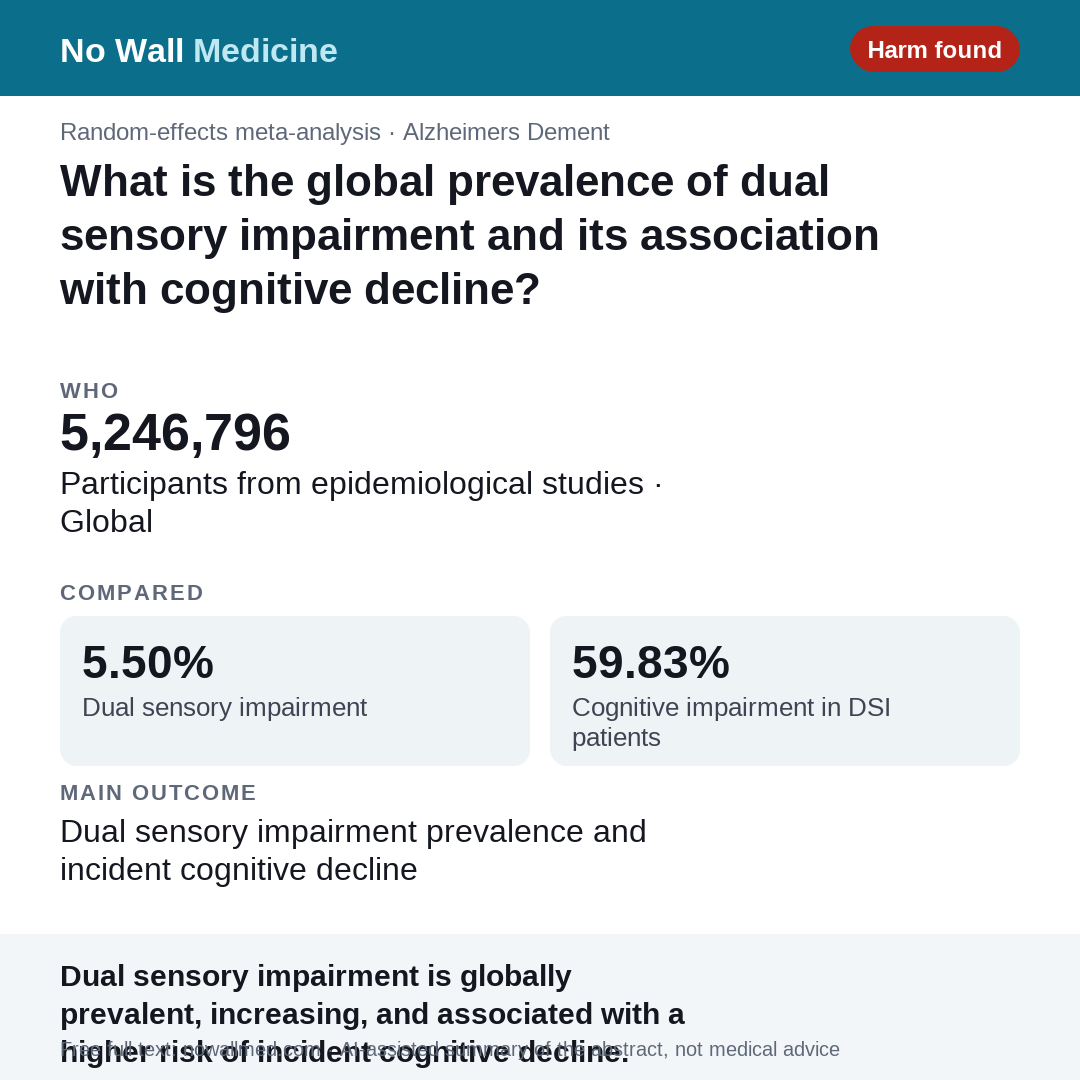
Clinical question: What is the global prevalence of dual sensory impairment and its association with cognitive decline?
Why it matters: The global prevalence of dual sensory impairment and the strength of its link to cognitive decline were previously unclear.
Key points
- A meta-analysis of 43 studies involving 5,246,796 participants found a global prevalence of 5.50% for dual sensory impairment, which is having both hearing and vision problems.
- Dual sensory impairment was associated with a 72% greater longitudinal risk of incident cognitive decline, with 3.81% of global cases potentially linked to these impairments.
- The prevalence of dual sensory impairment is projected to increase by 27.2% between 2025 and 2050.
Headline and key points written with AI from the paper’s abstract, with every number checked against it. Read the paper before relying on them.
Was this summary helpful?
Subject terms
Cite this article
Yeo BSY, Gao EY, Tan BKJ, Ong BDC, Cho RWY, Lim CY. Dual sensory impairment: Global prevalence, future projections, and its association with cognitive decline. Alzheimers Dement. 2025. doi:10.1002/alz.14465
Spotted a mistake? Suggest a correction
Top studies every Monday
The week’s key trials and guidelines in your specialties, plus any topics you follow. By email, free.
Get the weekly digest