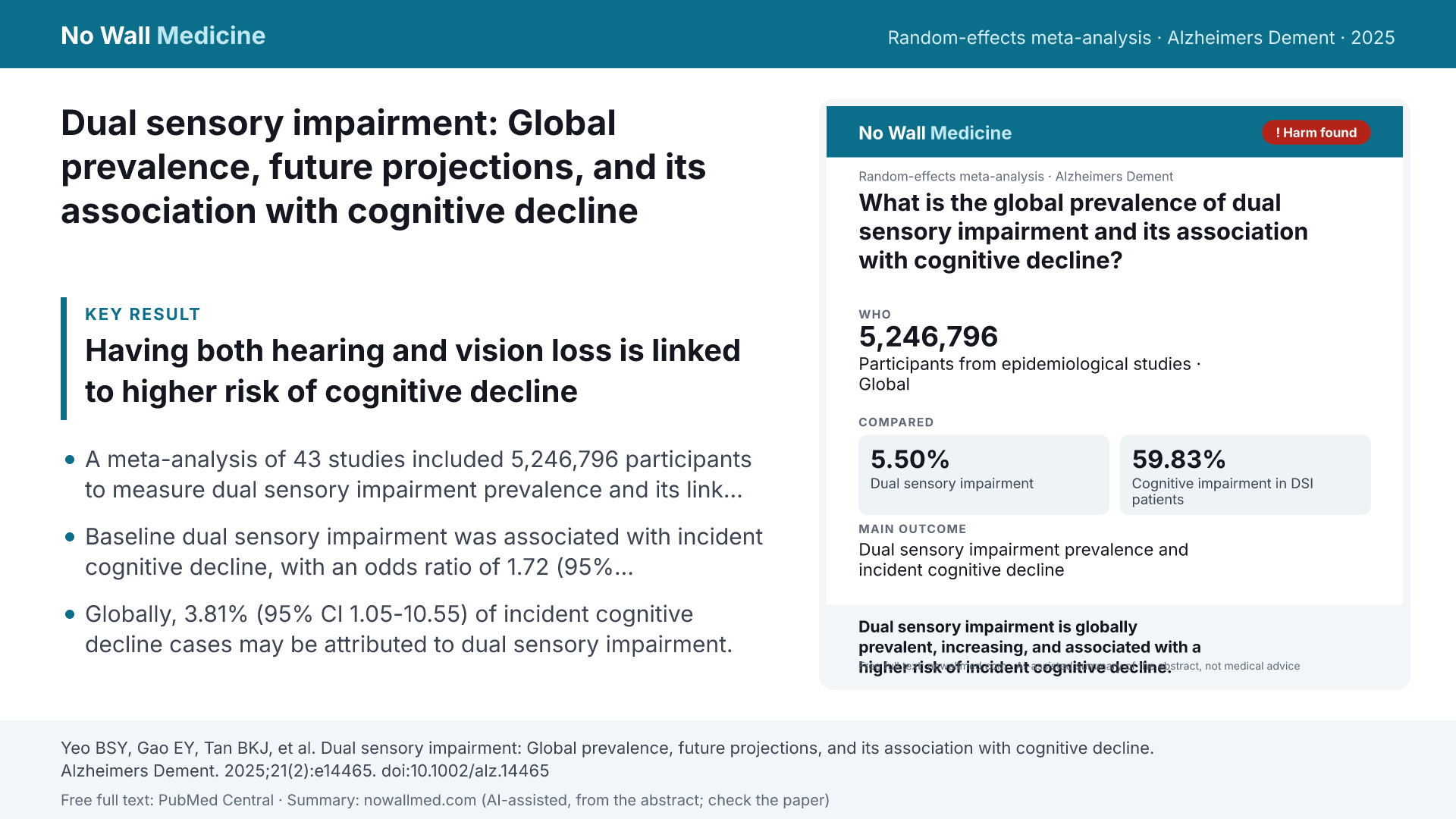
Dual sensory impairment: Global prevalence, future projections, and its association with cognitive decline
Key result: Having both hearing and vision loss is linked to higher risk of cognitive decline
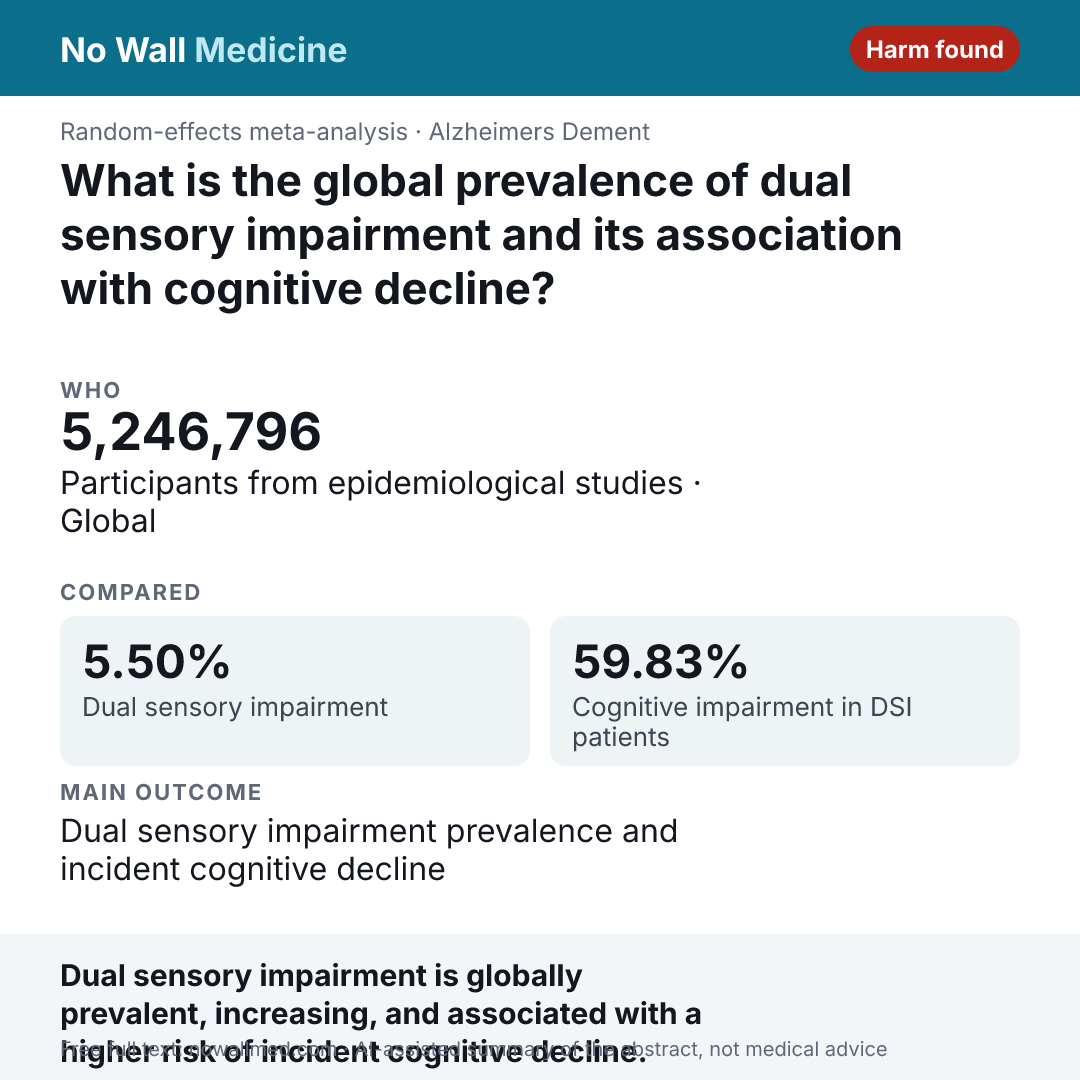
Random-effects meta-analysisHarm found
What is the global prevalence of dual sensory impairment and its association with cognitive decline?
Who
5,246,796
Participants from epidemiological studies · Global
Compared
5.50%Dual sensory impairment (95% confidence interval 2.88%-10.26%)
59.83%Cognitive impairment in DSI patients (95%CI 41.03-76.12)
Main outcome
Dual sensory impairment prevalence and incident cognitive decline
Result: odds ratio 1.72 (95%CI 1.37-2.15)
Bottom line: Dual sensory impairment is globally prevalent, increasing, and associated with a higher risk of incident cognitive decline.
Alzheimers Dement · 2025-01-30 · Save PNG
Key points
- A meta-analysis of 43 studies included 5,246,796 participants to measure dual sensory impairment prevalence and its link to cognitive decline.
- Baseline dual sensory impairment was associated with incident cognitive decline, with an odds ratio of 1.72 (95% CI 1.37-2.15).
- Globally, 3.81% (95% CI 1.05-10.55) of incident cognitive decline cases may be attributed to dual sensory impairment.
Why it matters: The global prevalence of dual sensory impairment and the magnitude of its association with cognitive decline were previously unclear.
Discussion prompts
- Would these patients look like yours? Who was left out?
- Is the main outcome one that matters to patients?
- Is the difference large enough to change what you do?
Cite: Yeo BSY, Gao EY, Tan BKJ, et al. Dual sensory impairment: Global prevalence, future projections, and its association with cognitive decline. Alzheimers Dement. 2025;21(2):e14465. doi:10.1002/alz.14465
Free full text: PubMed Central · Summary and visual abstract: nowallmed.com/a/dual-sensory-impairment-global-prevalence-future-projections-and-its-3fny83/ (AI-assisted from the abstract; check the paper before relying on it).