Supervised treadmill exercise improves walking distance in peripheral artery disease after 12 weeks
Duration of Supervised Exercise Necessary for Meaningful Improvement in Peripheral Artery Disease
Randomized trialBenefit found
How long is supervised treadmill exercise needed for meaningful improvement in peripheral artery disease?
Who
210
People with lower extremity peripheral artery disease
Compared
Supervised treadmill exercise 3 time weekly: 33.9 m improvement at 26-week follow-up
Nonexercise control group
Main outcome
Six-minute walk distance and Walking Impairment Questionnaire distance score
Bottom line: Meaningful gains in walking distance were measurable by week 12 of supervised treadmill exercise.
J Am Heart Assoc · 2025-09-05Download image
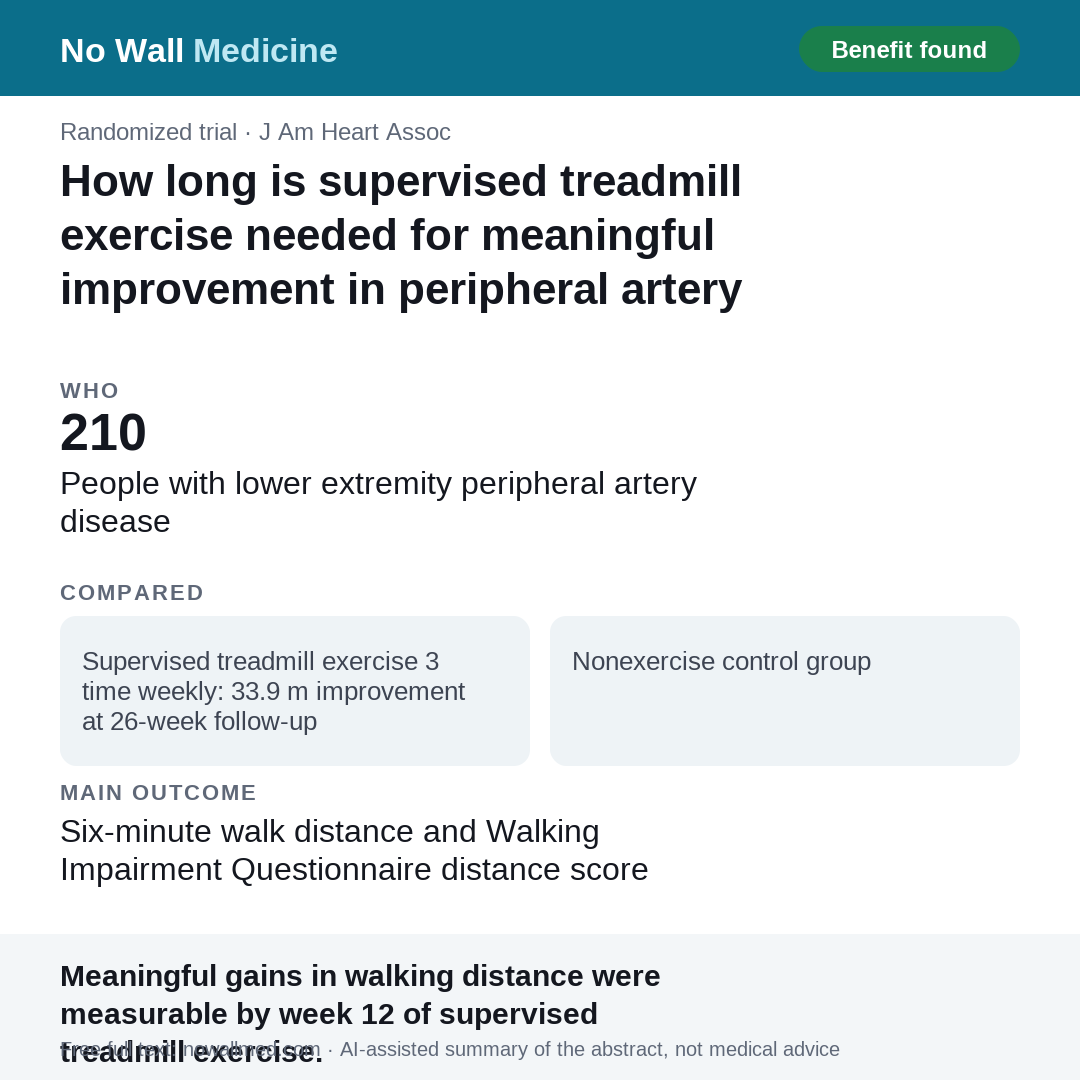
Clinical question: How long is supervised treadmill exercise needed for meaningful improvement in peripheral artery disease?
Why it matters: The time required to achieve meaningful improvements in walking distance and patient-reported walking ability during supervised exercise for peripheral artery disease is unknown.
Key points
- Researchers randomized 210 participants with peripheral artery disease to supervised treadmill exercise three times weekly or a nonexercise control group for 6 months.
- Supervised exercise improved the 6-minute walk distance by 13.0 m at 6 weeks, 31.8 m at 12 weeks, and 33.9 m at 26 weeks compared to controls.
- The Walking Impairment Questionnaire distance score showed a statistically significant increase of +6.59 at 12 weeks, but this difference was not statistically significant at 6 or 26 weeks.
Headline and key points written with AI from the paper’s abstract, with every number checked against it. Read the paper before relying on them.
Was this summary helpful?
Subject terms
Cite this article
McDermott MM, Zhang D, Zhao L, Polonsky T, Ferrucci L, Ho KJ. Duration of Supervised Exercise Necessary for Meaningful Improvement in Peripheral Artery Disease. J Am Heart Assoc. 2025. doi:10.1161/JAHA.124.040058
Spotted a mistake? Suggest a correction
Top studies every Monday
The week’s key trials and guidelines in your specialties, plus any topics you follow. By email, free.
Get the weekly digest