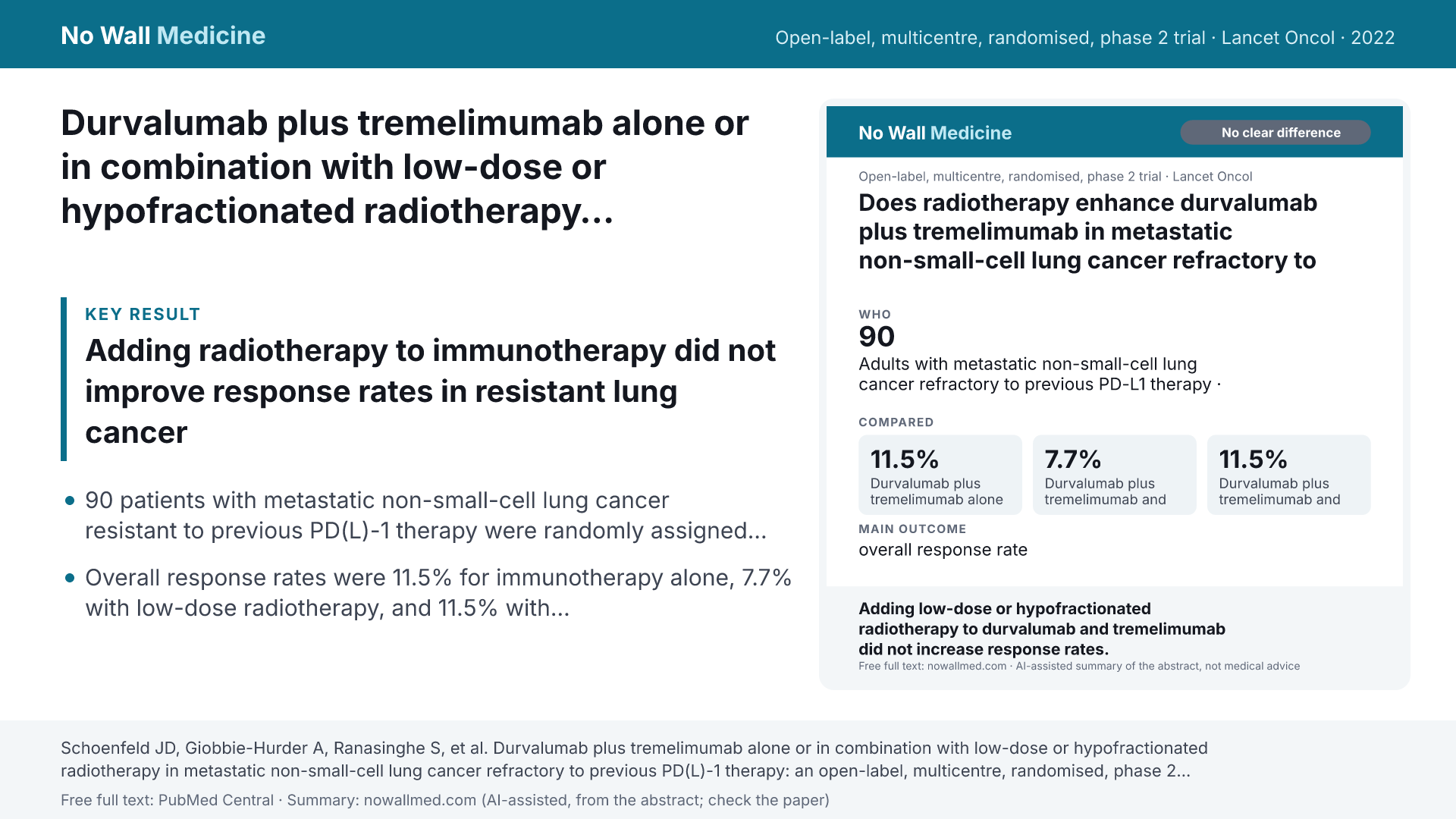
Durvalumab plus tremelimumab alone or in combination with low-dose or hypofractionated radiotherapy in metastatic non-small-cell lung cancer refractory to previous PD(L)-1 therapy: an open-label, multicentre, randomised, phase 2 trial
Key result: Adding radiotherapy to immunotherapy did not improve response rates in resistant lung cancer
Key points
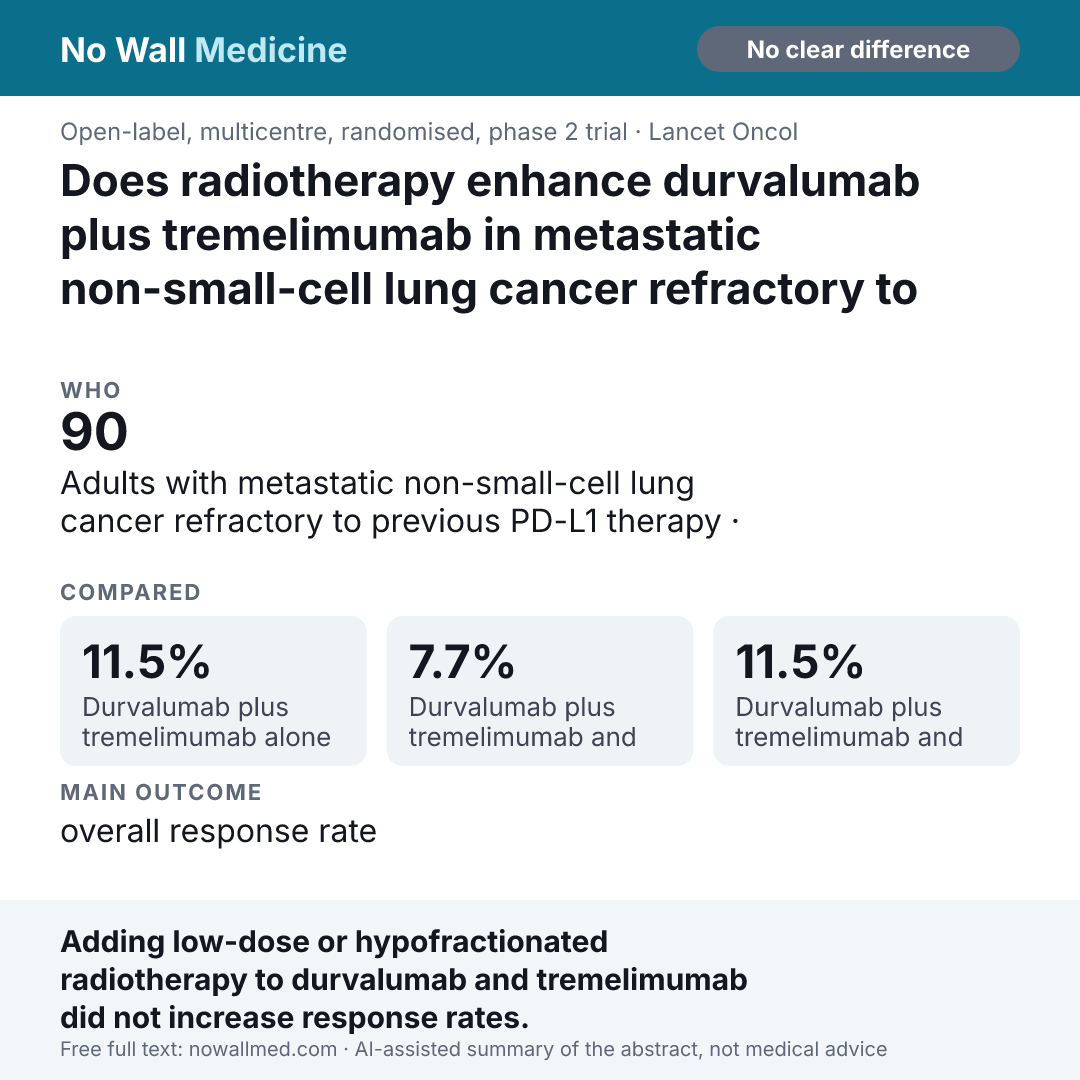
- 90 patients with metastatic non-small-cell lung cancer resistant to previous PD(L)-1 therapy were randomly assigned to three treatment groups.
- Overall response rates were 11.5% for immunotherapy alone, 7.7% with low-dose radiotherapy, and 11.5% with hypofractionated radiotherapy, with no significant differences.
- Treatment-related serious adverse events occurred in 4% of the immunotherapy-alone group, 19% of the low-dose radiotherapy group, and 15% of the hypofractionated group.
Limitation the authors note: The trial was stopped early due to futility assessed in an interim analysis.
Discussion prompts
- Would these patients look like yours? Who was left out?
- Is the main outcome one that matters to patients?
- Is the difference large enough to change what you do?
Cite: Schoenfeld JD, Giobbie-Hurder A, Ranasinghe S, et al. Durvalumab plus tremelimumab alone or in combination with low-dose or hypofractionated radiotherapy in metastatic non-small-cell lung cancer refractory to previous PD(L)-1 therapy: an open-label, multicentre, randomised, phase 2 trial. Lancet Oncol. 2022;23(2):279-291. doi:10.1016/S1470-2045(21)00658-6
Free full text: PubMed Central · Summary and visual abstract: nowallmed.com/a/durvalumab-plus-tremelimumab-alone-or-in-combination-with-low-dose-or-1fijoa2/ (AI-assisted from the abstract; check the paper before relying on it).