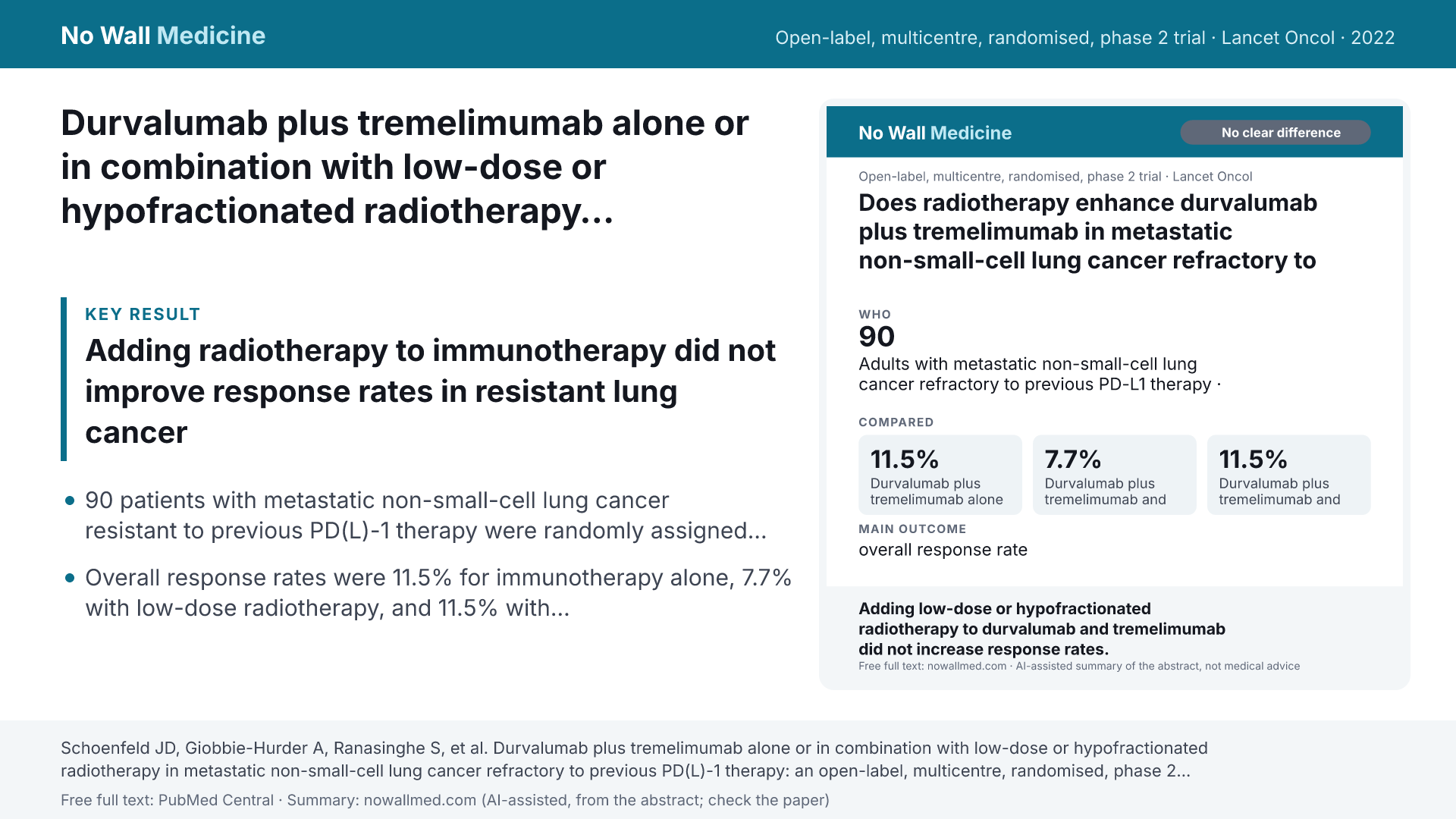
Adding radiotherapy to immunotherapy did not improve response rates in resistant lung cancer
Durvalumab plus tremelimumab alone or in combination with low-dose or hypofractionated radiotherapy in metastatic non-small-cell lung cancer refractory to previous PD(L)-1 therapy: an open-label, multicentre, randomised, phase 2 trial
Open-label, multicentre, randomised, phase 2 trialNo clear difference
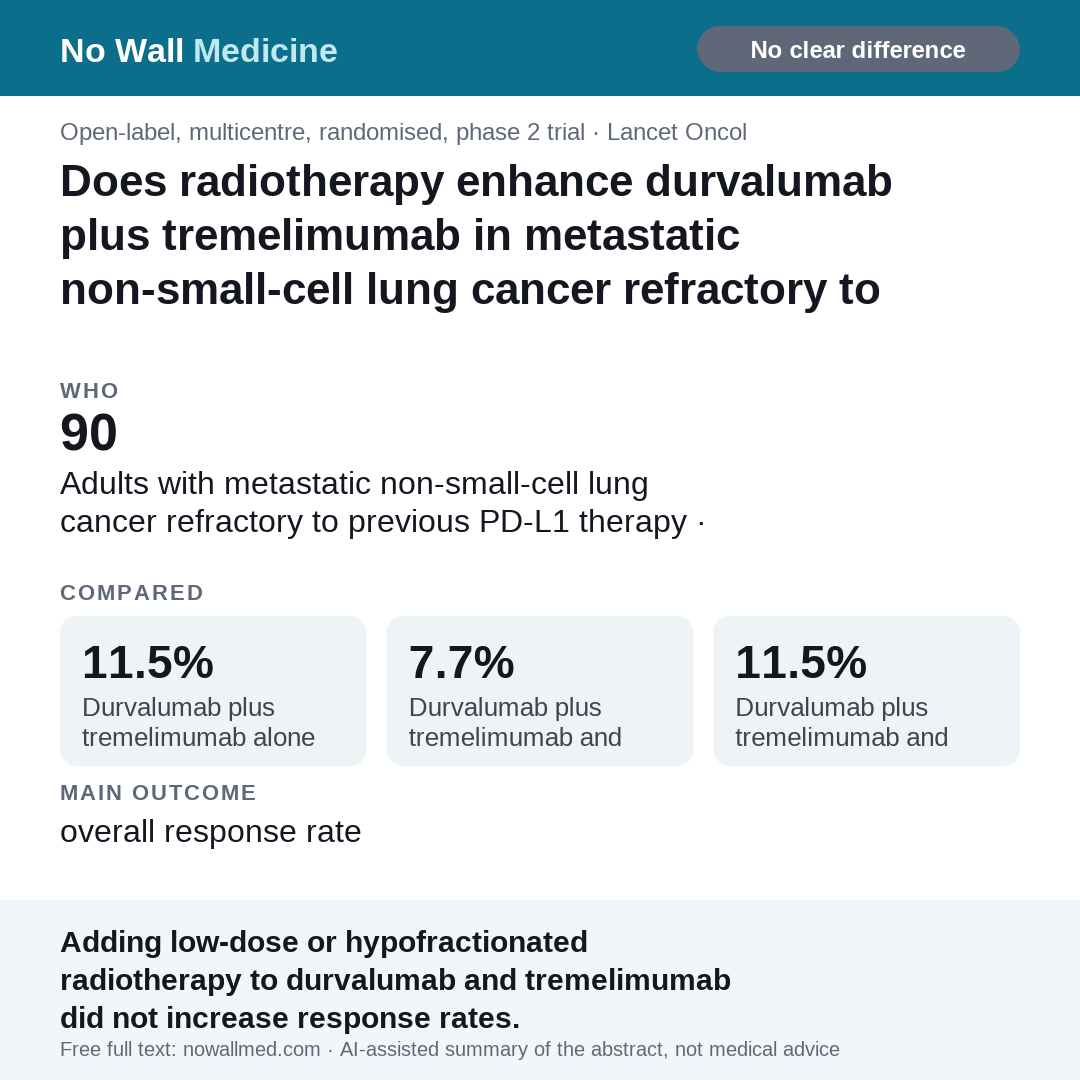
Does radiotherapy enhance durvalumab plus tremelimumab in metastatic non-small-cell lung cancer refractory to PD-L1 therapy?
Who
90
Adults with metastatic non-small-cell lung cancer refractory to previous PD-L1 therapy · 18 US sites
Compared
11.5%Durvalumab plus tremelimumab alone (3/26)
7.7%Durvalumab plus tremelimumab and low-dose radiotherapy (2/26)
11.5%Durvalumab plus tremelimumab and hypofractionated radiotherapy (3/26)
Main outcome
overall response rate
Bottom line: Adding low-dose or hypofractionated radiotherapy to durvalumab and tremelimumab did not increase response rates.
Limitation: This trial was stopped due to futility assessed in an interim analysis.
Funded by: US National Institutes of Health and Dana-Farber Cancer Institute
Lancet Oncol · 2022-01-13Download image
Clinical question: Does radiotherapy enhance durvalumab plus tremelimumab in metastatic non-small-cell lung cancer refractory to PD-L1 therapy?
Why it matters: It was unclear whether adding radiotherapy to PD-L1 and CTLA-4 inhibition would improve outcomes in patients whose cancer resisted prior immunotherapy.
Key points
- 90 patients with metastatic non-small-cell lung cancer resistant to previous PD(L)-1 therapy were randomly assigned to three treatment groups.
- Overall response rates were 11.5% for immunotherapy alone, 7.7% with low-dose radiotherapy, and 11.5% with hypofractionated radiotherapy, with no significant differences.
- Treatment-related serious adverse events occurred in 4% of the immunotherapy-alone group, 19% of the low-dose radiotherapy group, and 15% of the hypofractionated group.
Limitation the authors note: The trial was stopped early due to futility assessed in an interim analysis.
Headline and key points written with AI from the paper’s abstract, with every number checked against it. Read the paper before relying on them.
Was this summary helpful?
Subject terms
Cite this article
Schoenfeld JD, Giobbie-Hurder A, Ranasinghe S, et al. Durvalumab plus tremelimumab alone or in combination with low-dose or hypofractionated radiotherapy in metastatic non-small-cell lung cancer refractory to previous PD(L)-1 therapy: an open-label, multicentre, randomised, phase 2 trial. Lancet Oncol. 2022. doi:10.1016/S1470-2045(21)00658-6
Spotted a mistake? Suggest a correction