Dynamic Resting-State Network Biomarkers of Antidepressant Treatment Response
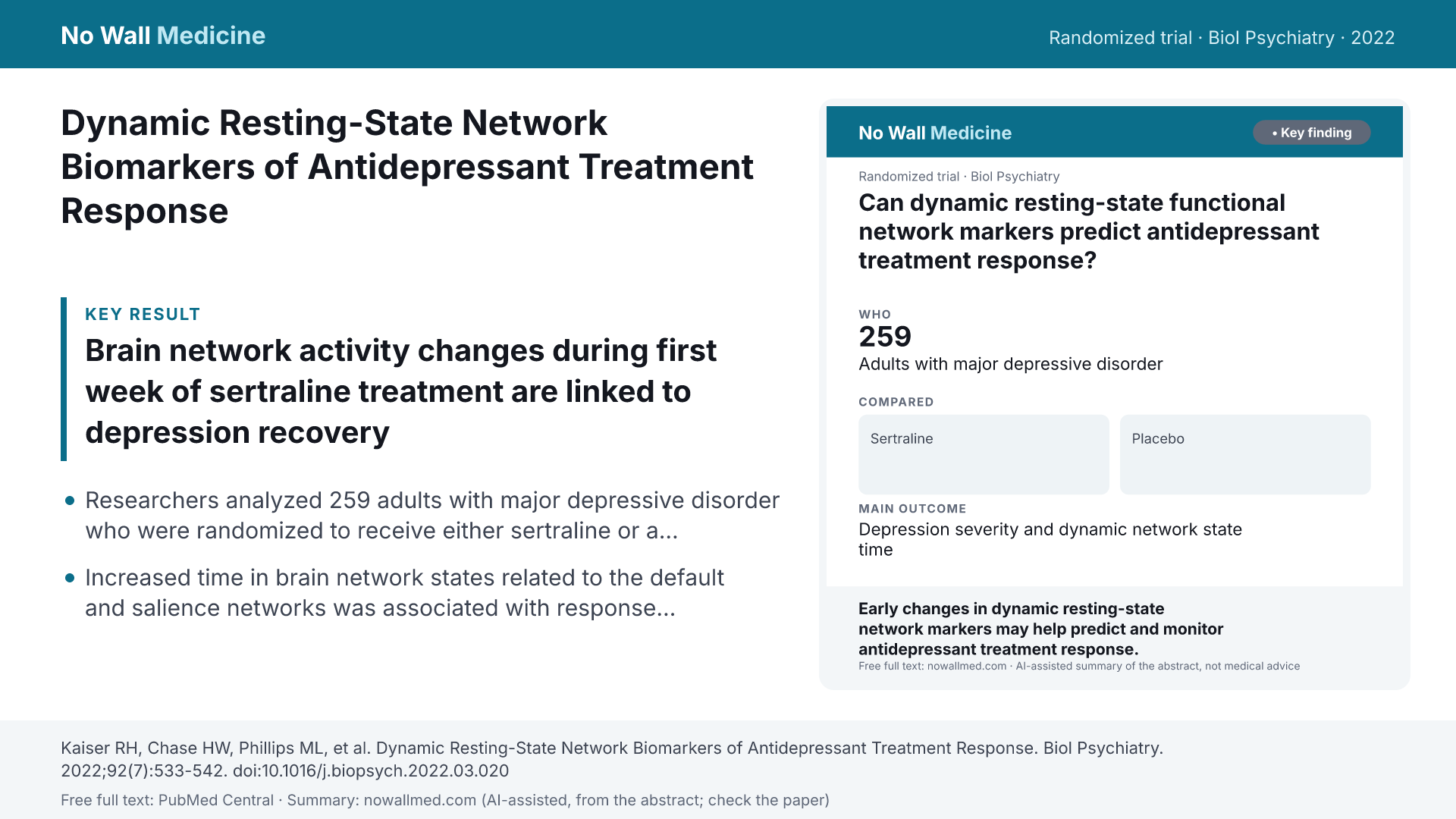
Key result: Brain network activity changes during first week of sertraline treatment are linked to depression recovery
Randomized trialKey finding
Can dynamic resting-state functional network markers predict antidepressant treatment response?
Who
259
Adults with major depressive disorder
Compared
Sertraline
Placebo
Main outcome
Depression severity and dynamic network state time
Bottom line: Early changes in dynamic resting-state network markers may help predict and monitor antidepressant treatment response.
Biol Psychiatry · 2022-04-06
Key points
- Researchers analyzed 259 adults with major depressive disorder who were randomized to receive either sertraline or a placebo for 8 weeks.
- Increased time in brain network states related to the default and salience networks was associated with response to sertraline.
- Changes in the dynamic functioning of corticolimbic and frontoinsular-default networks were associated with symptom recovery patterns common across both treatment groups.
Why it matters: A lack of objective tools makes it difficult to predict or monitor how patients will respond to antidepressant treatment.
Discussion prompts
- Would these patients look like yours? Who was left out?
- Is the main outcome one that matters to patients?
- Is the difference large enough to change what you do?
Cite: Kaiser RH, Chase HW, Phillips ML, et al. Dynamic Resting-State Network Biomarkers of Antidepressant Treatment Response. Biol Psychiatry. 2022;92(7):533-542. doi:10.1016/j.biopsych.2022.03.020
Free full text: PubMed Central · Summary and visual abstract: nowallmed.com/a/dynamic-resting-state-network-biomarkers-of-antidepressant-treatment-18fx8fr/ (AI-assisted from the abstract; check the paper before relying on it).