Dysphagia-optimised radiotherapy improved swallowing function in patients with pharyngeal cancers
Dysphagia-optimised intensity-modulated radiotherapy versus standard intensity-modulated radiotherapy in patients with head and neck cancer (DARS): a phase 3, multicentre, randomised, controlled trial
Phase 3, multicentre, randomised, controlled trialBenefit found
Does dysphagia-optimised intensity-modulated radiotherapy improve swallowing function compared with standard intensity-modulated radiotherapy?
Who
112
Adults with oropharyngeal or hypopharyngeal cancer and no pre-existing swallowing dysfunction · 22 radiotherapy centres in Ireland and the UK
Compared
Dysphagia-optimised intensity-modulated radiotherapy: mean score 77·7 [SD 16·1]
Standard intensity-modulated radiotherapy: 70·6 [17·3]
Main outcome
MD Anderson Dysphagia Inventory composite score at 12 months
Result: mean difference 7·2 [95% CI 0·4-13·9]
Bottom line: Dysphagia-optimised intensity-modulated radiotherapy improves patient-reported swallowing function compared with standard intensity-modulated radiotherapy in pharyngeal cancers.
Funded by: Cancer Research UK
Lancet Oncol · 2023-07-06Download image
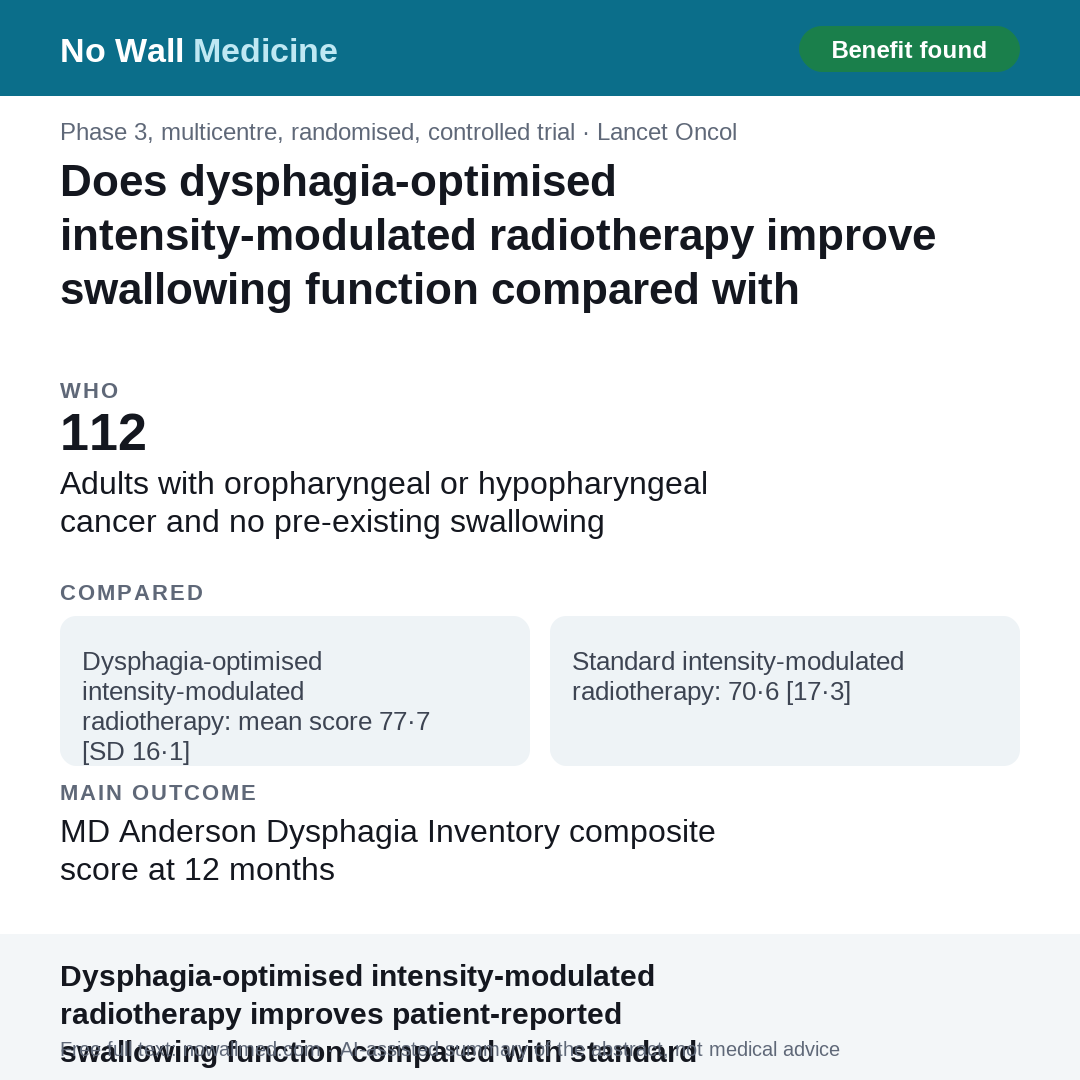
Clinical question: Does dysphagia-optimised intensity-modulated radiotherapy improve swallowing function compared with standard intensity-modulated radiotherapy?
Why it matters: It was unknown if tailoring radiation doses to protect swallowing structures would improve swallowing function in patients treated for pharyngeal cancers.
Key points
- In this trial of 112 patients with oropharyngeal or hypopharyngeal cancer, dysphagia-optimised intensity-modulated radiotherapy was compared to standard intensity-modulated radiotherapy.
- Patients receiving dysphagia-optimised radiotherapy had higher swallowing function scores at 12 months with a mean score of 77.7 compared to 70.6 in the standard group.
- The most common severe late adverse events were hearing impairment, dry mouth, and swallowing difficulties, occurring in 16% vs 13%, 5% vs 15%, and 5% vs 15% of patients respectively.
Headline and key points written with AI from the paper’s abstract, with every number checked against it. Read the paper before relying on them.
Was this summary helpful?
Abstract
Background
Most newly diagnosed oropharyngeal and hypopharyngeal cancers are treated with chemoradiotherapy with curative intent but at the consequence of adverse effects on quality of life. We aimed to investigate if dysphagia-optimised intensity-modulated radiotherapy (DO-IMRT) reduced radiation dose to the dysphagia and aspiration related structures and improved swallowing function compared with standard IMRT. Methods
DARS was a parallel-group, phase 3, multicentre, randomised, controlled trial done in 22 radiotherapy centres in Ireland and the UK. Participants were aged 18 years and older, had T1-4, N0-3, M0 oropharyngeal or hypopharyngeal cancer, a WHO performance status of 0 or 1, and no pre-existing swallowing dysfunction. Participants were centrally randomly assigned (1:1) using a minimisation algorithm (balancing factors: centre, chemotherapy use, tumour type, American Joint Committee on Cancer tumour stage) to receive DO-IMRT or standard IMRT. Participants and speech language therapists were masked to treatment allocation. Radiotherapy was given in 30 fractions over 6 weeks. Dose was 65 Gy to primary and nodal tumour and 54 Gy to remaining pharyngeal subsite and nodal areas at risk of microscopic disease. For DO-IMRT, the volume of the superior and middle pharyngeal constrictor muscle or inferior pharyngeal constrictor muscle lying outside the high-dose target volume had a mandatory 50 Gy mean dose constraint. The primary endpoint was MD Anderson Dysphagia Inventory (MDADI) composite score 12 months after radiotherapy, analysed in the modified intention-to-treat population that included only patients who completed a 12-month assessment; safety was assessed in all randomly assigned patients who received at least one fraction of radiotherapy. The study is registered with the ISRCTN registry, ISRCTN25458988, and is complete. Findings
From June 24, 2016, to April 27, 2018, 118 patients were registered, 112 of whom were randomly assigned (56 to each treatment group). 22 (20%) participants were female and 90 (80%) were male; median age was 57 years (IQR 52-62). Median follow-up was 39·5 months (IQR 37·8-50·0). Patients in the DO-IMRT group had significantly higher MDADI composite scores at 12 months than patients in the standard IMRT group (mean score 77·7 [SD 16·1] vs 70·6 [17·3]; mean difference 7·2 [95% CI 0·4-13·9]; p=0·037). 25 serious adverse events (16 serious adverse events assessed as unrelated to study treatment [nine in the DO-IMRT group and seven in the standard IMRT group] and nine serious adverse reactions [two vs seven]) were reported in 23 patients. The most common grade 3-4 late adverse events were hearing impairment (nine [16%] of 55 in the DO-IMRT group vs seven [13%] of 55 in the standard IMRT group), dry mouth (three [5%] vs eight [15%]), and dysphagia (three [5%] vs eight [15%]). There were no treatment-related deaths. Interpretation
Our findings suggest that DO-IMRT improves patient-reported swallowing function compared with standard IMRT. DO-IMRT should be considered a new standard of care for patients receiving radiotherapy for pharyngeal cancers. Funding
Cancer Research UK.
Abstract reproduced under the article’s CC BY licence.
Subject terms
Cite this article
Nutting C, Finneran L, Roe J, Sydenham MA, Beasley M, Bhide S. Dysphagia-optimised intensity-modulated radiotherapy versus standard intensity-modulated radiotherapy in patients with head and neck cancer (DARS): a phase 3, multicentre, randomised, controlled trial. Lancet Oncol. 2023. doi:10.1016/S1470-2045(23)00265-6
Spotted a mistake? Suggest a correction
Top studies every Monday
The week’s key trials and guidelines in your specialties, plus any topics you follow. By email, free.
Get the weekly digest