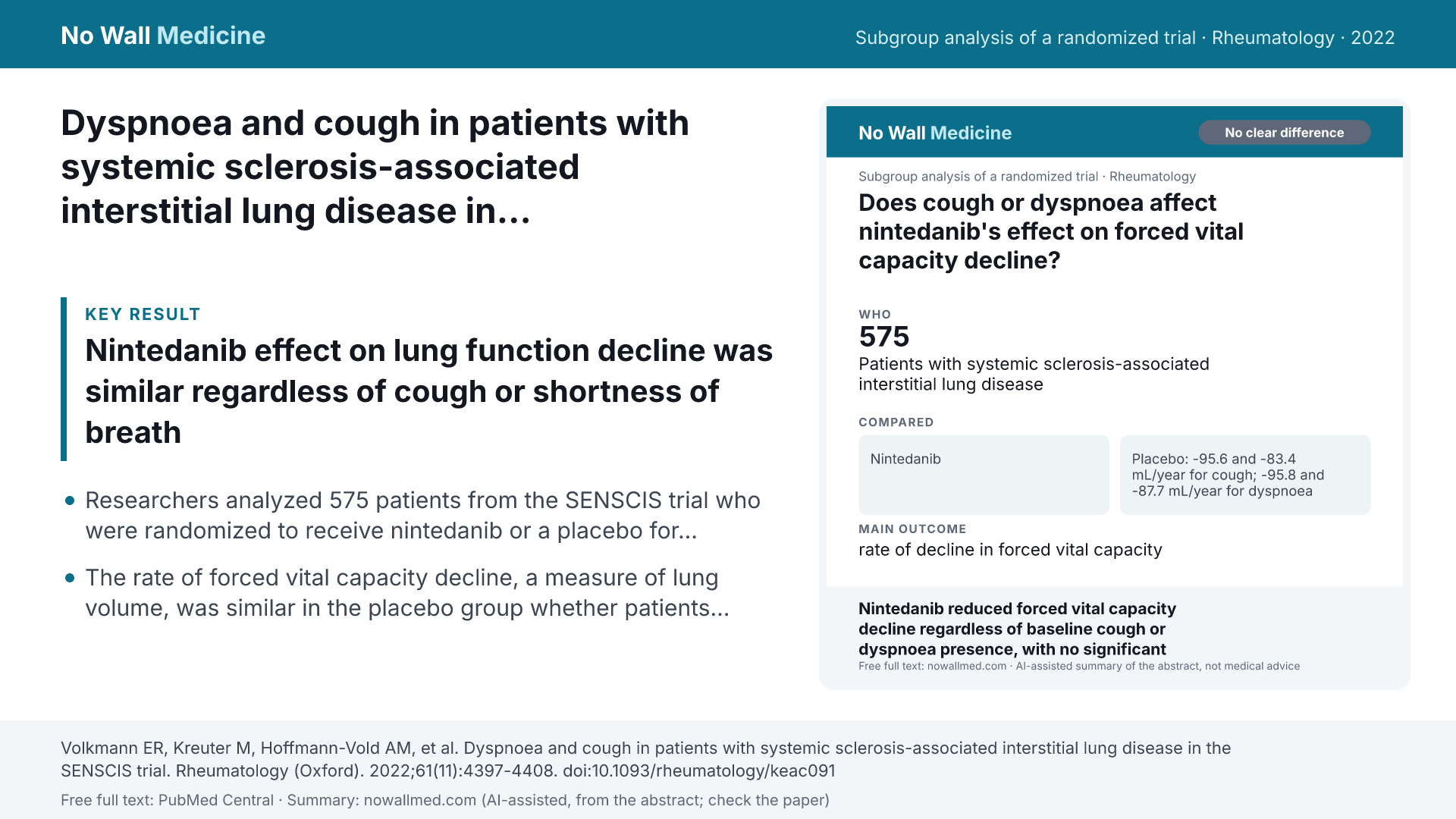
Nintedanib effect on lung function decline was similar regardless of cough or shortness of breath
Dyspnoea and cough in patients with systemic sclerosis-associated interstitial lung disease in the SENSCIS trial
Subgroup analysis of a randomized trialNo clear difference
Does cough or dyspnoea affect nintedanib's effect on forced vital capacity decline?
Who
575
Patients with systemic sclerosis-associated interstitial lung disease
Compared
Nintedanib
Placebo: -95.6 and -83.4 mL/year for cough; -95.8 and -87.7 mL/year for dyspnoea
Main outcome
rate of decline in forced vital capacity
Result: difference: 74.4 (95% CI -11.1, 159.8) vs 31.5 (-11.1, 74.1)
Bottom line: Nintedanib reduced forced vital capacity decline regardless of baseline cough or dyspnoea presence, with no significant subgroup heterogeneity.
Rheumatology · 2022-02-13Download image
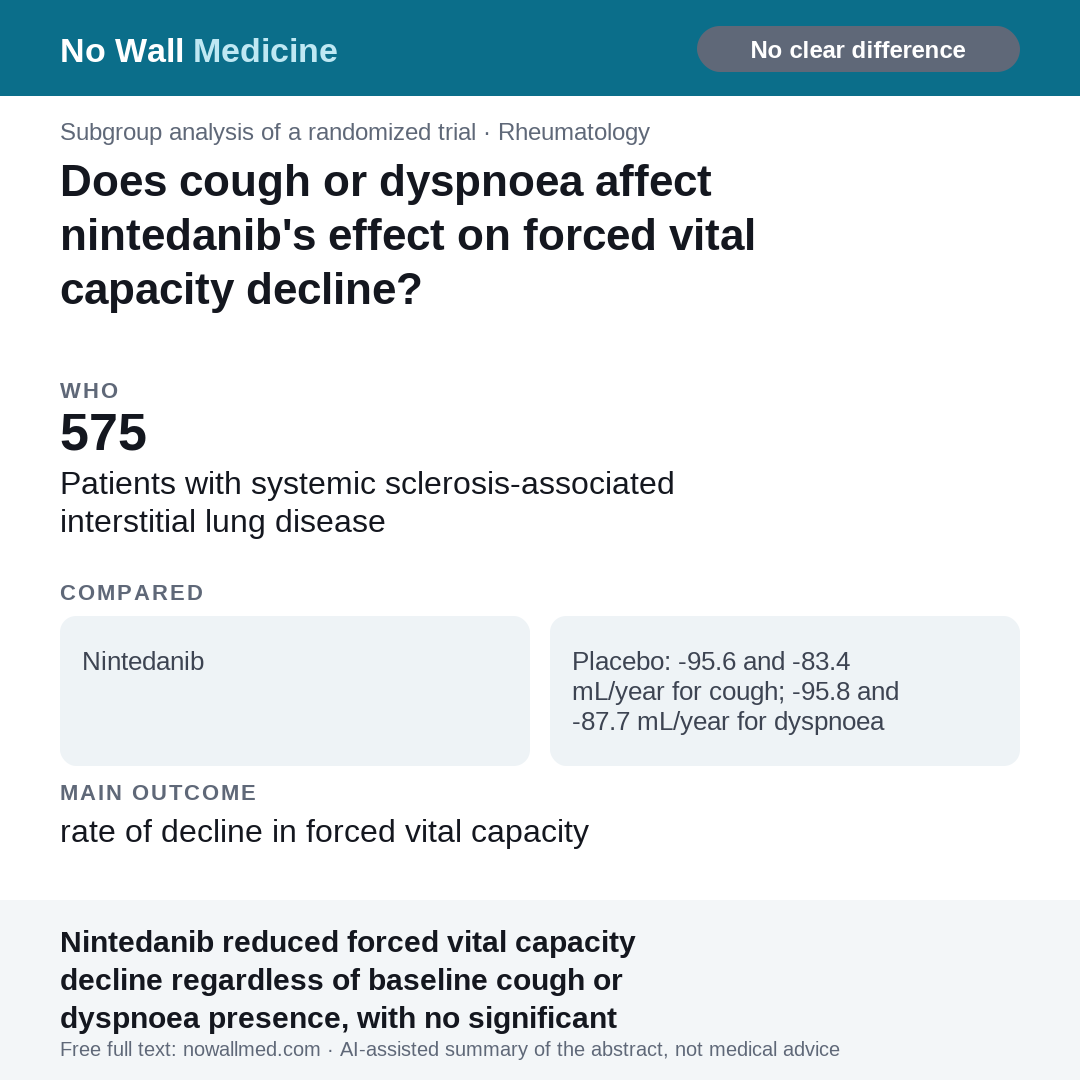
Clinical question: Does cough or dyspnoea affect nintedanib's effect on forced vital capacity decline?
Why it matters: It was unknown if the presence of cough or shortness of breath at the start of treatment influenced how well nintedanib slowed lung function decline.
Key points
- Researchers analyzed 575 patients from the SENSCIS trial who were randomized to receive nintedanib or a placebo for systemic sclerosis-associated interstitial lung disease.
- The rate of forced vital capacity decline, a measure of lung volume, was similar in the placebo group whether patients had cough or shortness of breath.
- While nintedanib showed numerically larger differences in patients without symptoms, interaction P-values showed no statistically significant difference in treatment effect between subgroups.
Headline and key points written with AI from the paper’s abstract, with every number checked against it. Read the paper before relying on them.
Was this summary helpful?
Subject terms
Cite this article
Volkmann ER, Kreuter M, Hoffmann-Vold AM, et al. Dyspnoea and cough in patients with systemic sclerosis-associated interstitial lung disease in the SENSCIS trial. Rheumatology. 2022. doi:10.1093/rheumatology/keac091
Spotted a mistake? Suggest a correction