Dyspnoea and cough in patients with systemic sclerosis-associated interstitial lung disease in the SENSCIS trial
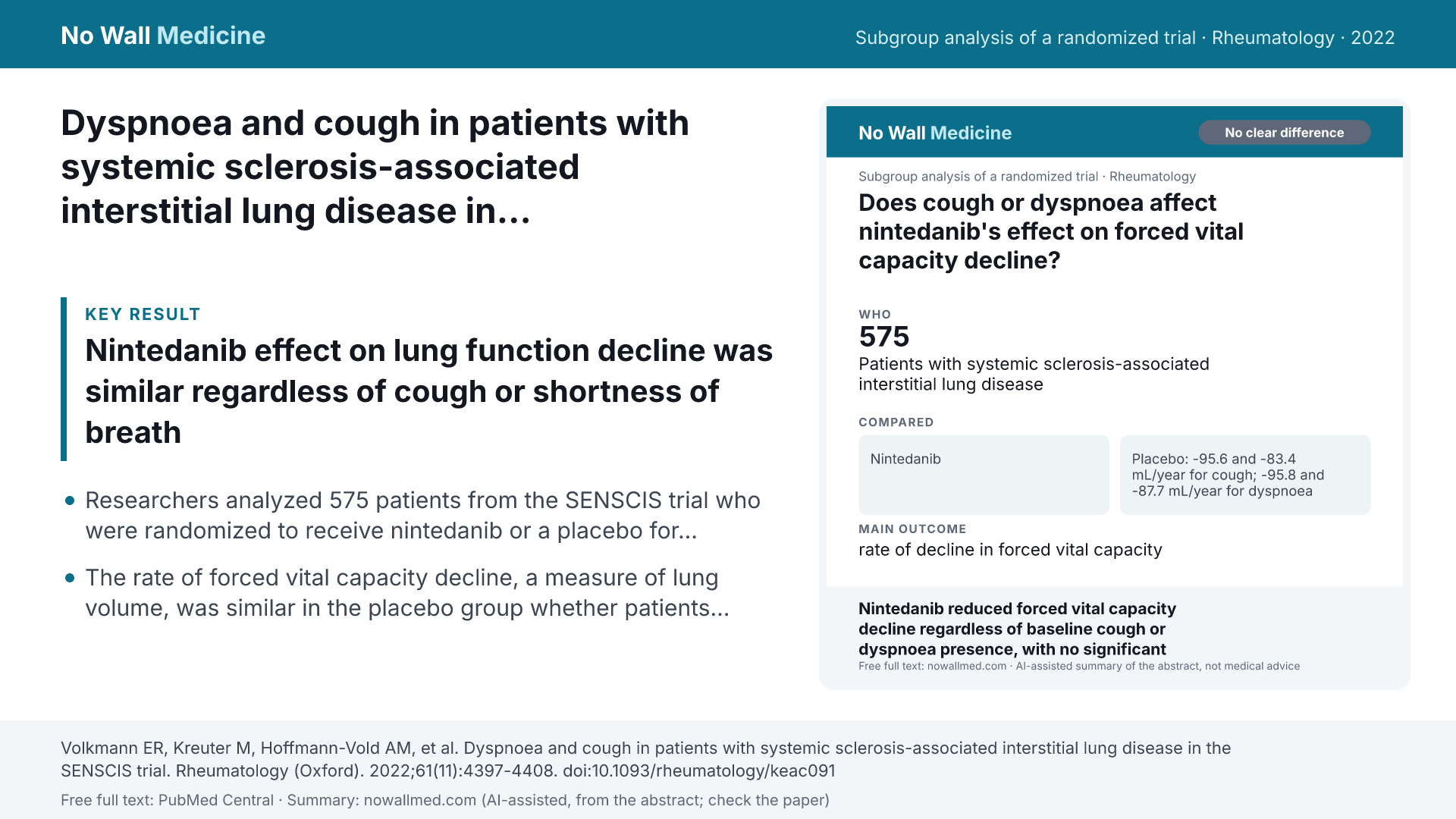
Key result: Nintedanib effect on lung function decline was similar regardless of cough or shortness of breath
Subgroup analysis of a randomized trialNo clear difference
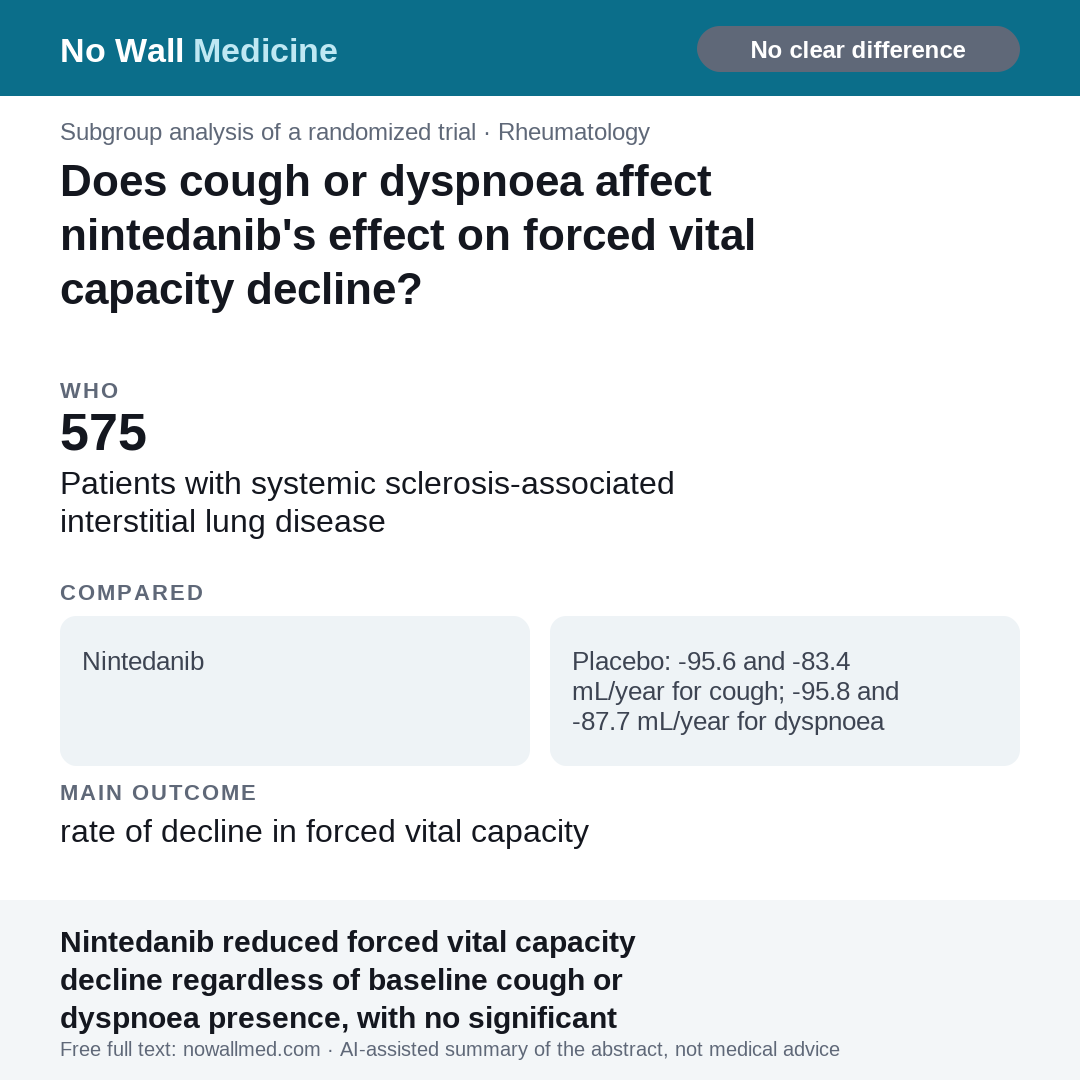
Does cough or dyspnoea affect nintedanib's effect on forced vital capacity decline?
Who
575
Patients with systemic sclerosis-associated interstitial lung disease
Compared
Nintedanib
Placebo: -95.6 and -83.4 mL/year for cough; -95.8 and -87.7 mL/year for dyspnoea
Main outcome
rate of decline in forced vital capacity
Result: difference: 74.4 (95% CI -11.1, 159.8) vs 31.5 (-11.1, 74.1)
Bottom line: Nintedanib reduced forced vital capacity decline regardless of baseline cough or dyspnoea presence, with no significant subgroup heterogeneity.
Rheumatology · 2022-02-13Download image
Key points
- Researchers analyzed 575 patients from the SENSCIS trial who were randomized to receive nintedanib or a placebo for systemic sclerosis-associated interstitial lung disease.
- The rate of forced vital capacity decline, a measure of lung volume, was similar in the placebo group whether patients had cough or shortness of breath.
- While nintedanib showed numerically larger differences in patients without symptoms, interaction P-values showed no statistically significant difference in treatment effect between subgroups.
Why it matters: It was unknown if the presence of cough or shortness of breath at the start of treatment influenced how well nintedanib slowed lung function decline.
Discussion prompts
- Would these patients look like yours? Who was left out?
- Is the main outcome one that matters to patients?
- Is the difference large enough to change what you do?
Cite: Volkmann ER, Kreuter M, Hoffmann-Vold AM, et al. Dyspnoea and cough in patients with systemic sclerosis-associated interstitial lung disease in the SENSCIS trial. Rheumatology. 2022. doi:10.1093/rheumatology/keac091
Free full text: PubMed Central · Summary and visual abstract: nowallmed.com/a/dyspnoea-and-cough-in-patients-with-systemic-sclerosis-associated-10ohn4z/ (AI-assisted from the abstract; check the paper before relying on it).