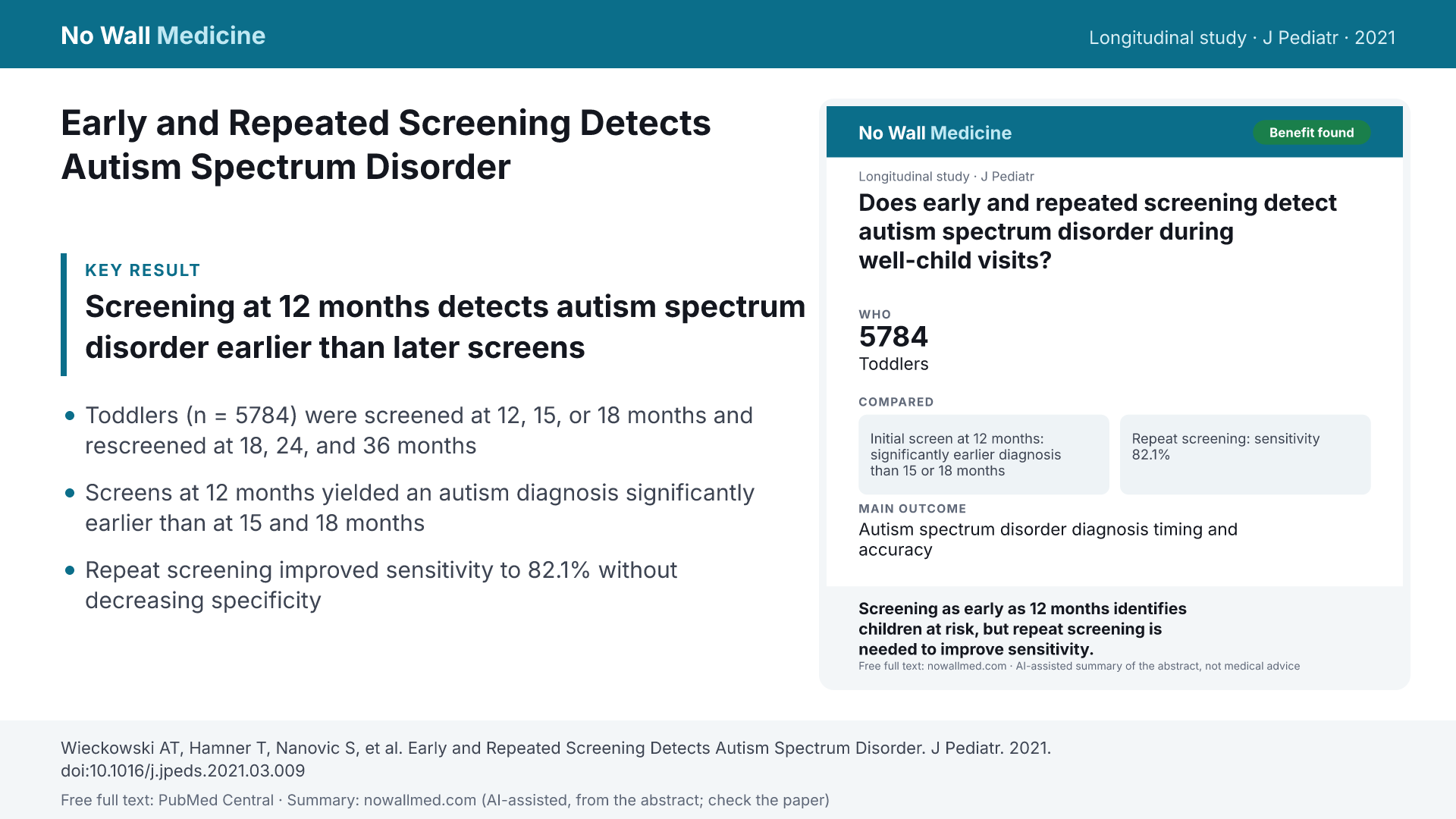
Screening at 12 months detects autism spectrum disorder earlier than later screens
Early and Repeated Screening Detects Autism Spectrum Disorder
Longitudinal studyBenefit found
Does early and repeated screening detect autism spectrum disorder during well-child visits?
Who
5784
Toddlers
Compared
Initial screen at 12 months: significantly earlier diagnosis than 15 or 18 months
Repeat screening: sensitivity 82.1%
Main outcome
Autism spectrum disorder diagnosis timing and accuracy
Bottom line: Screening as early as 12 months identifies children at risk, but repeat screening is needed to improve sensitivity.
J Pediatr · 2021-03-10Download image
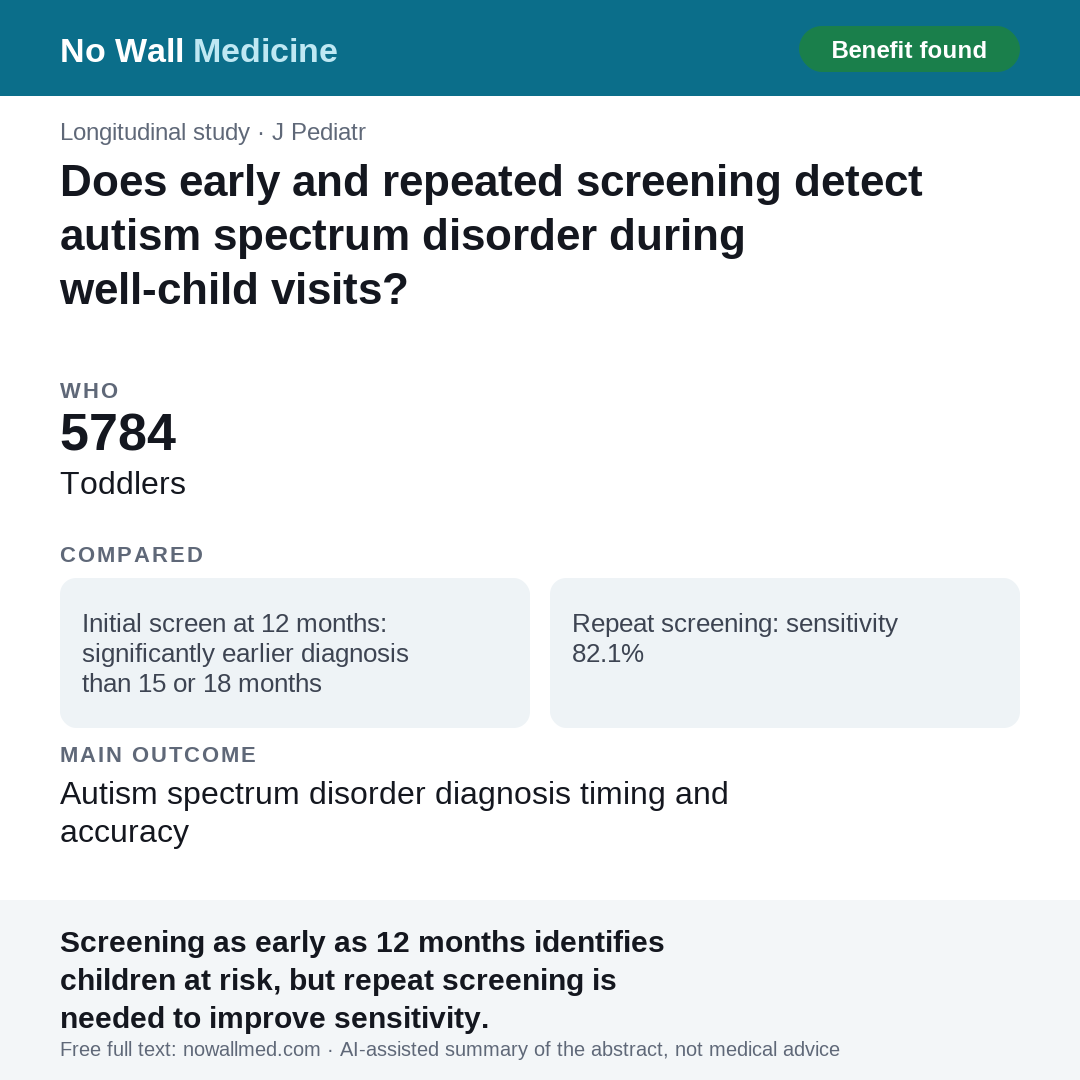
Clinical question: Does early and repeated screening detect autism spectrum disorder during well-child visits?
Why it matters: The optimal timing of autism spectrum disorder screening is unknown
Key points
- Toddlers (n = 5784) were screened at 12, 15, or 18 months and rescreened at 18, 24, and 36 months.
- Screens at 12 months yielded an autism diagnosis significantly earlier than at 15 and 18 months.
- Repeat screening improved sensitivity to 82.1% without decreasing specificity.
Headline and key points written with AI from the paper’s abstract, with every number checked against it. Read the paper before relying on them.
Was this summary helpful?
Subject terms
Cite this article
Wieckowski AT, Hamner T, Nanovic S, et al. Early and Repeated Screening Detects Autism Spectrum Disorder. J Pediatr. 2021. doi:10.1016/j.jpeds.2021.03.009
Spotted a mistake? Suggest a correction