Early and Repeated Screening Detects Autism Spectrum Disorder
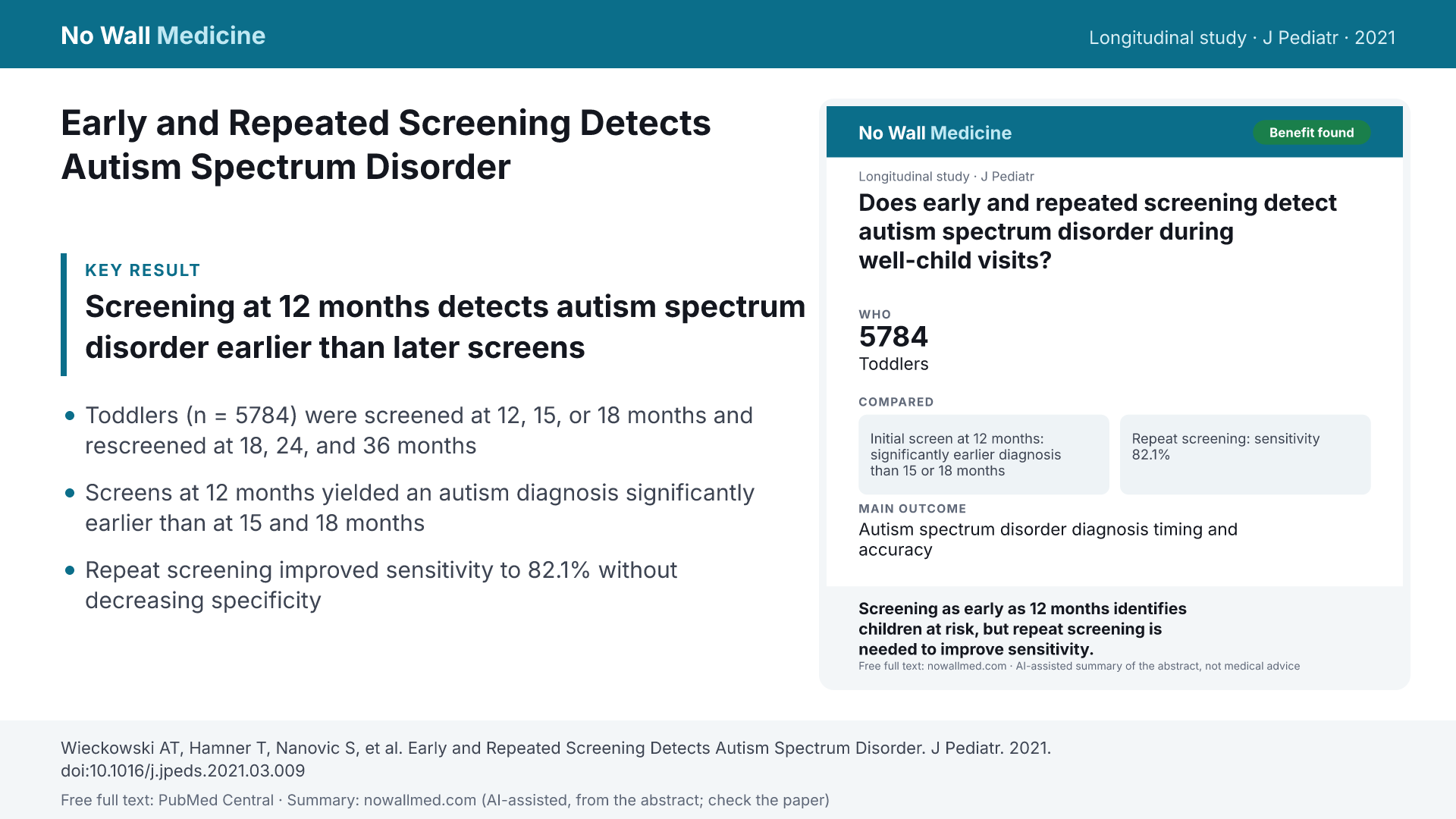
Key result: Screening at 12 months detects autism spectrum disorder earlier than later screens
Longitudinal studyBenefit found
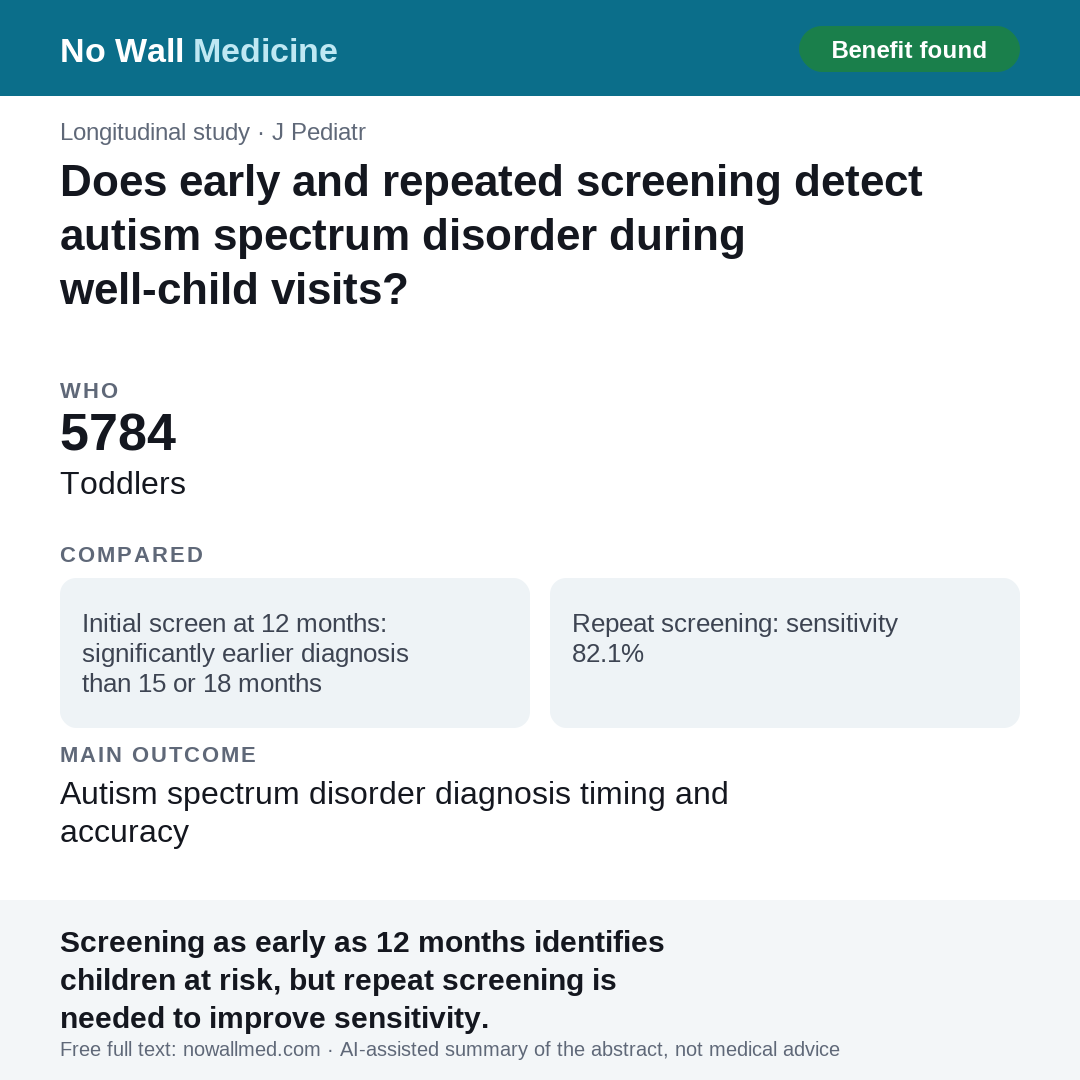
Does early and repeated screening detect autism spectrum disorder during well-child visits?
Who
5784
Toddlers
Compared
Initial screen at 12 months: significantly earlier diagnosis than 15 or 18 months
Repeat screening: sensitivity 82.1%
Main outcome
Autism spectrum disorder diagnosis timing and accuracy
Bottom line: Screening as early as 12 months identifies children at risk, but repeat screening is needed to improve sensitivity.
J Pediatr · 2021-03-10Download image
Key points
- Toddlers (n = 5784) were screened at 12, 15, or 18 months and rescreened at 18, 24, and 36 months.
- Screens at 12 months yielded an autism diagnosis significantly earlier than at 15 and 18 months.
- Repeat screening improved sensitivity to 82.1% without decreasing specificity.
Why it matters: The optimal timing of autism spectrum disorder screening is unknown
Discussion prompts
- Would these patients look like yours? Who was left out?
- Is the main outcome one that matters to patients?
- Is the difference large enough to change what you do?
Cite: Wieckowski AT, Hamner T, Nanovic S, et al. Early and Repeated Screening Detects Autism Spectrum Disorder. J Pediatr. 2021. doi:10.1016/j.jpeds.2021.03.009
Free full text: PubMed Central · Summary and visual abstract: nowallmed.com/a/early-and-repeated-screening-detects-autism-spectrum-17n6o5a/ (AI-assisted from the abstract; check the paper before relying on it).